







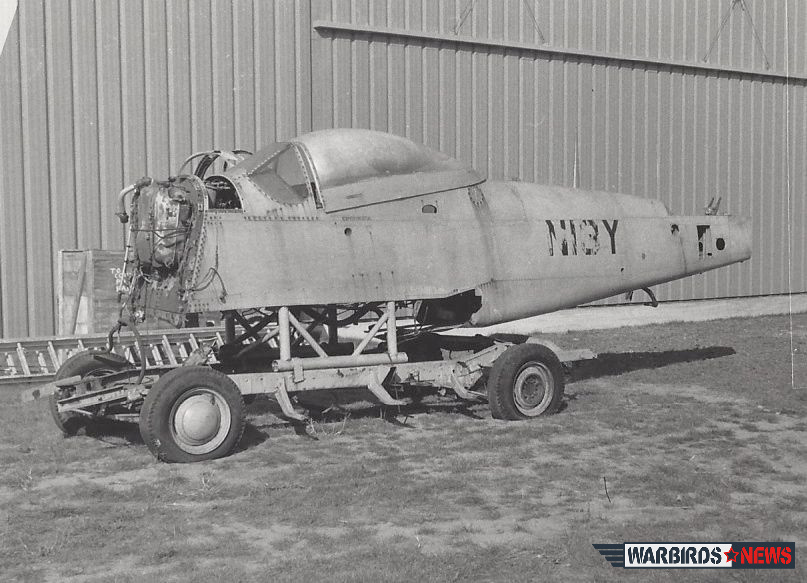
The New England Air Museum in Windsor Locks, Connecticut has a unique collection of remarkable aircraft, including several historic air racers. One such example, currently under restoration, is Anson Johnson’s P-51D Mustang, #44-72400. Johnson flew in the 1948 and ’49 Cleveland Air Races in this aircraft, winning the Thompson Trophy in 1948. Like most air racers based on military aircraft designs, this Mustang received a number of modifications to make it lighter and faster than a stock example.
Johnson’s modifications to the Mustang for the 1948 race were relatively standard. He removed all of the unnecessary military hardware, such as the armor plate and ancillary armament equipment. He replaced the standard Mustang propeller with a paddle-bladed unit in an attempt to gain more thrust with each revolution. He also upgraded the Merlin engine to a Packard V-1650-225 designed for long-haul transport aircraft. The engine had beefier cylinder banks which made it more durable for the roughly 500 mile race. Johnson also clipped two feet off each wing to reduce drag, and make the aircraft easier to turn on the race course. Even with all of these modifications, there were a number of aircraft in the race which should have beaten Johnson’s Mustang, including the three Goodyear F2G Corsairs in Cook Cleland’s team. The Thompson Trophy was as much an endurance race as it was one of speed though, and Johnson’s Mustang outlasted all of the other serious contenders which dropped out, one-by-one, due to various problems.
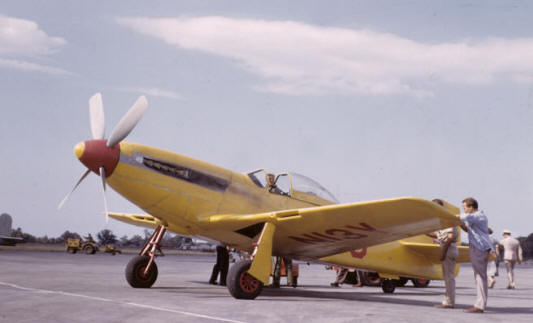
Johnson knew that the ’49 race would be more competitive though, so he made additional modifications to his Mustang in the interim. These included shortening the propeller blades by 6”, using shorter, low back-pressure exhaust stacks and re-profiling the lower engine cowling with a smoother contour. However, his most radical alteration was to completely remove the oil coolers and radiator along with their “doghouse” fairing to create a completely flush belly. He then built new cooling inlets into the wing leading edge, funneling the air into the old gun bays with ducting that passed through a re-purposed and modified P-39 Airacobra radiator. He fitted the old oil cooler into the right wing ammunition bay. The aircraft looked fast, even sitting on the ground, but sadly Johnson’s 1949 race was cut short after just 9 laps, due to engine fumes filling the cockpit as a result of the modified exhaust stacks.
As many readers will know, the Bill Odom’s multi-fatality crash in his P-51C “The Beguine”, and the onset of the Korean War led to permanent cancellation of the Cleveland Air Races, so Johnson never did get to see how well his creation would have fared in the legendary races. Johnson did attempt to set a world speed record in his Mustang in 1952 though, but the timing equipment on the ground failed to operate properly, invalidating his estimated 510mph run (which would have been a world record for a propeller aircraft at the time). Johnson sold his beloved Mustang shortly afterwards, and following seven other owners, the NEAM acquired her in 1972. She has suffered over the many years of external storage, but NEAM has been working steadily on restoring the old girl for the past couple of years. They will be preserving her in her 1949 racing guise, and it will be a treat to see when she’s finally on public view again.
The aircraft is currently in many different pieces, but things are starting to come back together. Here are some details of what NEAM have been up to in March.
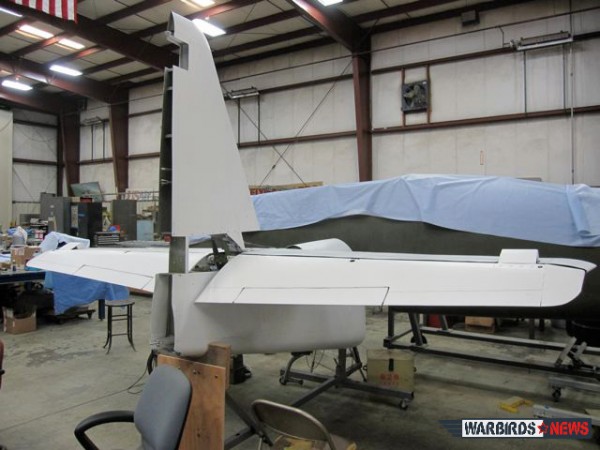 NEAM test fitted all of the major empennage components. This included mounting a remanufactured “elevator center hinge” on the horizontal stabilizer. The hinge provides support to the elevator control cable assembly and acts as a common tie point for both elevators. The team mounted both elevators and attached the commensurate control lines.
The vertical stabilizer was next in the installation queue, complete with its newly fabricated lower rudder hinge. NEAM is in the process of making sure all these systems function properly. Once the restoration team are satisfied it all fits properly, they will disassemble the empennage for its final painting.
The restoration team are gradually installing the landing gear hydraulic valves and other actuating components in the left wing, along with a maze of hydraulic plumbing for gear operation. The ‘Anson Johnson’ special puzzle of Glycol cooling plumbing in the left wing is also installed. This proved to be quite tricky to deal with, as it was unique to this aircraft following modifications for the 1949 air races.
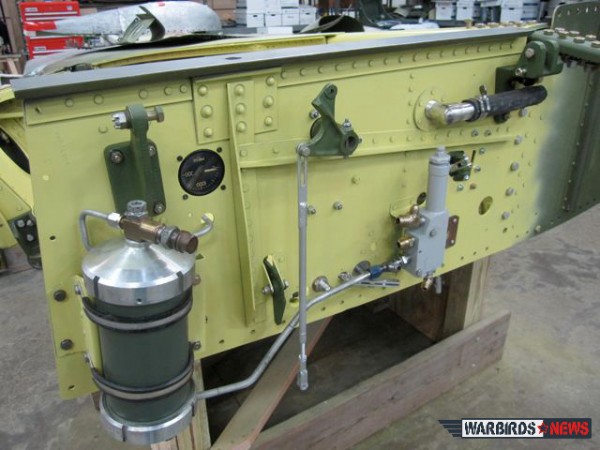 Missing components for the control stick aileron torque assembly are under manufacture, but to non-airworthy standard, as the aircraft will only ever be on static display. The throttle assembly guide and throttle stop were missing and these had to be scratch built. As readers will see from the photographs on the left (and those in the gallery) NEAM is hard at work on this magnificent aircraft, and it is surely in safe hands.
Please do visit the New England Air Museum if you get the chance, and as always, contribute to their fine work if you can. To learn more about the museum as a whole, or to find a way to help them please click HERE.
More pictures of the restoration.
[inpost_galleria thumb_width=”200″ thumb_height=”200″ post_id=”11488″ thumb_margin_left=”3″ thumb_margin_bottom=”0″ thumb_border_radius=”2″ thumb_shadow=”0 1px 4px rgba(0, 0, 0, 0.2)” id=”” random=”0″ group=”0″ border=”” type=”yoxview” sc_id=”sc1397182993030″]




I like what u r doing, keep up the good work. Hope to visit when the project is complete. Tiger
Tiger we will pass the nice comment to NEAM, I am sure they will be glad to hear that from you!
Strega will always rock! – Italians do it better 😉
I’glad to see this aircraft being restored. I wish they would restore it to near airworthy condition, just to be as authentic as possible. I have the NEAM on my bucket list as they have several unique artifacts I would like to crawl under and around, maybe even in. I especially want to look at the K class airship gondola restoration.
I got to see this craft at the famous “Cockroach Corners section of the Miami International Airport in 1957, shot colored slides of it, unfortunately I loaned these colored slides out to someone I trusted and they were NEVER returned!!!—lessoned learned!!!—but good!!!!!