







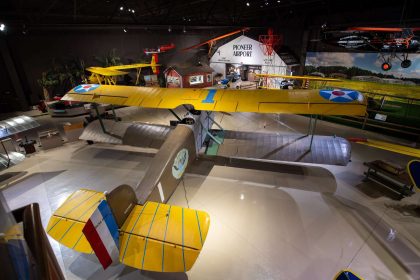
After a long struggle and many years of valiant effort in preserving American aviation history, the Octave Chanute Aerospace Museum in Rantoul, Illinois is sadly set to close at the end of this year due to lack of funds. Now comes the hardest part; deciding what to do with the fleet of thirty or so aircraft currently under their care? Nearly all of them still belong to the US Air Force Museum Program, so the move forwards will be a complicated process as there is a mountain of bureaucracy to hurdle in order to qualify for loan of an airframe, not to mention the expense involved in moving it.
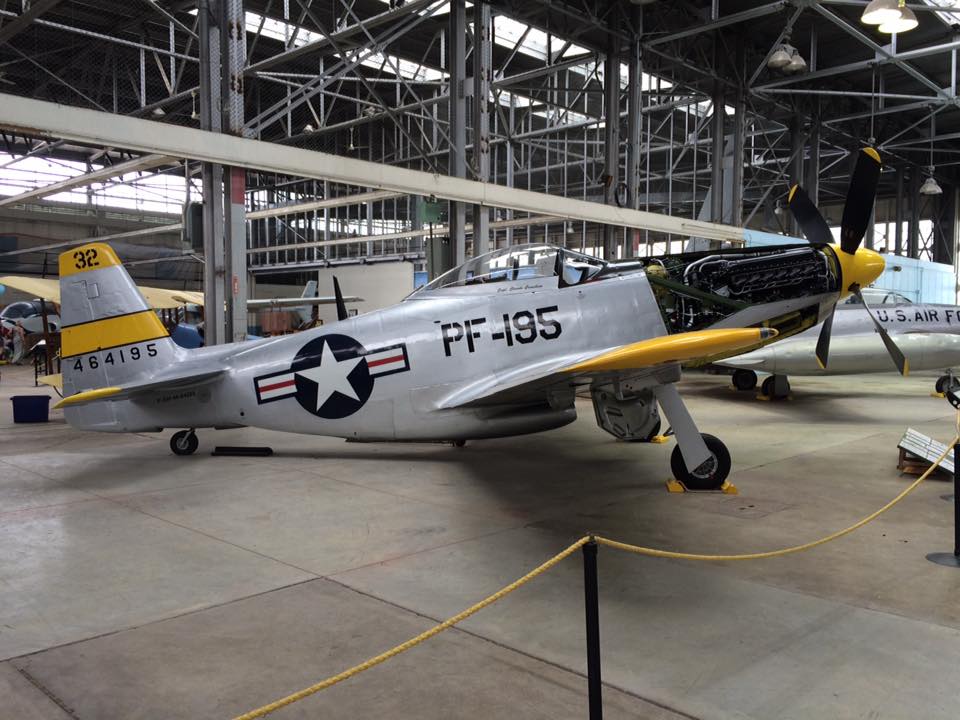
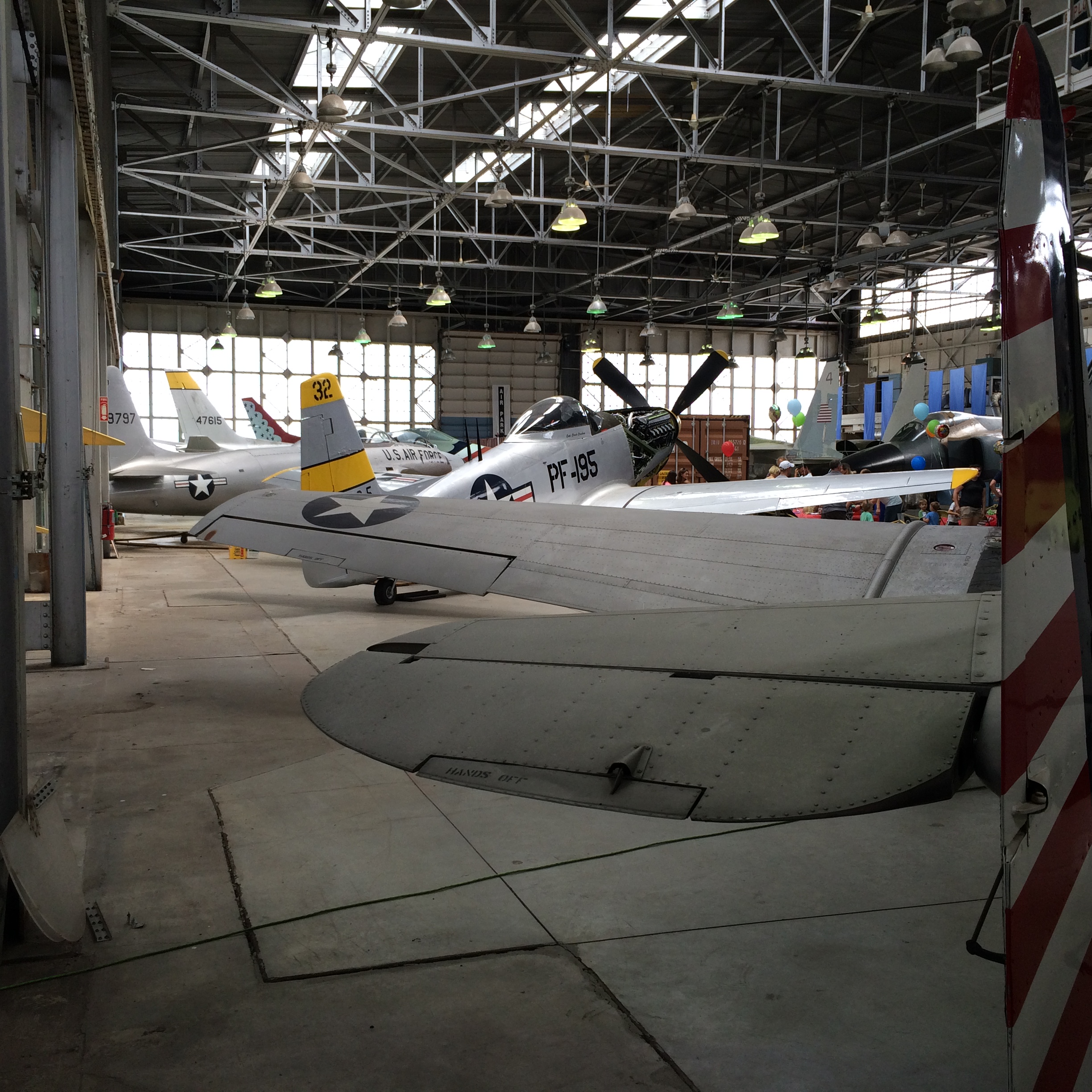
As a way of preserving some of their military heritage on site, the village of Rantoul had asked to keep three aircraft on display: an AT-6 Texan, F-86 Sabre and a P-51H Mustang. The H-model Mustang is a real rarity, being one of just a handful of survivors, and it has a special place in Rantoul having been restored there over the course of a decade by a dedicated crew of volunteers led by Curt Arseneau and Norman Meyers. However, the Air Force has turned down Rantoul’s request, and is now sending the P-51H to the Museum of Aviation in Warner Robins, Georgia. While the Texan will be heading to another museum, unfortunately the F-86 may end up being scrapped as it apparently has radium contamination in its belly.
Warner Robins is set to receive a real gem in the P-51H. According to the Chanute Museum, “The Mustang at the Chanute Air Museum is a P-51H-5-NA, the 105th produced out of 555 ‘H’ models built at the North American Aviation plant at Inglewood, California. It rolled off the assembly line in March of 1945. It’s North American Aviation production number was 126-35691, while the Army Air Force Serial number assigned was 44-64265. This aircraft was a part of USAAF order AC-1752 placed on June 30, 1944. One of only six P-51H airframes existing in the world, ours is the only P-51H on display in a museum setting for visitors to see close up.”
The Mustang had been on outdoor display at the former Chanute Air Force Base for decades, and had been in real decline until the museum took on its restoration beginning in 2003. According to Chanute, “Museum volunteer and Mustang enthusiast Norman Meyers ‘adopted’ the Mustang and founded the Mustang Restoration Project on October 1st, 2003 to take action to preserve and restore the P-51H for our visitors to enjoy. Working totally from donations and from their own pockets, Norm and a small team of volunteers have completed the static restoration of the Mustang to bring it to its current appearance. Completed in the summer of 2013, over 6,000 man hours were expended on the restoration, and another 4,000 hours spent on research and parts acquisitions.”
It must be a sad day for those involved in the restoration to let the Mustang go, but the aircraft is heading to a good home at least, and will probably be enjoyed by much larger crowds at the new location.
As for what will happen to the other aircraft currently on display at the Octave Chanute Aerospace Museum, the future is unclear. Many of the airframes are massive and present huge logistical challenges to move, not to mention the enormous financial commitment in doing so. For behemoths such as the C-133 Cargomaster and KC-97 Stratofreighter, the horizon seems pretty bleak, unfortunately. Rarities like the B-58A Hustler, XB-47 Stratojet and WV-2 Warning Star will probably find new homes, but time will tell.





It’s sad being someone who lives in Rantoul to see something of its history just being wiped out. The base is “was” something cool to see and to take pride in for this town.
Turn the title to the h model over to them let them sell it to the private sector and it will fund the museum for years !!!!!!
I was there a few months ago since I heard about the closure. There is so much to see there, including the minuteman missile training facility, the RB-66 Destroyer, the only one I’ve ever seen. The saddest part about this article is hearing that the F-86 Sabre may be scrapped! The 86 is what started my obsession with military aviation. Couldn’t it be used as a gate guardian!
Hopefully, appropriate homes will be found for this fine collection of Air Force history. Years ago, while I was at Chanute being trained to become a flight simulator technician during the Vietnam War, our squadron marched past a B-36 bomber on display at one the runway aprons. Last year, I stopped off at the Castle Air Park (formerly Castle AFB), where they have a nice outdoor display of many aircraft, I rediscovered Chanute’s old B-36. Their write-up described how it had been dismantled and moved from Chanute to Castle. I much preferred seeing/viewing the planes in the large hangar at Chanute over Castle’s outdoor display – it’s too bad that this community treasure will be lost due to lack of funding…
Any idea what the status of the Willy Victor is? I flew her out of Point Mugu ( Pacific Missile Range ) in the 60s. Was hoping to visit again, so sorry to hear the museum closed.
Tony Orth, For two + years I was with VW-15 out iof Patuxent River NAS in Maryland. This was late 50’s and early 60’s. WV #141311 at Rantoul was a part of our squadron. We plan on going down to visit her the week ofDecember 12th, 2016 !! Jerry Fritz Walnut, IL 815-866-5404.
I was there today to see the B-58 being dismantled. I took some photos of the WV-2, same company is preparing both for transit. Asked but can’t remember where the Connie is going. e-mail me at [email protected] if you’d like the photos. Scott
Going to the Yankee Air Museum-
You should be able to go visit again next year!
https://warbirdsnews.com/warbirds-news/ec-121-warning-star-moving-yankee-air-museum.html
I was in chanute in 1975 for training on welding i had a good time .never for get.i lik to know where are my friends on welding shop now .please contact to me by this e mail [email protected], thaks sumuch
Very disappointed to read about the Chanute Air Museum clossing! I went to Fire Protection School there in 78/79, one of the coldest winters on record there. I was privileged to visit the museum in 05 & 06 while attending the World Freefall Convention. They had an impressive collection. My favorites were the B-36 & B-58. I’m glad they’re both together again at Castle at least. The B-29 England Gay apparently ended up at the NASCAR. Don’t know where the B-17 ended up.
The B-29 was supposed to say Enola Gay…can’t trust spell check.
I was at Chanute from November 17, 1980 to February 6, 1981 for Aircraft Fuel Systems Maintenance. MSGT Baurdo was our instructor. I remember Mike Guadagno and Bruce Lobe in our class and Ron Early from Jet Mech. Great people, great times and great memories from our youth!
Had the privaledge to take my greatgrandson to see the B_47 and the houndog missile both of which I worked on during my career.
The National Museum of the Air Force at Wright Patterson has a Hound Dog on display. I was stationed there with the 17th AMMS and probably hung that particular missile a time or two..
Such a Sad thing to see this go. I’ve Grown up nd loved all air flying objects. I just learned from my Mom that this closed. I’m forever Grateful that my Husband and I were able to see this before it closed. We were there in June 2014. I’m sad however that my kids will Never be able to Enjoy it ever again.
I was at Chanute in 1966 going through my specialty school. The B-36 was my student sqaudren’s mascot. Once a month we had to spend a weekend cleaning and taking care of it. The B-58 was an active SAC airplane until one winter’s day in 1965 it came into Chanute with an engine problem, went off the runway and damaged the nose gear strut. SAC decided not to fix it, since they were being phased out of the inventory. SAC left it as a training/static display aircraft. That is why later on it had the support mechanism built around the nose strut. I visited Chanute about 3 years ago and sure glad to see what was still there. Looking at the satilite photo today there is not much left. I will always have my memories. Goodbye Chanute.
The first time I ever touched an aircraft was in about 1962 when I was 10 years old. My father stopped the car so my brothers and I could climb around an F-86 sitting on the side of the road. We all climbed up into the wheel well and engine bay, the same place that apparently was contaminated with radium. At the time, the thought of me ever being able to fly a fighter like that was about equal to me being able to walk on the moon.
Eight years later, I went to Chanute AFB for my USAF Academy physical fitness test. I stayed overnight in a wooden WW II vintage barracks. Before I left, I walked around the entire base looking at all the aircraft on display. I then walked out to the new Interstate to hitch a ride home to Blue Island, the first time I ever hitch hiked. I still remember talking to the driver, who was a veterinarian, who drove me home to my door.
In the Summer of 75, I graduated from the USAF Academy and drove my Corvette to Williams AFB, AZ for pilot training. Yes, I had a shiny yellow 74 Vette (still have it) but for the first three years, I used my thumb to get everywhere around Colorado. Learned the proper technique (it’s all about eye contact) on I-57.
In 1994, I flew an F-86 that we used as a drone. One of the photos of me flying with the canopy back won the photo-of-the-year for Aviation Week and was the centerfold for the annual photo contest issue. I had an oxygen mask on but I can swear that you can still see my grin! In the Summer of 1995 that particular flight formed the basis for my retirement ceremony. I was a fighter pilot and test pilot with time in about 60 types and models of military aircraft. I finished up with more than 4500 high performance jet hours primarily in the F-4, A-7, F-15, F-15E, F-16 and T-38. In those years, that former 10-year-old boy was able “to do a hundred things you’ve never dreamed of”.
Fortunately, I stopped by the museum a few years ago and took some pictures next to the specific F-86 that was the beginning of my aviation career. It was right across the way from an F-15 that was a sister to a highly modified F-15 that I flew extensively in a flight test program at Holloman AFB, NM, near where I now live.
Yes, Chanute holds a special place in my memories!
Thanks so much for writing in Lance… that was a terrific story, and we are glad that our article reminded you of so many great moments in your life.
I routinely visit air museums in my travels around the country and abroad, and have visited well over a hundred of them. Sadly, I never got to the Chanute museum and now never will.
Sad to hear the closing. I made the first WV11 reunion. I am a plank owner.
The first reunion, I was the only one there from all the men who formed the original squadron. I worked on the WV when I was just a young man. 1955-1957.
Wonder what will happen to the old VW11 WV?
Robert Edgerton Ret. Navy