






By Andrew Rodriguez.
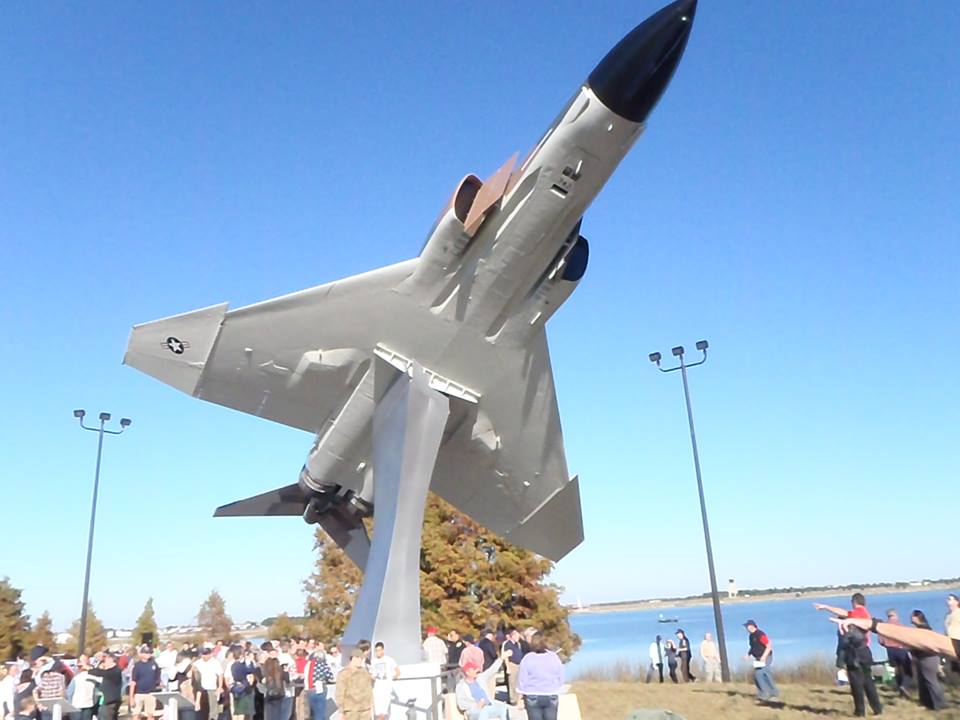
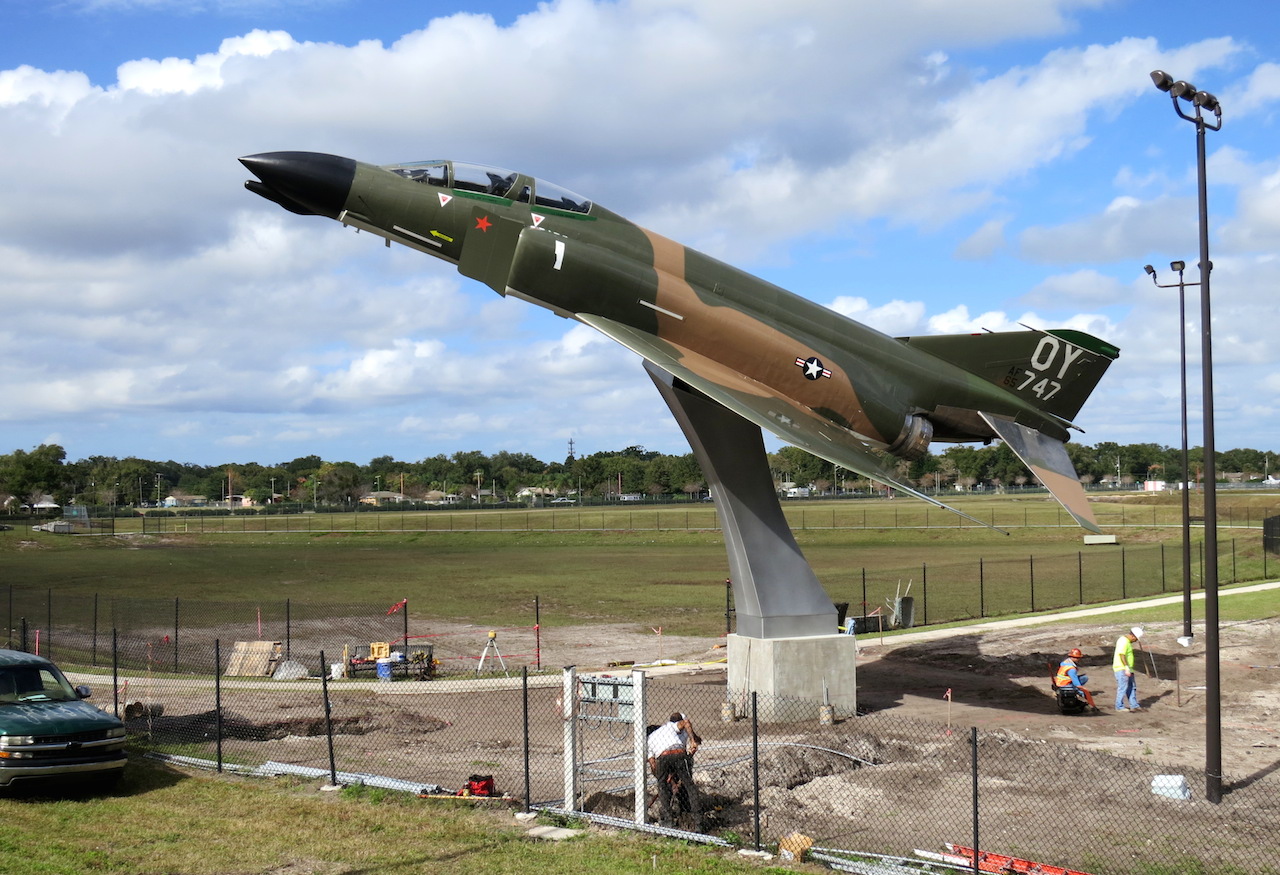
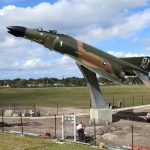
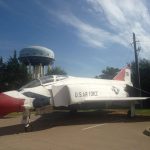
On Sunday December 14th, over a thousand people from central Florida and around the nation came together at Orlando Executive Airport in Orlando, Florida to dedicate a McDonnell Douglas F-4 Phantom II as a memorial to the many central Floridians who served in the Viet Nam War, and especially to the 350 who never came home. Orlando native Colonel Joe Kittinger USAF (Retired) actually flew this specific aircraft, serial number 65-0747, on four combat missions over North Viet Nam while commanding the 555th Tactical Fighter Squadron, the ‘Triple Nickel’, out of Udorn Thailand (1971-72). He even flew her again after the war when based at RAF Lakenheath in England with the 48th Tactical Fighter Wing (1975-77).
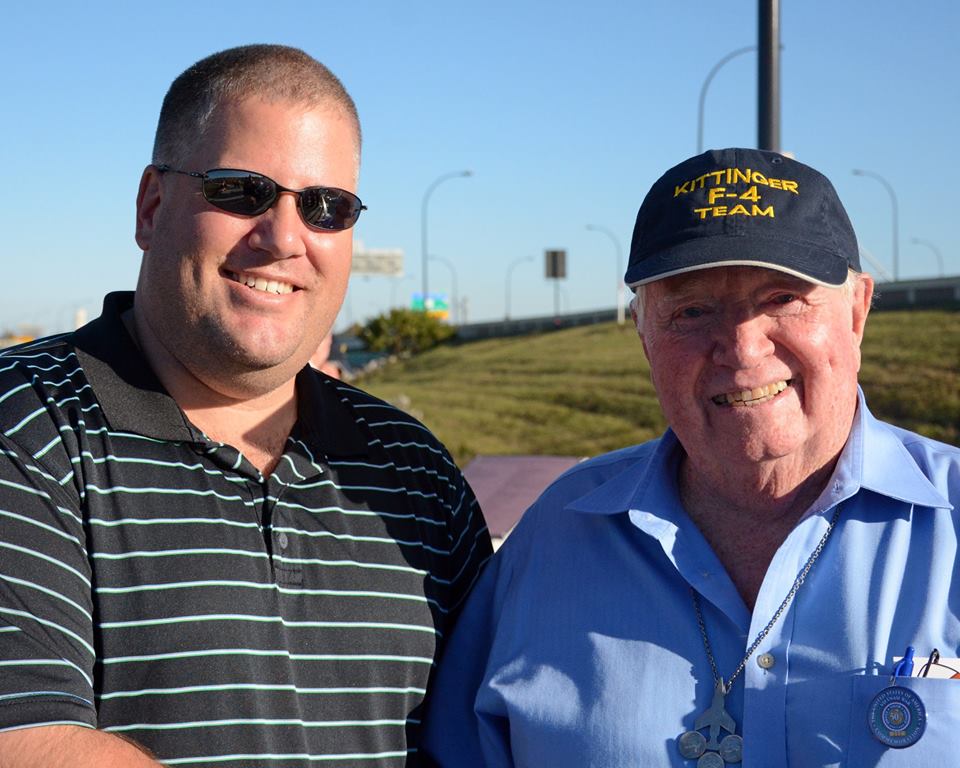
Over 60 businesses in central Florida donated products and services to make this monument a reality. Interestingly, one of these companies, Castle Constructors of Orlando, Florida, is owned by Orestes Lorenzo, the Cuban MiG-23 pilot who defected to the United States in March, 1991. The following year Lorenzo flew back to Cuba in a Cessna 310 to rescue his wife and two young sons and bring them back to the USA.
Given the strong ties to Colonel Kittinger, the memorial couldn’t have chosen a more appropriate aircraft to put on display. Kittinger is a legendary pilot with three tours of duty in Viet Nam and nearly 500 combat missions. The last of these missions in May, 1972 resulted in him being shot down and taken prisoner in North Viet Nam, where he endured nearly a year of brutal treatment and torture before his release. Kittinger is perhaps better known for one of his earlier aerial feats though, when he set the record in 1960 for the highest parachute jump in history, leaping from a ballon at 102,000 feet. His record was only recently broken by Felix Baumgartner. Colonel Kittinger was also the first man to fly a gas balloon solo across the Atlantic, which he achieved in 1984.
During his speech at the memorial dedication ceremony, Colonel Kittinger called Orlando Executive Airport his “Field of Dreams”, as during his childhood in the 1930s, he often rode his bicycle past what were then cow pastures to watch the airplanes take off and land. He of course tried to talk pilots into giving him a ride, sometimes successfully. Kittinger also remarked how he hoped the F-4 and the park named in his honor would serve as an inspiration and “Field of Dreams” to following generations. So with many old friends and new ones by his side, Kittinger cut the ceremonial ribbon and opened the park to the public. The park will provide an everlasting reminder to the sacrifice of those who served, but in so doing, hopefully spur future Floridians to greatness as well.


I have read some stories about the war in Vietnam and what I have heard is thousands of Vietnamese lost their lives to the war and there is quite a number of American troops that did not make it back home. I am fascinated by war planes and seeing such a gesture and recognition laid out to the warriors from that war is humbling to say the least.
If this is an area of study for you, you may wish to focus on two of the more spectacular air efforts: ‘Spooky’ missions and ‘Iron hand’ missions, later to be called ‘Wild Weasel’ missions that used F-4s in the latter stages. My uncle flew the early Spooky missions and I worked on the F-4’s flying MIGCAP and ground support.
I too worked on the F4 at Udorn and Ubon 67/68. I’m wondering if this is the same Jeff that I met at the recent Triple Nickel reunion.
Trying to contact Colonel Kittinger to see if he knows Colonel Doug Brenner who also flew combat in Vietnam. I am not sure if Doug flew F4s, he may have been in F100s.
Doug & I grew up together in Falls City, Nebraska. All he ever wanted to do was fly. He first tryed to get in the Navy but did not pass the physical.
Doug had a twin Dave who did make the Navy.
Doug was one of the original Thunderbirds & flew right wing for a couple years. His last duty station was Commander of Thule AF base, where passed away suddenly at age of 44.
I have done a scholarship in their honor at Falls City High
Don – I and Maj. Doug Brenner’s great-nephew and would love to talk to you about him if you ever had a chance.
f4d 65-0747 was my jet at raf hooterville (lakenheath) from 74-77. I would like to make contract with col kittinger. can you pass this info along to him.
thanks c/c h w stratton
Did Colonel Kittinger fly with Colonel Doug Brenner in Vietnam?
Colonel Brenner was a classmate of mine in Falls City High School. He passed away at the age of 44, during the the time he was serving as Commander of Thule Air Force Base.
His identical twin Dave, who was a Naval Aviator during Korea, passed away @ age 42 after he had left the Navy and was flying with Capitol Air Lines (now United).
I fund a scholarship in their memory at Falls City High School
My name is Robert Tavernier..I am the crew chief that launched you that fateful day…May 11..My birthday 1972 was with the 13th T.F.S. When I asked why my airplane hadn’t returned..I was told you were missing in action. Thank God you made it out. Sir..It was an honor to have served under you. God Bless and keep you. SGT. Robert Tavernier. currently discharged
I have just recently been given a copy of The Long Lonely Leap by Joe Kittinger. I would like to get in touch with Col. Kittinger. It is greatly appreciated. My email is included.
Hello Elliot, unfortunately we are not connected with Col Kittinger. Sorry.
I was the Crew Chief on this very same F-4 during 1970-1971 at Udorn. We called her the Executive Jet because of her tail number “747.” As a SGT, I was honored on September 13, 1971 to fly back seat, with Major Walter Bender as the pilot for an hour in my plane over Thailand in appreciation for my tour of duty.