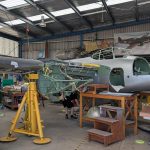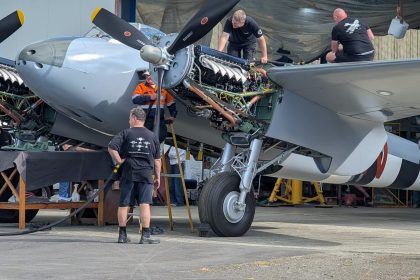
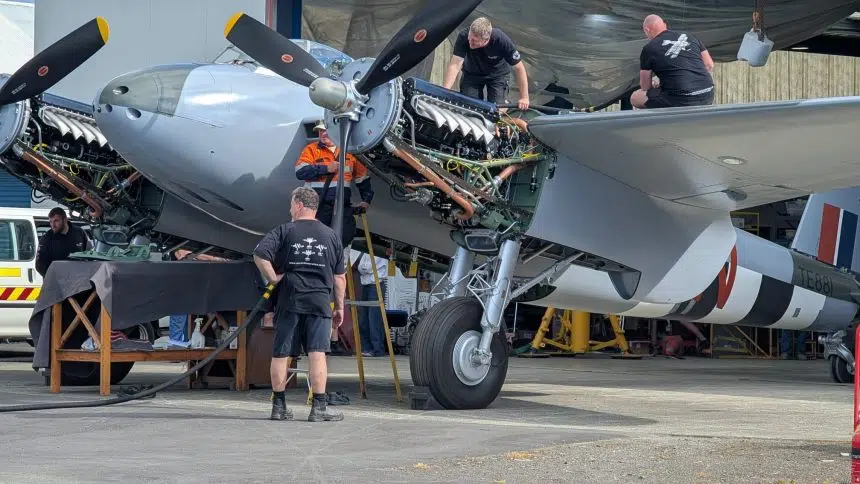

On Friday, October 23, The de Havilland Mosquito FB Mk.VI TE881, also known by its Royal New Zealand Air Force serial NZ2345, has completed its first engine runs following restoration by Avspecs in New Zealand. Announcing the milestone, FlyaSpitfire.com said the aircraft’s first flight is anticipated in the coming weeks and revealed that it will carry No. 23 Squadron markings, coded YP-N. The announcement marks a significant advance since Vintage Aviation News’ previous restoration update, published in December 2025, when the project was progressing toward a planned return to flight in 2026. The restoration brings together FlyaSpitfire.com and Avspecs, whose team has already returned four Mosquitos to the air. Vintage Aviation News
“It has long been our ambition to restore a de Havilland Mosquito in partnership with the highly experienced team at Avspecs,” FlyaSpitfire.com stated. “We’re thrilled to see the project progressing towards this important stage.” The newly announced scheme commemorates No. 23 Squadron’s service at RAF Little Snoring in Norfolk, where it operated as part of No. 100 Group from June 1944. Its work focused on disrupting German night-fighter operations and reducing the threat to Allied bomber formations operating over occupied Europe. No. 23 Squadron had begun operating Mosquitos in July 1942 before moving to the Mediterranean theatre, where it flew missions against targets in Sicily, Italy and Tunisia. A move to Sardinia followed in December 1943, before the squadron returned to England the following June to begin its assignment with No. 100 Group. From Little Snoring, its crews undertook demanding night intruder missions against the Luftwaffe’s night-fighter force, supporting the RAF’s broader campaign to protect its bomber streams. The squadron remained at the Norfolk airfield through the end of WWII and disbanded on September 25, 1945. TE881’s new markings pay tribute to that operational history; they represent a commemorative scheme rather than the aircraft’s own service with the unit.
Built in 1945 by the Standard Motor Company in Coventry, England, TE881 reached New Zealand after a ferry flight by an RAF/RNZAF crew and entered RNZAF service at Ohakea on May 28, 1947. It subsequently went into storage at Woodbourne. Declared surplus in June 1955, the aircraft was sold to the Williams Brothers with fewer than 70 airframe hours recorded. Surviving components later entered John Smith’s collection at Mapua and were recovered following his death, providing the basis for the restoration now nearing completion. Fly a Spitfire
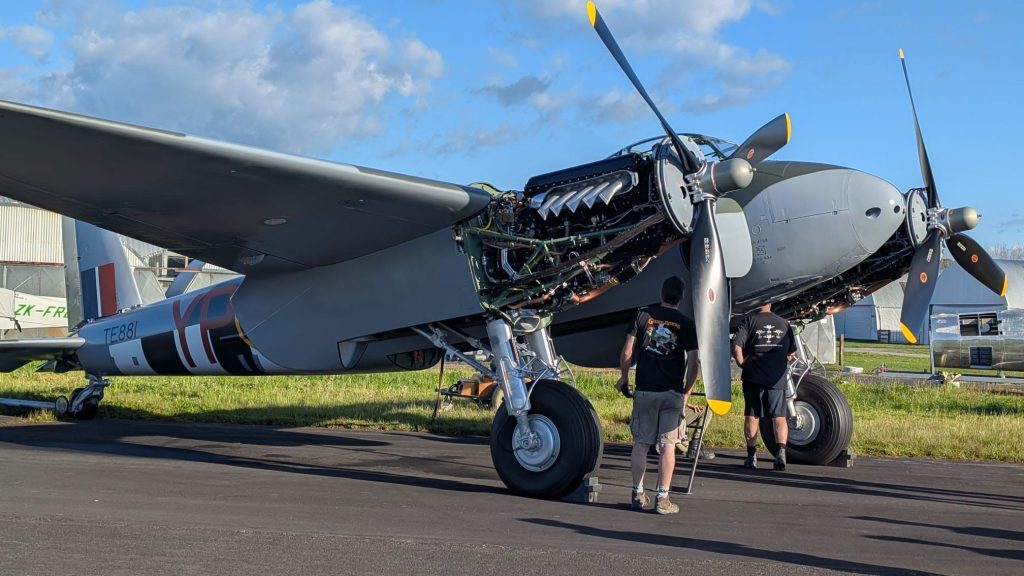
(Image credit: Flyaspitfire.com)
Although earlier coverage anticipated the Mosquito’s eventual return to the United Kingdom, FlyaSpitfire.com’s latest announcement leaves its future open. The company says decisions about the aircraft’s next chapter will follow its first test flight and an assessment of its performance. For now, the successful engine runs bring TE881 another step closer to flight, with the restoration team preparing for the next milestone in the Mosquito’s return to the skies. Further information about the aircraft is available through FlyaSpitfire.com, while details of Avspecs’ restoration work can be found at warbirdrestoration.co.nz.