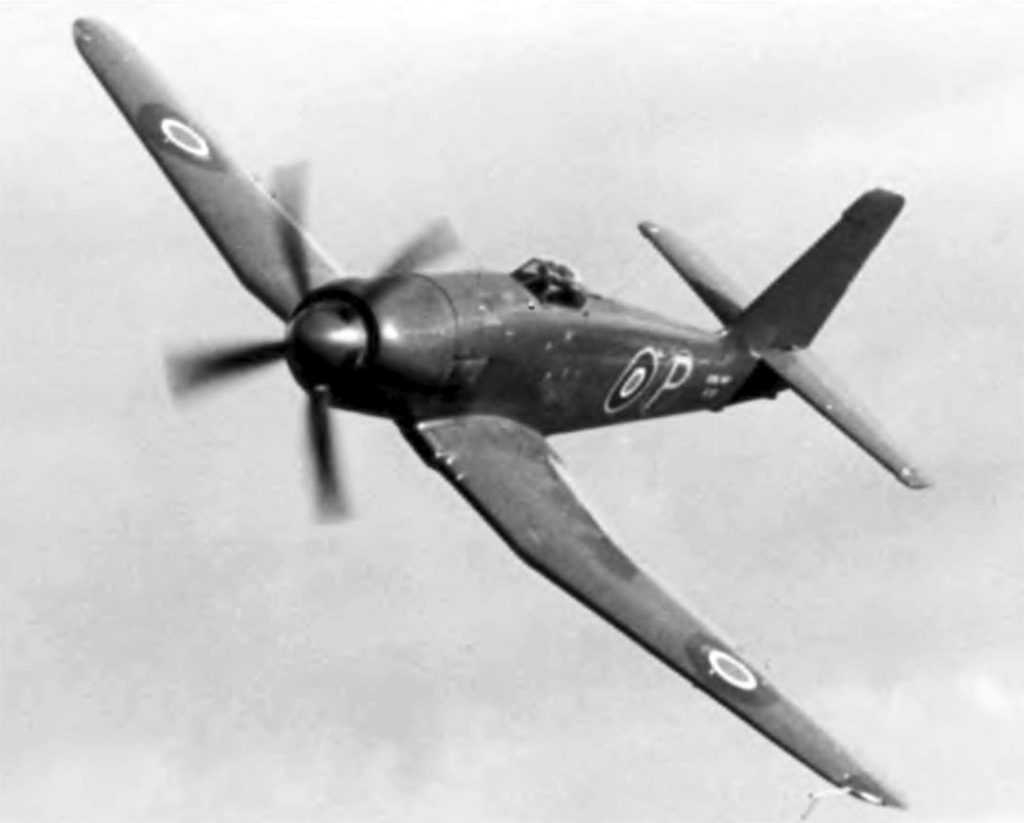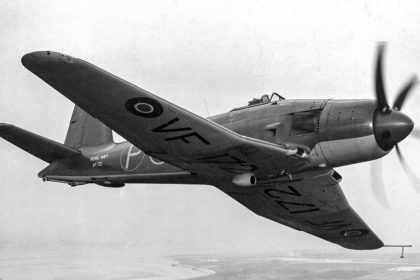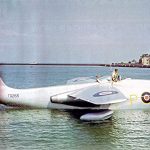






In September 1943, the British Fleet Air Arm began developing a laminar-flow wing that could reduce the aircraft’s weight by 700 lb and increase its speed by 13 mph. To meet this need, Blackburn began redesigning its troubled Firebrand aircraft. As the redesign progressed, it included a new fuselage and other improvements. In October 1943, Blackburn’s design team, led by G.E. Petty, began work on this development, which led the Air Ministry to issue Specification S.28/43 on February 26, 1944, for the new aircraft. The specification called for a Bristol Centaurus 77 radial engine with contra-rotating propellers, which allowed for a smaller rudder. Blackburn informally called the new design B.48, or the “Firecrest,” while the Air Ministry specification called it S.28/43. Blackburn Firecrest was a low-wing, single-seat, all-metal monoplane. The fuselage behind the cockpit was oval with a stressed skin, while the front had a circular, tubular-steel frame. The cockpit was repositioned forward and raised, allowing the pilot to see over the wing’s leading edge and down the nose. The canopy was taken from the Hawker Tempest fighter. In the rear fuselage, a single 62 US-gallon fuel tank and two 110 US-gallon fuel tanks sat in the center wing section. The aircraft featured a new, thinner inverted gull wing with a laminar-flow shape. The wing had a two-spar center section with about 6.5° of anhedral, and the outer panels had 9° of dihedral. The wings could fold hydraulically in two places for compact storage on aircraft carriers. The Blackburn Firecrest had four Fowler flaps for better low-speed handling when landing and retractable dive brakes on both wing surfaces. During the redesign, the structure was simplified to reduce weight by 1,400 pounds. We also increased the fuel capacity by 84 US gallons, but the total weight is still 900 pounds less than the Firebrand.
Design of Blackburn Firecrest

In November 1943, work began on two Blackburn Firecrest prototypes, but delays occurred due to proposals for alternative engines. By 1945, it was decided to add another prototype with a Centaurus engine and focus on three prototypes using the Napier E.122 engine under specification S.10/45. The Ministry of Defence believed this approach would help Blackburn learn more about aerodynamic and structural design and support engine development at Napier. However, it became clear that the S.10/45 aircraft could only achieve proper balance if the E.122 engine were placed behind the pilot. This required redesigning the aircraft and adding an extra 1,000 lbs. Because the Royal Navy had limited funds, this redesign was deemed unjustifiable, leading to the cancellation of the S.10/45 on October 8. While final designs were underway, the Centaurus 77 engine with contra-rotating propellers was canceled in January 1946. It was replaced with a standard 2,825 hp (2,107 kW) Centaurus 57 engine. This engine needed flexible mounts and was later modified into the Centaurus 59. To handle the new engine’s torque, the vertical stabilizer and rudder had to be enlarged from 33 sq ft to 41 sq ft. In September 1946, the Ministry of Supply conducted a strength analysis and found that the aircraft required additional strengthening to function as a strike fighter. This would involve costly redesigns to match the weight and performance of the already-flying Westland Wyvern, so no contract was placed for production aircraft. The first Blackburn Firecrest prototype was delayed because its propeller arrived late. It was rolled out at Brough in February 1947 and then taken by road to RAF Leconfield. There, it made its first flight on April 1, 1947. By the end of September 1947, all three prototypes were finished. The third prototype was changed to lower the outer-wing angle to 3°.
The Cancellation

The Ministry of Supply later ordered that flying should stop and all work on the aircraft should cease. However, later that month, the third prototype was used to test powered aileron controls. Tests on the prototype showed that the ailerons worked well at cruise speed but felt heavy at both low and high speeds. The second prototype was set aside for structural testing. The third prototype had its first flight in early 1948. However, the testing was slow, with only 7 hours and 40 minutes of flight time by November 30. More than half of this time came from air show performances. Testing ended in March 1949 when the officer in charge decided further tests were unnecessary. The Firecrest was faster than the Firebrand and gave the pilot a better cockpit view. However, it was disappointing in other ways. Test pilot Captain Eric Brown said the Blackburn Firecrest was even less maneuverable than the sluggish Firebrand. The powered ailerons made the controls feel uneven, which caused instability in turbulent air. Blackburn’s Firecrest strike fighter was not suitable for carrier operations. The pilot sat near the wing’s trailing edge and had to look over a long and wide nose, which made landing difficult. The Firecrest became outdated with the introduction of gas turbine engines. Although Blackburn planned to create turboprop versions of the Firecrest using the Armstrong Siddeley Python engine, these plans were never built. Instead, orders went to Westland for their Wyvern fighter. The two flying prototypes continued to be used until 1949, were returned to Blackburn in 1950, and were later scrapped. Read more Grounded Dreams articles HERE.