

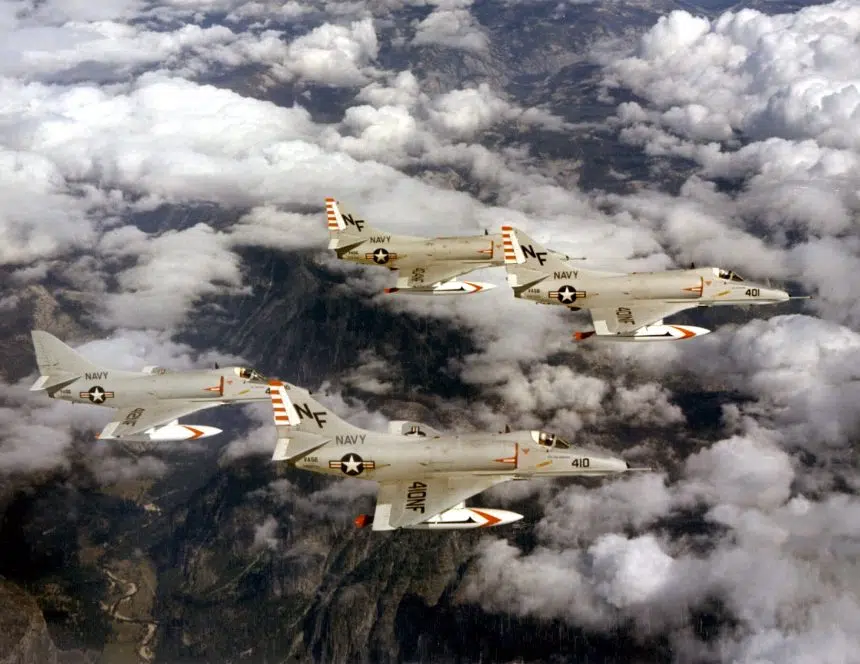

Attack Squadron 56 (VA-56), known as the Boomerangs from 1957 to 1958 and later as the Champions, was a US Navy attack squadron formed on June 4, 1956. From October 25 to 31, 1961, VA-56 took part in Operation Crosstie, which tested the compatibility of US Navy and Royal Navy aircraft. While operating from the British aircraft carrier HMS Victorious, the squadron conducted flight operations to evaluate aircraft handling, armament compatibility, and carrier facilities. After this, VA-56 embarked on the USS Constellation for the carrier’s trip from the US East Coast to its new home port on the West Coast, which occurred between July 16 and September 15, 1962, as the carrier sailed around Cape Horn. By 1964, Attack Squadron 56 operated the Douglas A-4E Skyhawk and took part in U.S. missions in Southeast Asia. In July, the squadron joined Yankee Team missions. They gave air refueling support and assessed armed A-4Es as escorts for reconnaissance aircraft such as the RF-8 and RA-3. These missions over Laos and South Vietnam aimed to spot Communist military movements. The squadron became more active after the Gulf of Tonkin incident. Between August 2 and 4, 1964, USS Maddox was on a DESOTO patrol off North Vietnam when three motor torpedo boats attacked on August 2. After this incident, Attack Squadron 56 conducted sorties to support the destroyers involved in the DESOTO patrols. On August 5, the squadron’s A-4Es took part in Operation Pierce Arrow, which was the US response against targets in North Vietnam.

Working with Carrier Air Wing 5 (CVW-5), VA-56 attacked antiaircraft positions at the Vinh oil storage site, destroying about 90 percent of the complex. They also struck the Ben Thuy naval base, sinking or destroying several North Vietnamese torpedo boats. In October and November 1964, Attack Squadron 56 continued Yankee Team operations, flying missions off Vietnam’s coast. On December 5, 1965, VA-56 experienced a major accident involving nuclear weapons. An A-4E aircraft carrying a B43 nuclear bomb fell off the USS Ticonderoga during a training exercise about 80 miles from Okinawa. The plane was moving from the No. 2 hangar bay to the No. 2 elevator when it went over the side. The pilot, Lieutenant (junior grade) Douglas M. Webster, and the aircraft (BuNo 151022) with the nuclear weapon were never found. The plane sank in about 16,000 feet of water. Attack Squadron 56 also had members recognized for their bravery over North Vietnam. On February 7, 1966, Lieutenant Commander Render Crayton received the Silver Star for his actions during a combat mission. He was later released during Operation Homecoming in February 1973. On June 10, 1967, Attack Squadron 56 lost its commanding officer, Commander Peter Sherman, who did not return from a strike mission over North Vietnam. His remains were identified in January 1991, after he was listed as missing in action. In June 1968, Lieutenant Commander Crater was awarded the Silver Star for leading a successful nighttime rescue of a downed F-4 crewman over North Vietnam. This rescue was part of a larger operation, during which helicopter pilot Lieutenant Clyde Everett Lassen, who was not part of Attack Squadron 56, was awarded the Medal of Honor.

On November 1, 1968, Attack Squadron 56 completed its last transfer of A-4E Skyhawk aircraft and began training to use the LTV A-7 Corsair II. The squadron then operated the A-7B variant during its deployments with CVW-5 on the USS Midway. From April to November 1971, VA-56 deployed to Vietnam on the Midway. The following year, the squadron resumed combat during a stronger US air campaign against North Vietnam. On May 12, 1972, the Midway, with VA-56 aboard, shifted operations from the An Loc area in South Vietnam to targets in North Vietnam. The squadron took part in Operation Pocket Money, which involved mining and blocking routes in Haiphong Harbor and along North Vietnam’s coast. This operation started on May 9 with support from USS Kitty Hawk and USS Coral Sea. VA-56 also joined Operation Linebacker, a focused air campaign aimed at disrupting supply movements into North Vietnam. This campaign continued until October 22, 1972. Attack Squadron 56 operated on the USS Midway during the later years of the Vietnam War. On April 29 and 30, 1975, parts of the squadron took part in Operation Frequent Wind, which involved evacuating American citizens from Saigon as the South Vietnamese government fell. The squadron stayed active during the Cold War, supporting US carrier missions in the western Pacific and Indian Ocean. In August 1976, Attack Squadron 56 worked in Korean waters aboard the Midway after the Axe Murder Incident. In this incident, North Korean personnel killed two US Army officers in the Korean Demilitarized Zone.

From April to May 1979, the Midway, with Attack Squadron 56 onboard, was sent to the Gulf of Aden. This deployment replaced the USS Constellation and helped maintain a US carrier presence after fighting between North and South Yemen and the fall of the Shah of Iran. In October 1979, the carrier and its air wing received orders to return to the Indian Ocean for a second deployment that year due to anti-American protests in Iran. After the US Embassy in Tehran was seized and Americans were taken hostage on November 4, the Midway went to the Gulf of Oman. Attack Squadron 56 stayed deployed there until early February 1980, when the carrier was replaced. In May and June 1980, the squadron returned to Korean waters as the Midway operated off the coast during civil unrest and events surrounding the Gwangju massacre. In its final years, VA-56 experienced a significant change in US Navy carrier aviation. In May 1986, the squadron moved to Naval Air Station Lemoore as part of Carrier Air Wing 5’s shift from A-7 and F-4 aircraft to the F/A-18A Hornet. VA-56 began transferring its personnel and aircraft in preparation for disbanding. On August 31, 1986, the Champions were officially disbanded, ending a 30-year history. Read more Squadron Histories articles HERE.