





In January 1948, the Soviet Union needed a long-range all-weather interceptor capable of intercepting hostile aircraft at long range from their targets, both day and night. Several design bureaus tackled this requirement, including Mikoyan-Gurevich with the I-320 and Sukhoi with the Su-15. The Mikoyan-Gurevich I-320 design was a twin-engine aircraft with swept wings. Its engines were arranged in tandem, with one at the front and the other at the back of the fuselage. Air entered through a nose inlet, which split into three ducts; one went to the front engine, and the other two went around the cockpit to the rear engine. The crew consisted of two members, the aircraft commander and a radar operator, who both had ejector seats and shared a side-by-side cockpit that was not pressurized.
Design of Mikoyan-Gurevich I-320
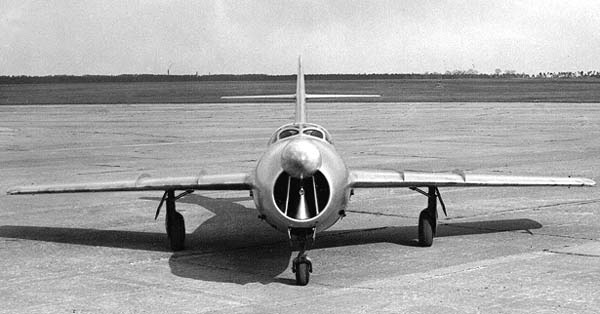
The wings, similar to those of the smaller MiG-15 fighter, were swept back at a 35-degree angle and included large wing fences. The aircraft also featured air intercept radar. Initially, it used the Toryii radar, but later versions were upgraded with the improved Korshun radar, which was housed in a radome at the top of the air intake. The first Mikoyan Gurevich I-320 prototype, the R-1, was powered by two Klimov RD-45F engines, each producing 5,000 lbf of thrust. These engines were unlicensed copies of the British Rolls-Royce Nene engine. The R-1 carried two Nudelman N-37 cannons, one on either side of the air intake. It made its first flight on April 16, 1949. A second prototype, the R-2, followed. It had more powerful Klimov VK-1 engines, producing 5,900 lbf of thrust. The R-2 also included a third N-37 cannon and an improved windscreen and canopy. This Mikoyan-Gurevich I-320 prototype was completed in November 1949. However, the R-2 was damaged when a cannon shell exploded. The aircraft was rebuilt, and its wings were modified by adding a third fence. It flew again as the R-03 on March 30, 1950.
The Cancellation

During tests of the Soviet interceptor prototype, the Mikoyan-Gurevich I-320 reached a top speed of 680 mph at sea level. However, during further state testing, pilot Yu. A. Antipov found that the aircraft’s wings could warp or bend at high speeds. Because of this issue, officials limited its maximum operational speed to 600 mph. The Mikoyan-Gurevich I-320 performed well but did not enter production because new requirements replaced its specifications, leading to the production of the Yakovlev Yak-25. The MiG design bureau kept the two prototypes and used them as testbeds for developing avionics. In the Grounded Dreams series, although the two physical prototypes never entered mass production, they were not entirely wasted. The Soviet Air Force used the leftover airframes for several years as flying testbeds. It helped the service develop and improve advanced avionics and radar systems that would later be used in active Cold War jets. Read more Grounded Dreams articles HERE.