

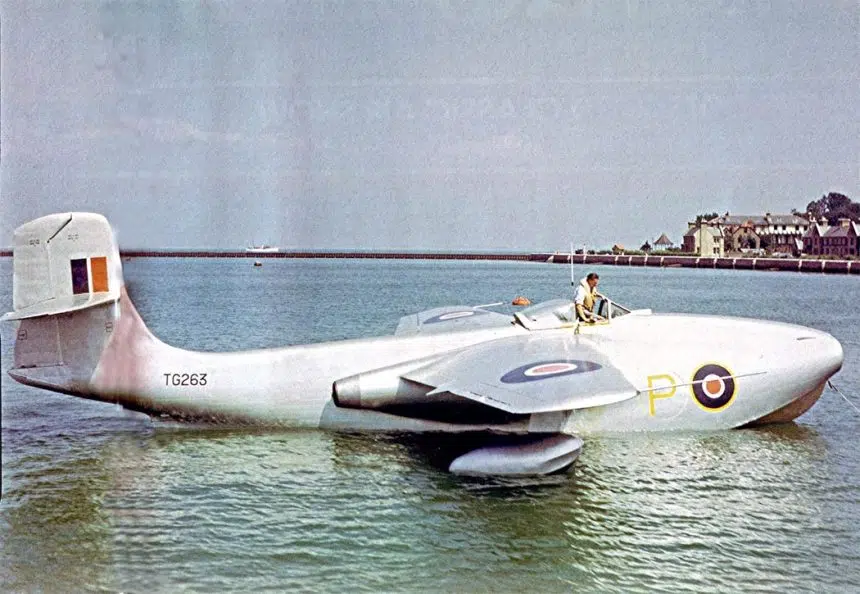

In mid-1943, Saunders-Roe proposed a jet-powered seaplane to the British Air Ministry. The seaplane, called Saunders-Roe SR.A/1, was inspired by the Imperial Japanese Navy’s partial successes with seaplane fighters, such as the Nakajima A6M2-N and the Kawanishi N1K. Officials at the Ministry initially criticized Saunders-Roe’s idea, noting that the wing thickness relative to its length was too high for a fast fighter operating at high altitudes. In response, Saunders-Roe modified the seaplane’s design. In April 1944, the Air Ministry issued Specification E.6/44 to address these changes. The following month, the ministry issued a contract to produce three prototypes. At this stage, plans called for the Saunders-Roe SR.A/1 to be used in the Pacific against Japan. As a result, the developers began preparing for rapid production early on. However, soon after the Pacific War ended in August 1945, Saunders-Roe shifted focus to the Saunders-Roe Princess, a long-range civilian flying boat project. This decision delayed fighter development. With the war over, demand to start fighter production dropped. On July 16, 1947, the first prototype of the aircraft, flown by Geoffrey Tyson, took its first flight. Just two weeks later, Tyson made another test flight in front of an audience which included representatives of the Royal Navy, Royal Air Force, Royal Aircraft Establishment, Saunders-Roe, Metropolitan-Vickers and at least one foreign government.
Design of Saunders-Roe SR.A/1
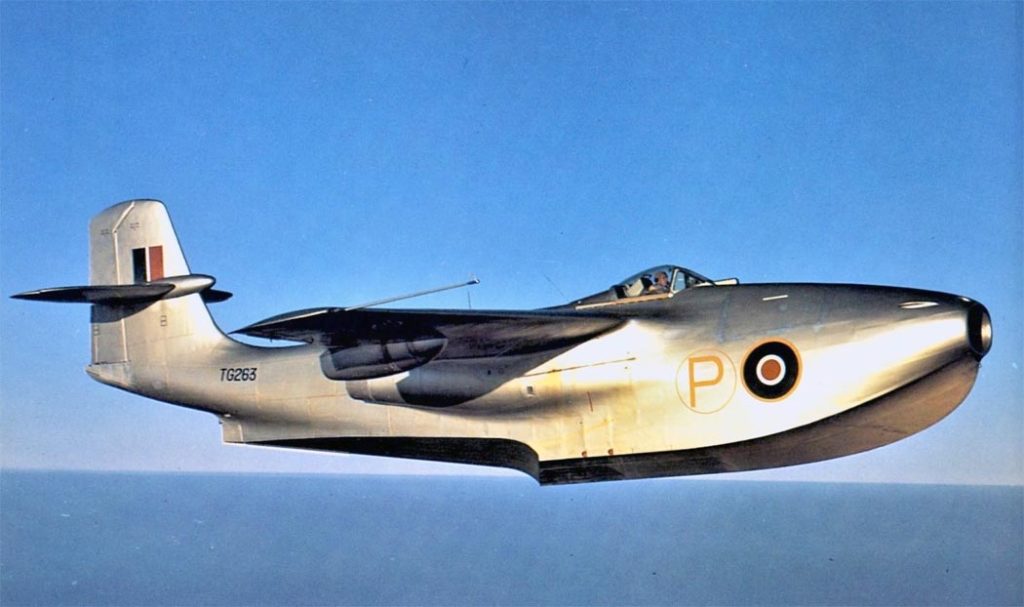
Tests on the prototype proved that the Saunders-Roe SR.A/1 handled well and performed well. The 1948 Farnborough Airshow also helped demonstrate to the world that the Tyson could be agile, performing high-speed aerobatics and inverted flight. During the flight test program, two of the three prototypes were involved in accidents, which paused the trials and required modifications to the remaining aircraft. The Saunders-Roe SR.A/1 had a small and heavy cockpit canopy, which made it hard for the pilot to see outside, a drawback for a fighter aircraft. However, the pressurized cockpit was relatively spacious, allowing room for an additional crew member or an observer in a rearward seat. To improve safety, two Saunders-Roe SR.A/1 prototypes were equipped with the first Martin-Baker ejection seats. An automatic mooring system enabled the pilot to moor the aircraft without external help or leaving the cockpit. The engine air intake was extendable to reduce the risk of seawater entering during takeoffs, though testing showed only minor performance drops because of this feature. To decrease drag, the floats could be retracted during flight. A big problem during development was that the Beryl engine that powered the aircraft was no longer being made.
The Cancellation
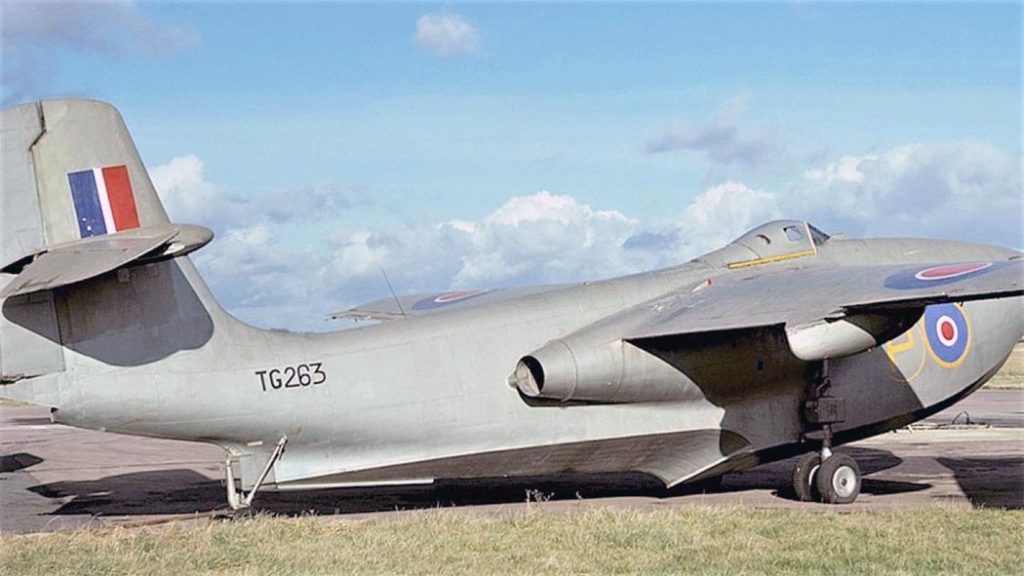
The British company Metropolitan-Vickers had stopped all jet engine development, leaving only a few engines available. To continue production, they needed a replacement engine. Although the aircraft had some good qualities, officials decided its need had ended with the war. Additionally, the success of aircraft carriers in the Pacific showed a better way to project air power over the oceans. However, Saunders-Roe argued that carriers and their escorts remained vulnerable to attacks from other aircraft or ships. Not enough orders were received to continue work on the project, and the remaining prototype was put into storage in early 1950. Interest in the Saunders-Roe SR.A/1 program was revived in November 1950, just after the Korean War had begun. The United States learned about the project, but it soon became clear that it was outdated compared to newer, better land-based fighter planes. As a result, the project was finally canceled. The SR.A/1 prototype flew for the last time in June 1951 and is now displayed at the Solent Sky Museum in Southampton, UK. In the Grounded Dreams series, the Saunders-Roe SR.A/1 was canceled because of the delays and engine problems. Read more Grounded Dreams articles HERE.