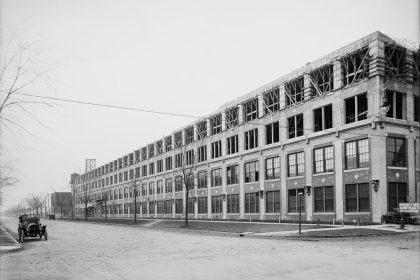


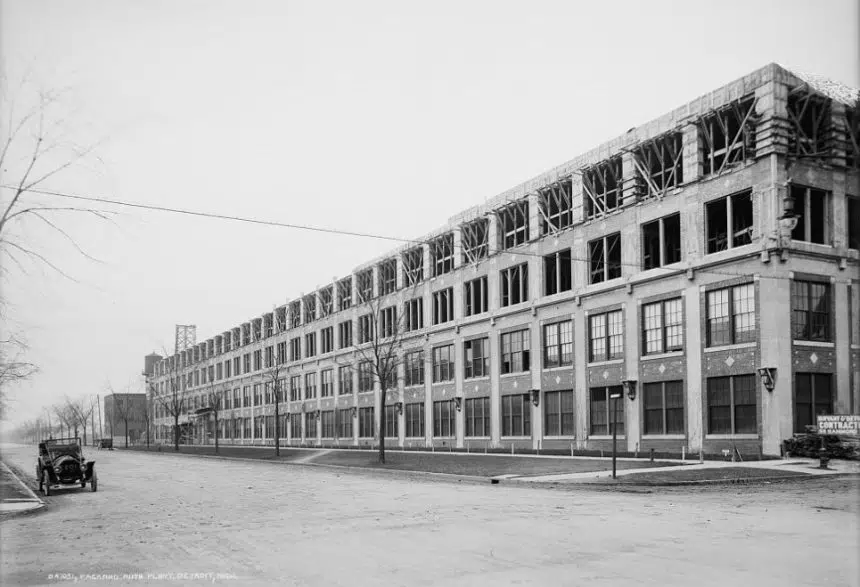

The Packard Motor Car Company started and ended outside Detroit, but it thrived there. It was known as the top luxury car of its time and became the favorite of celebrities and movie stars. The company also played an important role in both World Wars. The first Packard was made in 1899 by the New York and Ohio Company. The company was founded by brothers William and James Packard in Warren, Ohio. Henry Bourne Joy, from Detroit, bought a Packard while in New York City. He was so impressed that he visited the Packard brothers in Ohio. After that, he convinced some wealthy friends to invest in the company, which was renamed the Ohio Automobile Company. In 1902, the business changed its name to the Packard Motor Car Company and moved to Detroit the following year. The company hired architect Albert Kahn to design a factory on East Grand Boulevard. It started with 10 buildings and then expanded to a complex of 40. It was the beginning of Kahn’s career as a factory architect, building factories with large windows and open spaces using reinforced concrete, such as Packard Factory Building No. 10. James Packard remained at the helm until 1909, when general manager Henry Joy took over, running it until 1916. Packard was known for its race cars, for popularizing the 12-cylinder engine and airplane engines.

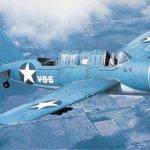
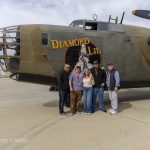
Packard achieved many important milestones. It was the first car company to use a steering wheel instead of a tiller for control. Packard built the Liberty Engine, which was used in WWI aircraft and later became a successful marine engine for motorboat racer Gar Wood. Packard also created the “Gray Wolf,” the first US race car to go a mile a minute. During WWII, Packard produced 55,000 airplane engines using the Rolls-Royce Merlin engine. The engines were most famously used in the North American P-51 Mustang fighter plane. It enhanced the plane’s performance, allowing it to escort Allied heavy bombers on missions to Germany or Japan and back. The engine was also used in many Allied aircraft such as Avro Lancaster B.III/B.X, Bell XP-63 Kingcobra, Curtiss P-40F/L/Kittyhawk Mk.II, Curtiss P-60, de Havilland Mosquito B.VII/B.25, Hawker Hurricane Mk. X, XI, XII, North American F-82 Twin Mustang, and Supermarine Spitfire Mk.XVI. Packard also made an updated version of the Liberty V-12 engine. The engine, measuring 2,490 cubic inches (40.8 liters), powered United States Navy PT boats.

After WWII, Packard struggled to compete as an independent car maker against the big companies such as General Motors, Ford, and Chrysler. To help survive, Packard merged with Studebaker in 1953 to form the Studebaker-Packard Corporation. It planned to join with American Motors Company (AMC), but disagreements between the companies’ leaders stopped those plans. As a result, Studebaker-Packard remained separate. The Packard brand was discontinued in 1959 after two years of declining sales for the Studebaker-made Packard models from 1957 and 1958. Since it closed, the 40-acre Packard site has fallen into disrepair and is now a well-known example of Detroit’s “ruin porn.” Over the years, various efforts have tried to repurpose some buildings, but none have succeeded, and the city has torn down some of the structures. In 2019, the iconic bridge over East Grand Boulevard, which had a clock on it, collapsed. Read more Forgotten Factories articles HERE.