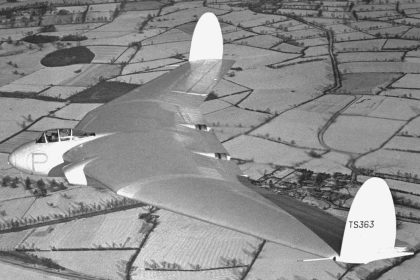
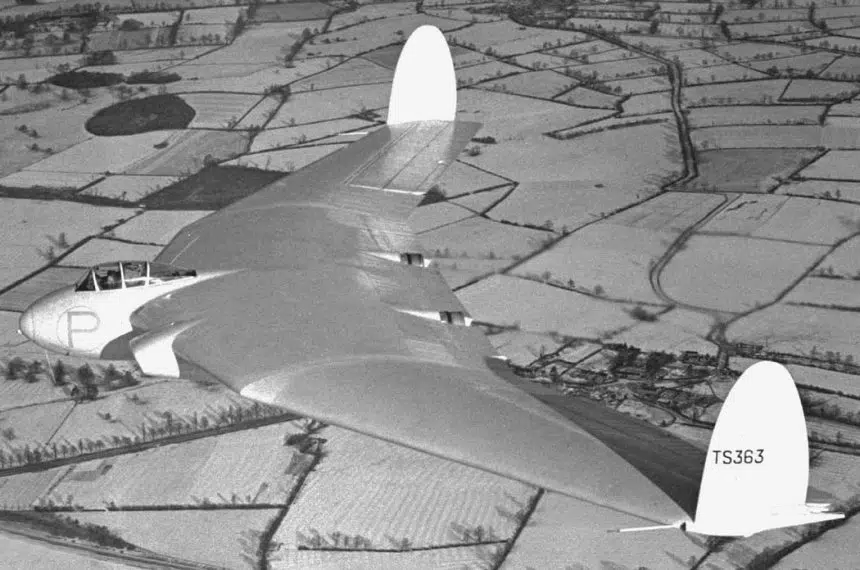

On this day in aviation history, 79 years ago (November 13, 1947), the Armstrong Whitworth A.W.52 took flight for the first time. Flown by test pilot Eric George Franklin, the British experimental aircraft was an all-metal, twin-engine flying wing developed to investigate the aerodynamic advantages of tailless aircraft and laminar-flow wings. Designed by John Lloyd, the A.W.52 originated from wartime research into reducing aerodynamic drag. Armstrong Whitworth believed that combining a flying-wing configuration with laminar-flow airfoils could produce an aircraft considerably more efficient than conventional designs. The company envisioned eventually developing a large jet-powered flying-wing airliner. To investigate the concept, engineers first constructed the wooden A.W.52G glider, which flew in March 1945, followed by two full-scale jet-powered prototypes.

The first prototype, TS363, was powered by two Rolls-Royce Nene turbojets, while the second aircraft, TS368, used less powerful Rolls-Royce Derwent engines. Flight testing revealed difficulties maintaining laminar airflow over the wings, resulting in disappointing performance. On May 30, 1949, TS363 encountered severe pitch oscillations during a test flight, forcing pilot John Oliver Lancaster to eject. The incident marked the first emergency use of an ejection seat by a British pilot. Armstrong Whitworth subsequently abandoned the flying-wing program, although the second prototype continued experimental flying until 1954. The A.W.52 TS363 measured 37 feet 5 inches in length with a wingspan of 89 feet 11 inches and was powered by two Rolls-Royce Nene turbojets producing 5,000 pounds of thrust each. Its published specifications included a maximum speed of 500 mph, a range of 1,500 miles, and a service ceiling of 36,000 feet. The aircraft had a gross weight of 34,150 pounds and a rate of climb of approximately 4,800 feet per minute. Only two jet-powered A.W.52 prototypes were constructed.