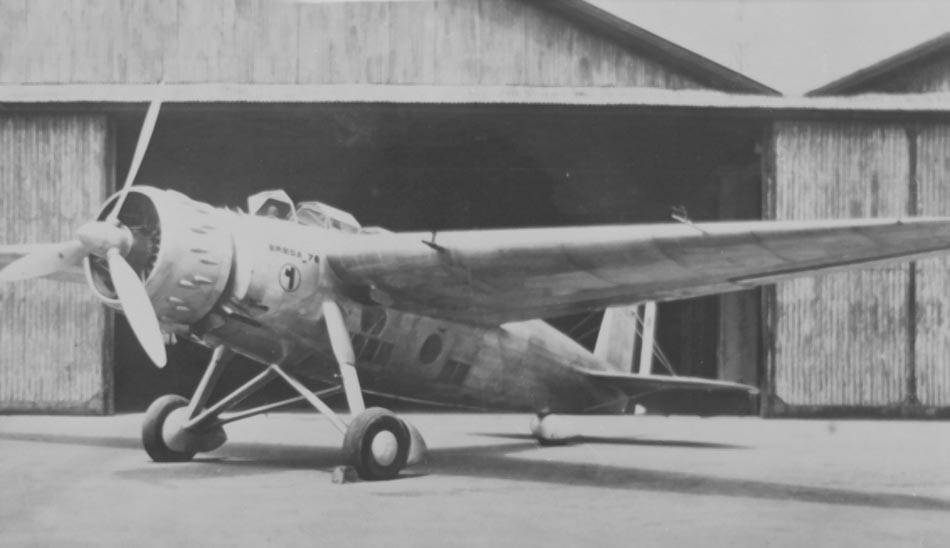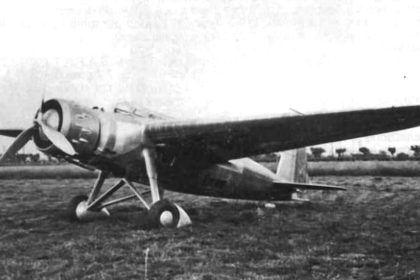
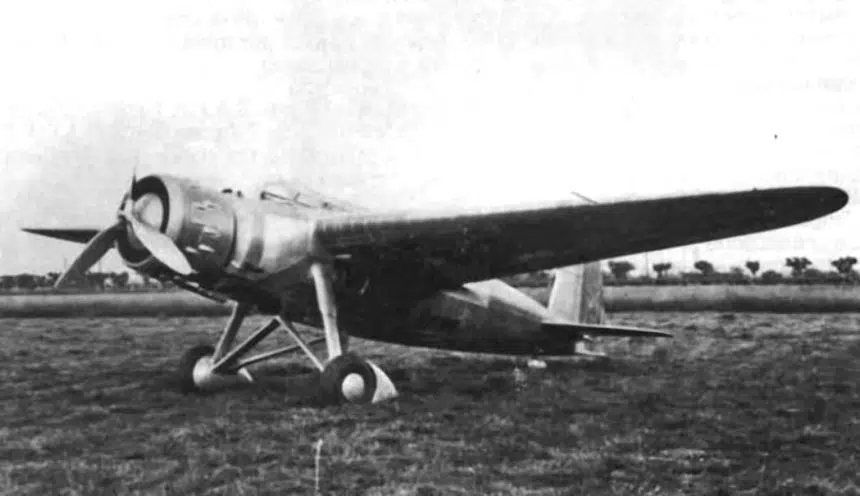


In 1937, the Italian Royal Air Force (Regia Aeronautica) asked Breda to design a dedicated reconnaissance aircraft derived from the Ba. 65. The new aircraft needed to work closely with the Ba.65 and escort fighters during missions. It was designed to operate effectively at tactical depth and to support ground forces. The aircraft was also expected to carry out long-range reconnaissance flights on its own. Designer-engineer Giuseppe Panzeri developed the Ba.75 from a modified version of the Ba. 65. It had a modified wing, tail, and engine. The new aircraft was about 20% larger than its predecessor. It had an all-metal structure, except for the aileron skins. The rudder skin was made of duralumin. The Breda Ba.75 was different from its predecessor because it was designed as a high-wing monoplane. In the observer’s cabin area, it had a well-glazed lower fuselage that could fit a camera and a third crewman. The gunner covered the lower rear with a movable machine gun and attacked ground targets.
Design of Breda Ba.75

The pilot’s cabin was also well-glazed and had a flattened shape, similar to an iron. Behind the pilot’s cabin, another movable machine gun let the observer fire and protect the upper rear. The Breda Ba.75’s main landing gear differed from the previous model. The landing gear units were tall, non-retractable pyramids fixed to the fuselage, with fairings covering the wheels. The aircraft was 37 feet long, 10.2 feet high, with a wingspan of 51.2 feet. It was powered by an Isotta-Fraschini K.14 radial piston engine, producing 900 hp. The Breda Ba.75 was envisioned to fly at a maximum speed of 233 mph, with a cruise speed of 190 mph and a range of 1,100 miles. The aircraft had two 12.7 mm Breda-SAFAT machine guns mounted in the wings, outside the propeller area. Each gun had 200 rounds. It could also carry up to 1,100 pounds of bombs under its wings.
The Cancellation

The Breda Ba.75 prototype made its first flight in the summer of 1939, with factory test pilot A. Colombo at the controls. The tests were successful, but the Breda Ba.75 was intended to operate alongside the older Ba.65 multirole aircraft. The Regia Aeronautica command changed its ideas about close air support aircraft because the Ba.65 was already outdated. As a result, development of the Breda Ba.75 was put on hold, and in early 1940, the program was officially canceled. The aircraft, with the military registry number MM.301, never served with the Italian Air Force. Other similar aircraft, such as the American Curtiss O-52, North American O-47, and German Arado Ar 198, also never gained wide popularity. Designers of successful aircraft in this category, such as the British Westland Lysander and the German Focke-Wulf Fw 189, took different approaches. In the Grounded Dreams series, the Breda Ba.75 was presented as one of the least-known and least-documented Italian aircraft of WWII. Read more Grounded Dreams articles HERE.