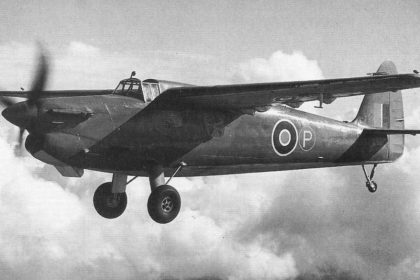
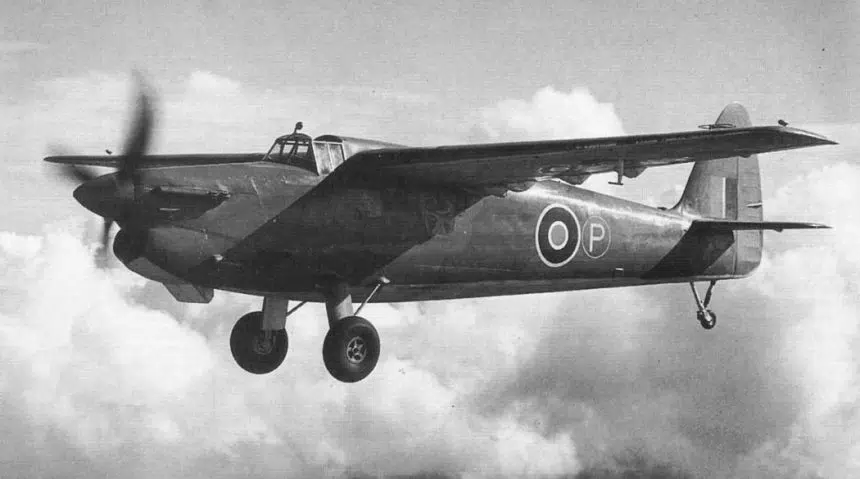

In 1937, Supermarine developed the Type 322 to meet a 1937 requirement for a new aircraft to replace the British Royal Navy’s Fairey Albacore biplane. At the time, the Albacore had not yet flown, and both Supermarine and Fairey Aviation received orders for what would become the Barracuda. Supermarine’s design featured a high-wing monoplane, and it was originally meant to be powered by the Rolls-Royce Exe engine. The Supermarine Type 322 included a variable-incidence wing, a feature first shown at the 1913 Paris Airshow on the French Paul Schmitt biplane. The aircraft design allowed for adjustable wing angles to improve visibility while maintaining lift. This was particularly useful on aircraft carriers with tailwheel landing gear. The wing angle could change from 2 degrees with the flaps neutral to 16 degrees when the flaps were lowered to 60 degrees. At this setting, the lift coefficient was 3.9, twice that of typical aircraft, resulting in a stalling speed of 57 knots (66 mph). The wing could also fold, an important technical achievement with only a small weight increase. The fixed tailwheel landing gear was simpler compared to retractable designs.
Design of Supermarine Type 322

The Supermarine Type 322 primarily used wood in its construction because lightweight metal was in short supply during its design phase. The Exe engine project was canceled in 1938, and the design was updated to include the Rolls-Royce Merlin engine, producing 1,300 hp. The three-crewed Supermarine Type 322 was 40 feet long, 14.2 feet high, with a wingspan of 50 feet and a wing area of 284 square feet. Its empty weight was 9,175 pounds, and the gross weight was 12,000 pounds. It was expected to reach a maximum speed of 279 mph at 4,000 feet, with a cruise speed of 250 mph at 2,000 feet, a stall speed of 58 mph, and a range of 825 miles. The aircraft could carry a 7.7 mm Browning machine gun in the wing, a 7.7 mm Vickers K machine gun, or a Browning in the rear cockpit. It could also carry a 1,500-pound torpedo or six 250-pound bombs. Two prototypes of the Supermarine Type 322, nicknamed “Dumbo” because of their chunky appearance, were built. They were supposed to be finished in early 1941, but delays occurred because the focus shifted to producing Spitfires. The first prototype (R1810) flew on February 6, 1943, followed by the second prototype (R1815), which had a Merlin 32 engine instead of the Merlin 30. It also featured a four-blade Rotol constant-speed propeller, a larger tail, and outer wings covered in alclad.
The Cancellation

By this time, Fairey’s competing design, the Fairey Barracuda, had entered service, so the two Supermarine Type 322s were used for experimental purposes. The team planned a developed version, the Supermarine Type 380. This design aimed to use new wing technology to replace the Sea Otter, helping seaplanes maintain the best angle for their floats during takeoff and landing. After the war, the company kept R1815. In 1946, it used the aircraft to help test the low-speed handling of the Supermarine Attacker jet fighter. In the Grounded Dreams series, engine delays and the Barracuda’s better performance put the Supermarine Type 322 at a dead end. Read more Grounded Dreams articles HERE.