
After the Hawker Hurricane entered service, Hawker started developing its successor. The company asked the Air Ministry which projects to consider, and it approved two designs. One used the Type N, powered by a Napier Saber engine, and the other the Type R, powered by a Rolls-Royce Vulture engine. In July 1937, Hawker sent the Air Ministry drawings and data for the Sabre fighter. The ministry indicated that it would soon release a specification for such a fighter. Hawker began the Vulture engine design in October. The ministry officially released Specification F.18/37 early in 1938 after Hawker’s follow-up, but it did not send the complete specification and invitation to bid until April. The specification called for a fighter to replace the Spitfire and Hurricane. It required the fighter to carry twelve 7.7 mm machine guns, reach a top speed of at least 400 mph at 15,000 ft, and have a service ceiling of 35,000 ft or higher. Other manufacturers also responded. Bristol designed a fighter with a 42 ft wingspan, powered by a Bristol Centaurus, Sabre, or Vulture engine. Gloster created a twin-boom pusher design that concentrated its weapons at the front and based their twin-engine model on their F.9/37 fighter. Supermarine offered two similar twin-engine designs, one with a tractor configuration and one with a pusher setup. The Hawker designs were selected, and on March 3, 1938, two prototypes of both the Type N and R were ordered. On July 10, 1939, Hawker received a contract to produce 500 Vulture and 500 Sabre engine fighters. In August, the official name ‘Tornado’ was assigned to them.
Design of Hawker Tornado
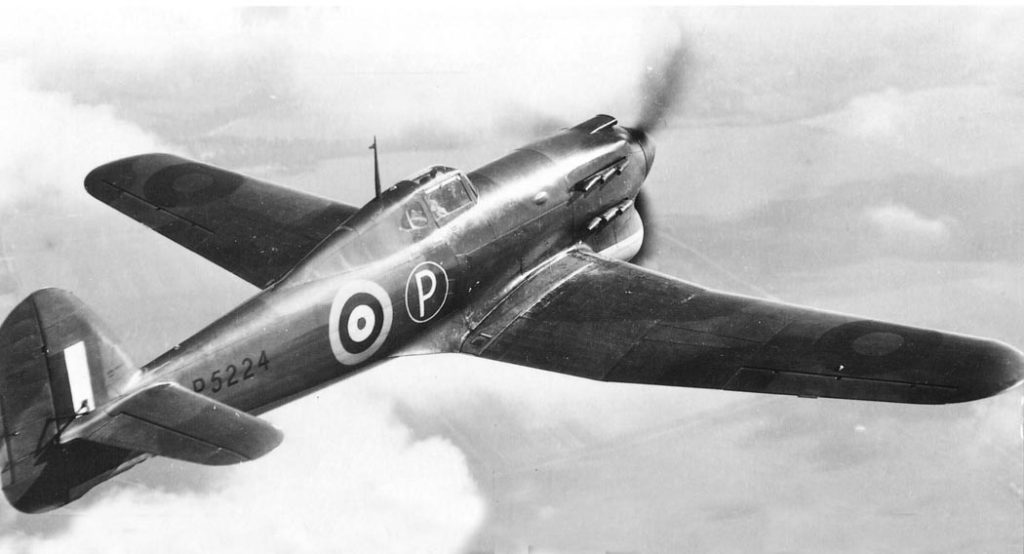
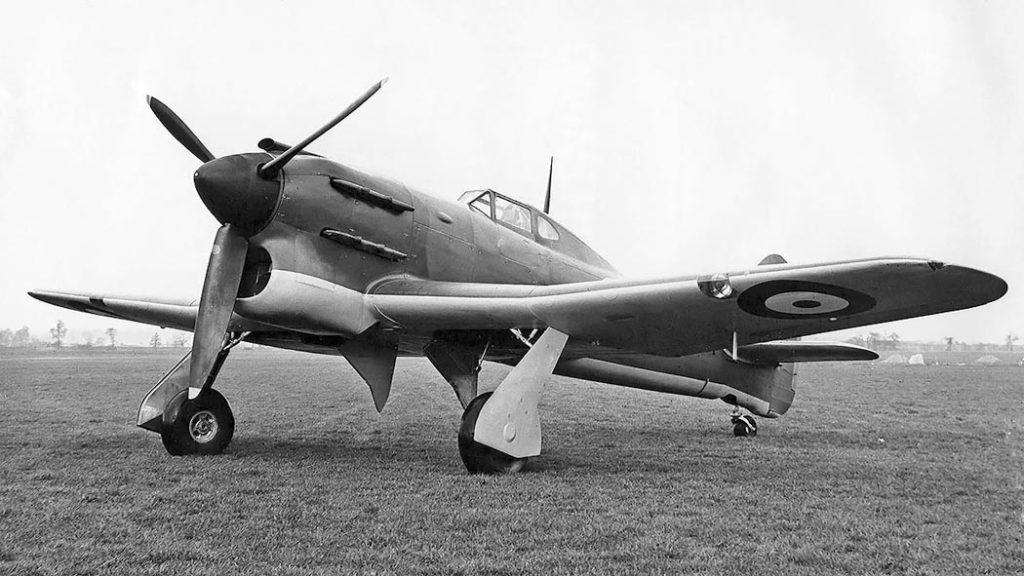
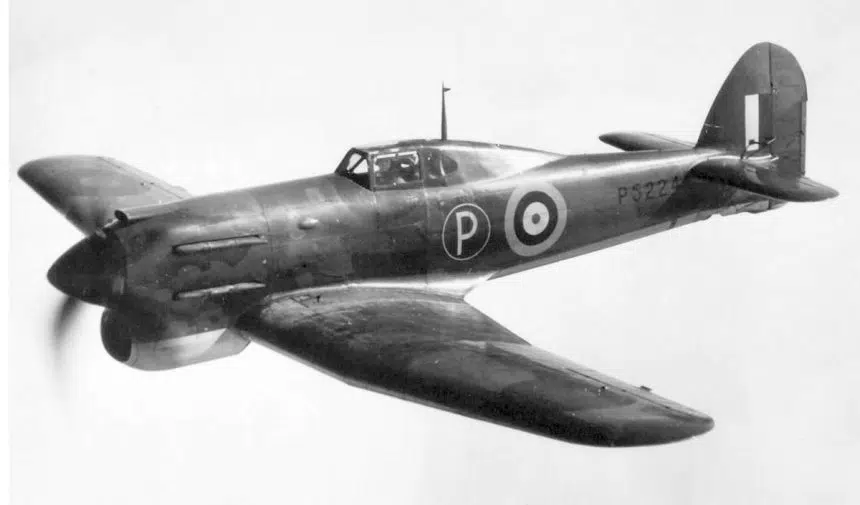
Both prototypes looked similar to the Hurricane and used some of the same construction methods. They had a front fuselage made from a swaged and bolted duralumin tube structure developed by Sydney Camm and Fred Sigrist in 1925. The new design featured side-opening doors for easy entry and a large 40 ft wing thicker than the wings of planes like the Supermarine Spitfire. Unlike the Hurricane, the rear fuselage, from behind the cockpit, used a duralumin semi-monocoque structure with flush rivets. The all-metal wings housed the wide-track, inward-retracting main undercarriage legs and wheel-bays. The two models were quite alike; the R plane had a rounder nose and a ventral radiator, while the N model had a flatter deck and a chin-mounted radiator. The fuselage of the Tornado, in front of the wings, was 12 in longer than the Typhoon’s, and its wings were mounted 3 in lower on the fuselage. The Vulture’s X-24 cylinder configuration required two sets of exhaust stacks on each side of the cowling, and the engine had to be placed farther forward than the Sabre to clear the front wing spar. On October 6, 1939, P.G. Lucas flew the first prototype of the aircraft, P5219. Flight tests showed airflow issues around the radiator, so it was moved to a chin position. Other changes included a larger rudder and an upgrade to the Vulture Mark V engine. Hawker’s production lines were busy with the Hurricane, which delayed the completion of the second prototype, P5224. This prototype featured the chin radiator, added window panels behind the cockpit, and replaced the twelve .303 in machine guns with four 20 mm Hispano cannons.
The Cancellation

It first flew on December 5, 1940, using a Vulture II engine. However, like the first prototype, it was later fitted with a Vulture V. To avoid disrupting Hurricane production, the company subcontracted work to Avro in Manchester and Cunliffe-Owen Aircraft in Eastleigh. In 1939, it ordered 1,760 aircraft from Avro and 200 from Cunliffe-Owen. However, only one aircraft, serial R7936 from Avro, was built and flown. It took its first flight at Woodford on August 29, 1941. Soon after, the Vulture program was abandoned, and the Hawker Tornado order was canceled. At that time, four aircraft were at different stages of production at the Avro factory near Leeds. Rolls-Royce canceled the Vulture engine in July 1941 because of problems using it on the Avro Manchester, and mostly because they wanted to focus on developing the Merlin engine. The Rolls-Royce Merlin was beginning to provide similar power levels. However, installing the Vulture engine in the Hawker Tornado was mostly successful, and the Tornado had fewer flight issues than the Sabre-engined version. In February 1942, a contract was made to convert one Tornado prototype to use the Centaurus sleeve-valve radial engine. It took its first flight on October 23, 1941, powered by a Centaurus CE.4S engine. This Hawker Tornado was built from two incomplete production frames (R7937 and R7938). It tested different combinations of the Centaurus engine and propeller. This prototype eventually led to the Hawker Tempest II, of which nearly 1,700 were built. In the Grounded Dreams series, the Hawker Tornado itself wasn’t a success, but it paved the way for the Tempest. Read more Grounded Dreams articles HERE.