

In 1941, successful tests of Britain’s first jet-powered aircraft, the Gloster E.28/39, generated interest in the use of the new technology in fighter planes. In 1942, work began on a larger twin-engine fighter that would become the Gloster Meteor, the first Allied jet fighter. The British company Rover, contracted to produce the Power Jets W.2 jet engine, struggled to make enough engines during the war. The Air Ministry became concerned about the production issues this caused. It saw the benefit of a single-engine fighter instead of the twin-engine Meteor and issued Specification E.5/42 to design and build such an aircraft. To meet this requirement, Gloster designed a low-wing monoplane with a sharply tapered wing, a T-tail, and a tailwheel undercarriage. It was intended to be powered by either a Halford H.1 or a Rolls-Royce Nene engine, with intakes in the wing roots. In late 1943, construction began on two prototype GA.1 aircraft. Manufacturing problems were solved by Rolls-Royce Limited trading jet engine production with Rover for Meteor tank engine production, which helped solve the problems. However, interest in a single-engine design faded, and the GA.1 was no longer needed. Gloster decided to continue developing the design privately and planned to use a Halford H.1 engine instead of the W2/Welland engine. In 1944, the Air Ministry issued Specification E.1/44 for a new experimental jet aircraft powered by the Rolls-Royce Nene engine.

Design of Gloster E.1/44
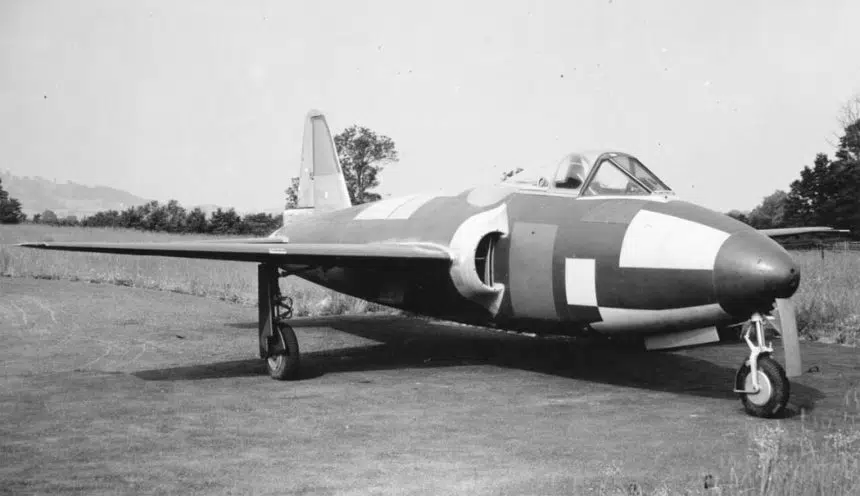
Gloster’s design team decided to develop a new design, called GA.2, which was larger than their earlier model, E.5/42. Later in 1944, after reviewing different designs, the Air Ministry awarded Gloster a contract for a prototype. By late 1945, it added more orders for three additional aircraft. The Gloster E.1/44 was a sturdy mid-wing monoplane with a strong fuselage and wide landing gear. It looked different from the twin-jet Meteor and shared only some similarities with the earlier E.28/39 model. The Gloster E.1/44 was larger and heavier than the E.28/39. Instead of drawing air through the nose like the E.28/39, the E.1/44 used a pair of semi-circular air intakes located in front of the wing roots for its Nene engine. The tailplane was positioned midway up the rear fuselage, below the single fin and rudder. Unlike the earlier E.5/42, the Gloster E.1/44 had widely spaced tricycle landing gear. The E.1/44 had a wide body made in sections. The front section connected to the central section with four longerons. The central fuselage had strong Z-shaped frames and heavy double-channel frames. It housed the Nene engine and had attachment points for the wing center. On the sides of the central section, air intakes included boundary-layer bleeds and could be removed easily. The rear fuselage used a semi-monocoque design, supported by Z-shaped frames and top-hat stringers. The tail section was also detachable and had a similar structure. Most of the tail unit was made from metal and designed to be strong. However, the upper part of the fin was made of wood for insulation. Rivets held the different sections together.

The Cancellation
Progress on the new fighter was slow because Gloster focused on the twin-engine Meteor. The first prototype was not finished until July 1947. The project faced a setback when the prototype was destroyed in a road accident while being transported to RAF Boscombe Down for flight testing. The second prototype of the Gloster E.1/44 was the first to fly. On March 9, 1948, it took its first flight at RAF Boscombe Down, with Gloster Chief Test Pilot Bill Waterton at the controls. Waterton did not think highly of the aircraft, noting its weak power and poor flying ability, calling it the “Gormless.” Although this name did not become popular, the prototype was never officially named, despite a suggestion of “Ace” at one time. After its first flight, the second prototype went to RAF Moreton Valence in Gloucestershire for more test flights. Initial flight tests showed the aircraft handled poorly, so designers installed a new tail unit with a high-mounted tailplane. The change improved handling, but the aircraft’s performance was still not much better than the existing Meteor. The lack of potential for further development was a key reason the test program ended in 1949. The fourth prototype, TX150, was never finished. Other aircraft used some of its design features. The tail design updated for the Gloster E.1/44 was also used in the Meteor, specifically in the Meteor F 8 and later models. After the program ended, the two aircraft that flew continued to be used for testing for a while before they were scrapped. Reports indicate that at least one of these prototypes still existed as late as 1951. In the Grounded Dreams series, the Gloster E.1/44 proved to be an underpowered fighter but still helped in collecting some data on flight characteristics. Read more Grounded Dreams articles HERE.