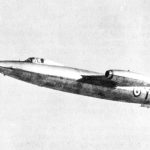
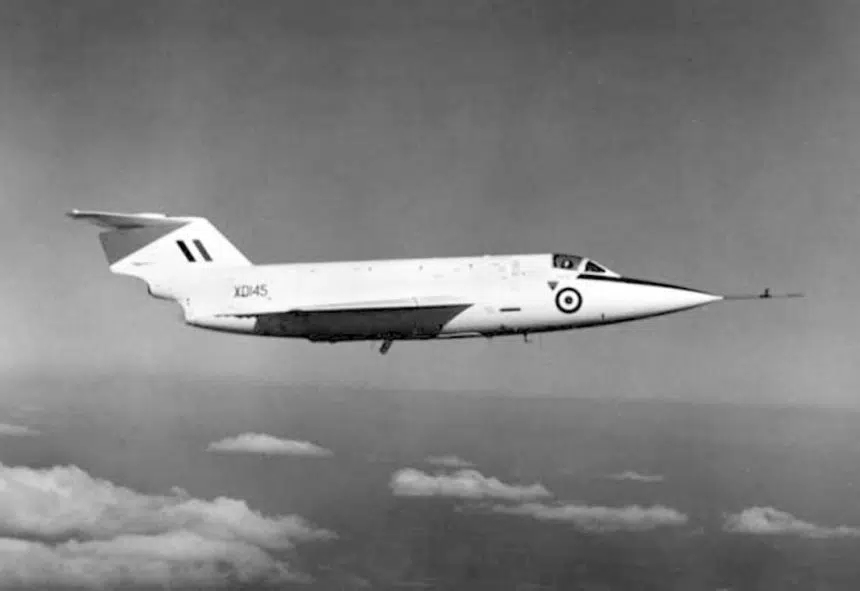


In 1951, the British Air Ministry became concerned about the growing threat from the Soviet strategic bomber fleet and its new atomic weapons. It created Operational Requirement OR 301 for a rocket-powered interceptor needed to reach an altitude of 60,000 feet in just 2 minutes and 30 seconds. The requirements stemmed from fears that Soviet bombers would soon become faster. By the early 1960s, it was believed these bombers could fly at speeds up to Mach 2 and altitudes as high as 80,000 feet. Saunders-Roe submitted its detailed proposal for a new single-seat aircraft called the SR.53. The aircraft was designed to reach very high speeds, with a projected top speed of Mach 2.44 at an altitude of 60,000 ft. It could climb at 52,000 ft per minute. The aircraft could use an auxiliary disposable undercarriage for takeoffs, along with cordite-based booster rockets. In emergencies, the original design included a jettisonable cabin to help the pilot escape. However, the engineers later changed this to a standard ejection-seat setup. The company realized that the original concept of an unpowered ‘glide home’ would be dangerous and expensive. They suggested fitting a second jet engine to push the plane on its way back. The Air Ministry was interested and in May 1951 asked all interested companies to look into the arrangement. The SR.53 was a sleek aircraft with a pointed nose, delta-shaped wings, and a T-tail. It was powered by a single Armstrong Siddeley Viper turbojet engine and a de Havilland Spectre rocket engine. The exhausts were stacked one on top of the other at the back of the fuselage, below the tail.
Design of Saunders-Roe SR.53
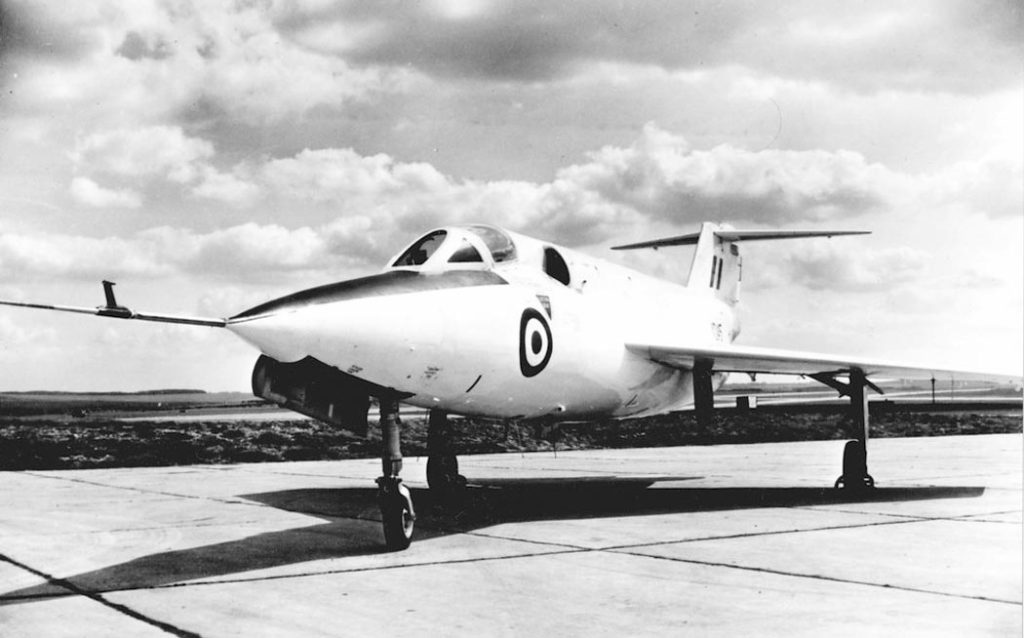
Originally, Saunders-Roe planned to build its own rocket motor for the Saunders-Roe SR.53 because it was dissatisfied with the performance of the Spectre or Screamer engines. However, it realized that developing its own engine would take a lot of time and effort. By October 1952, the company had finalized the aircraft’s basic design. The company replaced the combined flaps and ailerons from earlier designs with slotted flaps. The company moved the Viper engine higher and fitted it with a straight jet pipe instead of a bifurcated one. The company also moved the tailplane higher, to the top of the fin. On October 30, 1952, the company received permission from the Ministry to complete three prototypes. On December 12, 1952, further design improvements led to the release of Specification OR 337. The main changes in this specification involved the armament, which now included the Blue Jay infrared-guided air-to-air missile, replacing the originally planned retractable battery of 51-millimeter rockets. During the first four months of 1953, Saunders-Roe had to redesign the SR.53’s fuselage, wing, and undercarriage. The change was necessary because the Royal Aircraft Establishment found that the wing needed a greater anhedral angle than originally designed. Of the six companies that submitted proposals, the Avro 720 from A.V. Roe and the Saunders-Roe SR.53 were selected to compete further. By September 1953, the plan to develop these aircraft came under scrutiny because of the need to cut costs. As a result, the contract for the Avro 720 was canceled.
The Selection

One reason for choosing the SR.53 over the Avro 720 was that, even though the SR.53 was behind in development, its use of hydrogen peroxide as an oxidizer was seen as safer than the Avro 720’s use of liquid oxygen, which posed a fire hazard. The RAF preferred the HTP approach used by the Saunders-Roe SR.53 because it did not want to support two different fuel programs. However, this reasoning is weakened by the fact that Avro had suggested switching to HTP and using the Spectre engine, the same engine used by the Saunders-Roe SR.53. Another reason for the cancellation was the RAF’s hesitation to support either project. The RAF wanted to wait until flight evaluations were complete before deciding on its preference. On June 28, 1956, the team sent the first prototype, XD145, to the Airplane and Armament Experimental Establishment at RAF Boscombe Down for assembly. On January 16, 1957, the team performed the first ground run of its Spectre engine. Then, on April 16, 1957, it conducted the first ground run of its Viper engine. On May 9, 1957, XD145 took part in its first ground taxiing trial. On May 16, 1957, Squadron Leader John Booth DFC flew XD145 for the first test flight. He then flew the second prototype, XD151, on December 6, 1957. Test results showed that the aircraft was very easy and enjoyable to fly, with controls that worked well together. Both prototypes completed 56 test flights, reaching speeds of Mach 1.33.
The Cancellation

During testing at RAE Boscombe Down, the aircraft XD151 crashed on June 5, 1958. It happened during its 12th flight when the pilot had to abort the takeoff. The plane ran off the runway and hit a concrete approach light, causing an explosion on impact. The pilot, Squadron Leader Booth, was killed. The other prototype continued flying, with Lt Cdr Peter Lamb taking over the flight tests. The first Saunders-Roe SR.53 flew in 1957, just over a month after the 1957 Defence White Paper was published. The paper outlined the British government’s plan to move away from piloted aircraft and focus on missile development. At the same time, jet engine technology had improved over the six years since the SR.53’s design began. Improvements in radar also meant that threats from enemy bombers could be detected much earlier. Because of these advancements, the need for a plane like the Saunders-Roe SR.53 faded away, and the project was canceled on July 29, 1960. As a result, the third prototype (XD153) was never built. In the Grounded Dreams series, the Saunders-Roe SR.53 performed well during test flights, but advances in surface-to-air missile technology changed the need for this aircraft. Read more Grounded Dreams articles HERE.