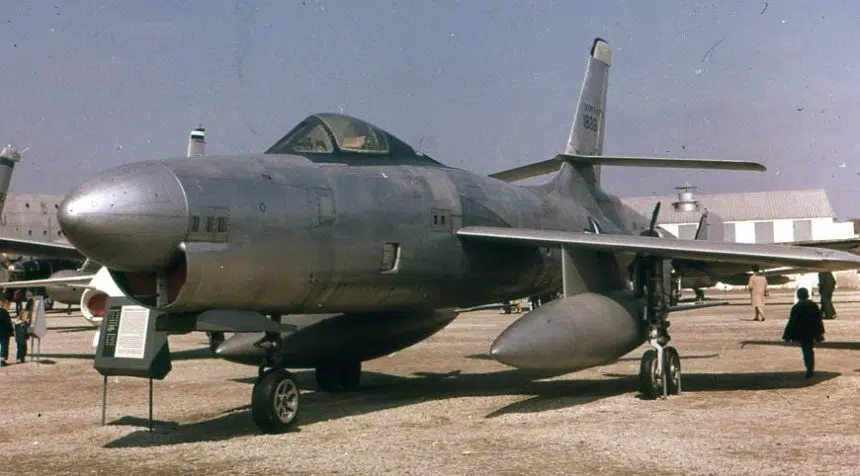


During the development of the XP-84, Republic’s Alexander Kartveli investigated adding rockets to fighters. The company utilized German military aircraft, especially the rocket-powered Messerschmitt Me 163 and the experimental rocket-boosted turbojet Messerschmitt Me 262C, built as interceptor prototypes. As a result, the company developed the Republic XF-91 Thunderceptor. The Thunderceptor design was one of two modified versions of the original Republic F-84 Thunderjet. The other version is the Republic F-84F Thunderstreak, which came later. A major issue with most swept-wing designs at that time was their dangerous performance at low speeds and high angles of attack. The airflow over the wing did not flow smoothly and tended to move toward the wingtips. It caused the wingtips to stall before the rest of the wing. As a result, lift moved forward of the center of mass, causing the nose to pitch up. This could increase the angle of attack and, in some cases, cause the aircraft to tumble end over end. In such cases, the planes often stall and crash. It caused several accidents with the North American F-100 Super Sabre. They called the phenomenon the “Sabre dance.” The Thunderceptor’s main design feature was to solve a particular problem. The wings were wider at the tips than at the base, which helped them create more lift.
Design of Republic XF-91 Thunderceptor
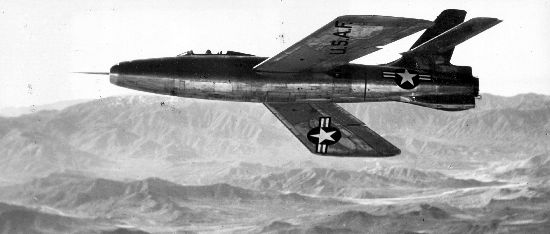
The design change helped stop a problem called Sabre dance by moving the stall point at the tips of the wings back to match the rest of the wing. It also created more space inside the wings, allowing the landing gear to retract outwards, with the wheels positioned at the tips. The setup used two smaller wheels together on each main gear strut instead of one larger wheel. Another improvement was the ability to change the wing’s angle of incidence. During takeoff and landing, the wings could tilt up for better low-speed operation. Then they would level off for high-speed flight. It kept the fuselage more level during landing, greatly improving visibility. To serve as an interceptor, the nose was redesigned to include a radar antenna. The change meant moving the engine’s air intake from the front of the nose to a new location below it. The rest of the fuselage was very similar to the F-84. The first Republic XF-91 Thunderceptor prototype flew for the first time on May 9, 1949, and it broke the sound barrier in December 1951. This prototype was later updated with a small radome to help with gunnery ranging, though it lacked the full radome found on the second prototype. The second prototype featured a full radome and a chin-mounted intake, but it was mostly similar to the first. With both the jet and rockets working, the aircraft could reach Mach 1.71. Over five years, both prototypes completed 192 test flights. In the summer of 1951, the second prototype experienced an engine failure while taking off from Edwards Air Force Base. Republic test pilot Carl Bellinger escaped just as the aircraft’s tail melted off 90 seconds into the flight.
The Cancellation
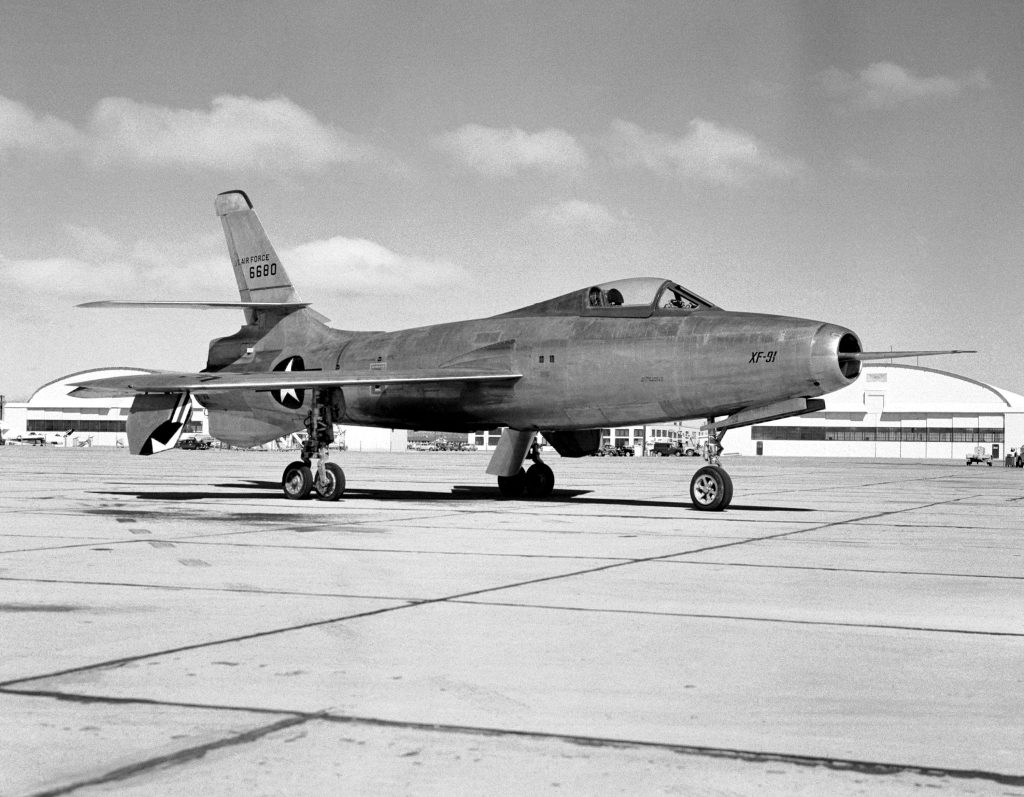
By the time the fire team arrived, after driving seven miles across the dry lake bed, the tail section had burned to ashes. The plane was later modified with a “V” tail and tested again in this new design. Eventually, it served as a training simulator for crash crews at Edwards AFB before it was scrapped. Designs from other companies soon outperformed the Republic XF-91 Thunderceptor, but like the Thunderceptor, none of these new models went into production. The United States Air Force chose to wait a short time to introduce newer, better designs from the 1954 interceptor project. The Republic XF-91 Thunderceptor, like other interceptor designs of the time, had very short flight times of about 25 minutes, making it nearly useless for protecting a large area like the United States. The 1954 designs were faster, had a longer range, and could stay in the air longer. They also included the radar and fire-control systems needed for night and all-weather operations. The surviving Republic XF-91 Thunderceptor prototype is on display in the Research & Development Gallery at the National Museum of the United States Air Force, located at Wright-Patterson Air Force Base in Dayton, Ohio. Read more Grounded Dreams articles HERE.