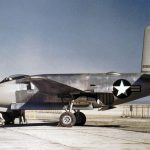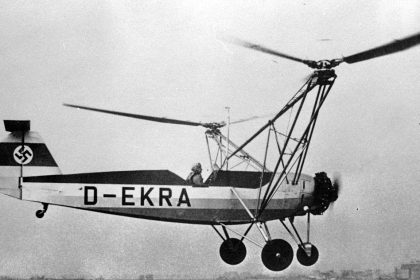
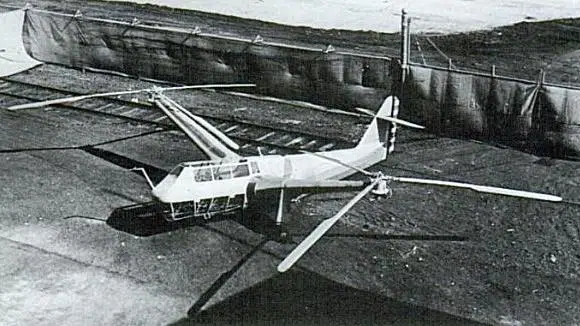


In 1939, Platt-LePage Aircraft Company developed the Model PL-3, later called the Platt-LePage XR-1 by the US Army, from an earlier design that had not succeeded, the PL-1. In 1940, it won a design competition established by the Dorsey-Logan Act to develop a helicopter for the United States Army Air Corps. The Army judged the Platt-LePage design to be better than its competitors, which included a helicopter from Vought-Sikorsky and autogyros from Kellett and Pitcairn. After selecting the Platt-LePage design in May 1940, the Army issued a contract in July to build a prototype and a static test airframe. The contract required the flying prototype to be delivered by January 1941. However, the plane was finished three months late. The XR-1 design resembled the Focke-Wulf Fw 61 helicopter, developed by Heinrich Focke in Germany. The XR-1 was powered by a Pratt & Whitney R-985 radial engine mounted inside the fuselage. It had two rotors, each with three blades, arranged side by side on wing-like supports. The Platt LePage XR-1 was a conventional layout with a steel-tube structure and fabric covering. It had a tail like a normal airplane and a fixed taildragger landing gear setup. The wheels could turn freely for easier maneuvering on the ground. The cockpit of the Platt LePage XR-1 was to contain two crew members in tandem, with the pilot in front. The cockpit had large windows for good visibility, as the aircraft was meant for observation and army cooperation.
Design of Platt LePage XR-1

During its development, Major General Robert M. Danford suggested that the War Department test the Platt LePage XR-1 against the Stinson YO-54 and the Kellett YG-1B autogyro. After several months of ground testing, the Platt LePage XR-1 had its first flight on May 12, 1941, but it was tethered during these early flights. On June 23, the aircraft flew freely for the first time, though it stayed close to the ground. As testing continued, the Platt LePage XR-1 encountered control problems, making the aircraft difficult to handle. The design also had resonance problems that induced pilot-induced oscillations. Even after modifying the aircraft, the problems continued. The company’s test pilot, Lou Leavitt, was not confident in the aircraft and would not push it to its limits. The situation changed when Colonel H. Franklin Gregory, who directed rotor-wing projects for the Army Air Forces, flew the aircraft himself. On his first flight, he reached 100 mph. Most of the major problems were fixed, and in 1943 the Platt LePage XR-1 aircraft was submitted to the Army Air Forces for testing. The tests broke the tail section of the XR-1, which required repairs and surface hardening. Testing resumed in 1944, and the XR-1, despite modifications, still had flight control problems. In July 1943, the aircraft crashed, injuring test pilot Jim Ray. The crash happened because an inspector mistakenly left a faulty part on the aircraft, causing the rotor hub to fail during flight. While the Platt LePage XR-1 was repairable, it took a year to get it ready to fly again.
The Testing

Testing continued while Platt-LePage renegotiated the Platt LePage XR-1 contract to include a second flight-test aircraft. The new aircraft, called the XR-1A, was built based on an improved version of the XR-1 design and had its first flight in May 1943. The XR-1A had a new cockpit design with more windows for better visibility, and the pilot and observer positions were reversed, with the pilot now seated in the rear cockpit. During testing, the XR-1A performed better in the air than the Platt LePage XR-1. However, the controls still had some issues, though most major problems seemed to have been resolved. After a flight from Platt-LePage’s factory in Pennsylvania to Wright Field in Ohio, testing of the XR-1A continued. However, on October 26, 1944, a mechanical failure in the rotor hub caused it to crash-land. The company decided to sell the wreckage for scrap. Meanwhile, the XR-1 was repaired and flying again. Platt-LePage received a contract to build seven pre-production aircraft based on an improved version of the XR-1A, called the YR-1A. The decision was influenced by Congress, which was concerned about possible favoritism towards Sikorsky Aircraft. Sikorsky had been awarded a contract for an upgraded version of their VS-300 helicopter. The contract required the first YR-1A to be delivered to the Army in January 1945. However, due to ongoing financial issues and flight testing problems, Platt-LePage was unable to meet this deadline. By the end of 1944, the problems with the Platt LePage XR-1 helicopter were almost solved. But the long development time meant that better helicopters, such as Sikorsky’s XR-4, were coming along. The XR-4 was cheaper and more maneuverable than the Platt LePage XR-1.
The Cancellation

Even after improvements, the XR-1A still had control and vibration problems. The Army Air Forces’ Air Materiel Command criticized the company for being “inept” and using a random approach to research and development. Because of this assessment, the Army canceled all contracts with the company in early April 1945. After the Army canceled the program’s remaining contracts, Platt-LePage took back the XR-1, believing it could be developed as a civilian aircraft. The company planned to create a civilian version called the PL-9, which would be larger and have two engines. However, Platt-LePage was facing serious financial problems after losing the Army contract. By mid-1946, they ended the flight test program for the Platt LePage XR-1, and the aircraft was sent to the Smithsonian Institution. Meanwhile, Lou Leavitt, a former test pilot for the company, bought the wreckage of the XR-1A for just 4 cents per pound. Leavitt, who was flying for Helicopter Air Transport (HAT), aimed to prepare the XR-1A for flight in hopes of a postwar aviation boom. However, this boom did not happen, and HAT soon went bankrupt. The company sold the XR-1A to Frank Piasecki, another ex-Platt-LePage employee who had started his own helicopter company. Leavitt flew the helicopter to Piasecki, who never flew it because he had concerns about its safety. Instead, he used the airframe to work on the PA-2B, a planned tiltrotor that never went beyond the mock-up stage. In the Grounded Dreams series, the Platt-LePage XR-1 was a good aircraft that learned from its mistakes, but it took too long to do so. Read more Grounded Dreams articles HERE.