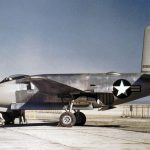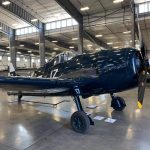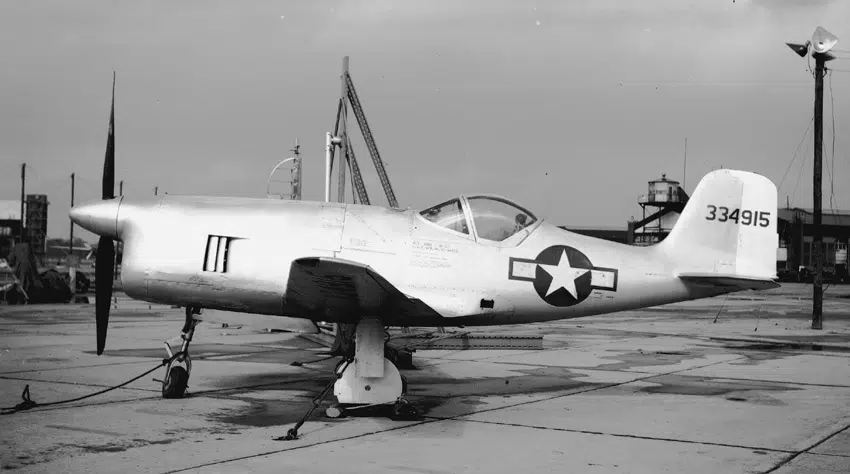


In WWII, the US Army Air Forces sought to develop a lightweight fighter plane using non-strategic materials. As a result, the Bell XP-77 program began at Bell Aircraft Corporation in October 1941. The aim was to produce a small, lightweight fighter based on the 1930s Thompson Trophy air racers. On May 16, 1942, the US Army Air Forces recommended the building and testing of 25 XP-77s. The Bell XP-77 was a low-wing monoplane with a single engine and was mostly made of wood. It had tricycle landing gear, which improved ground handling. The aircraft featured a bubble canopy that offered good visibility, except for the view directly in front due to its long nose. The Bell XP-77 fighter plane was initially planned to use a powerful air-cooled 500 hp (370 kW) Ranger XV-770-9 12-cylinder engine with a supercharger. However, due to delays in engine development, the prototypes were built with a non-supercharged XV-770-7 engine instead. Since the original engine would not be available for another 1.5 years, Bell suggested building seven XP-77s using the available XV-770-7 engines.
Design of Bell XP-77

The planned weapons for the Bell XP-77 included one Hispano 20 mm cannon that fired through the propeller hub, similar to the 37 mm cannon used in the P-39 Airacobra. It was also envisioned to have two 12.7 mm M2 Browning machine guns. Alternatively, there was an option to carry either a 300-lb bomb or a 325-lb depth charge if the cannon was removed. An inspection of the mockup on September 21-22, 1942, showed problems for both the manufacturer and the USAAF inspection team. The weight had exceeded the 3,700-lb design limit, and the program was already facing delays. Bell had subcontracted the wooden construction because its own facilities were not adequate for the Bell XP-77 research and development due to ongoing production demands. Bell requested and received permission to reduce the production run to two prototypes. Problems arose when the subcontractor for the wing assembly changed, and the first subcontractor wouldn’t release key parts. The glue wouldn’t hold the parts together, so it was hard to trust the plane’s structural integrity. Worried about going over budget and lacking hope for the supercharged engine to be ready, the USAAF decided to keep the project going only to test wooden construction in fighter planes.
The Cancellation

The first Bell XP-77 flew on April 1, 1944, at Wright Field, but flight tests revealed vibration problems caused by the engine being mounted directly to the airframe without shock absorbers. Also, the long nose and cockpit at the rear of the aircraft reduced visibility compared with other planes of that period. The Bell XP-77 was difficult to fly and didn’t perform as expected, mainly because it lacked power, guns, or armor. Further tests were conducted at the USAAF Proving Ground at Eglin Field using a second aircraft. The aircraft was destroyed on October 2, 1944, when it entered an inverted spin during an Immelmann maneuver, and the pilot had to bail out. All development of the Bell XP-77 ended in December 1944. After the program was canceled, the prototype went to Wilbur Wright Field, then to Eglin Field, and back to Wright. The aircraft appeared at several air shows before being sent to an unknown air base to serve as a gate guard. It was on display for several years but eventually deteriorated and was burned. In the Grounded Dreams series, the Bell XP-77 was a practical plan that was canceled by delays and engine issues. Read more Grounded Dreams articles HERE.