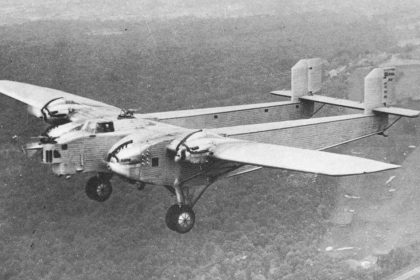
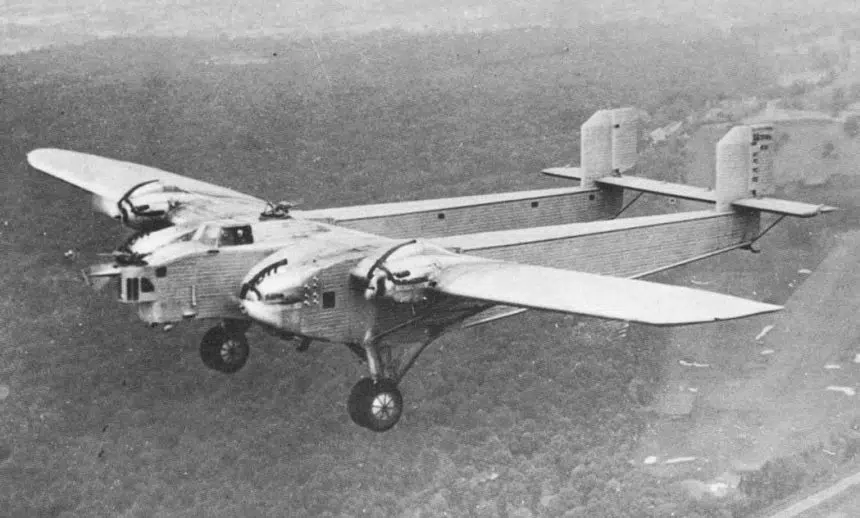

In the 1930s, the Société Aérienne Bordelaise (SAB) developed a four-engine night bomber version of the three-engine Dyle et Bacalan DB-70 airliner, the SAB AB-20. After the bankruptcy of Dyle et Bacalan in 1929, the company changed its name. It re-emerged as SAB, which continued development of the DB-70. The DB-70 had a wide, thick center section, with plenty of room for passengers. This structure carried the engines and the twin tail fuselages. The outer wings were of regular thickness, and the cockpit and undercarriage were also attached to the center section. The spacious area between the wings could also hold crew, fuel, and a bomb-room for military use. The SAB AB-20 was originally meant to have three engines like the previous model, but during the design process, the military requested a bombardier’s position and a gunner’s cockpit in the nose, which required removing the center engine and adding two extra engines on the wings outside of the center section.
Design of SAB AB-20

The SAB AB-20 and DB-70 shared several features despite their extra engines, different crew areas, and lack of passenger space. Both had a thick center section and outer wings mounted high, twin fuselages with a long horizontal stabilizer, twin fins and rudders. Additionally, both aircraft used conventional landing gear with widely spaced pairs of main wheels on V-struts attached to the lower longerons of the center section. The new central crew pod had flat sides and tapered forward to a complex cylindrical nose. The nose included a simple lower part with a windowed cabin for the navigator/bombardier. Above this cabin was an open gunner’s cockpit, equipped with a machine gun ring. A long, conical probe on the nose had fine extensions that may be pressure sensors. Further back was an enclosed pilot’s cabin. A second gunner sat on top of the center section, and a third gunner operated from a turret underneath the pod. The SAB AB-20 first flew on January 15, 1932. The next year, it was reported that the plane had been modified for attack purposes and was returning to Villacoublay for testing.
The Cancellation

By early 1934, an improved version, the AB-21, was released. It featured modern V-12 Lorraine Petrel water-cooled engines and had a tapered, sleek wing design without the struts found on the earlier SAB AB-20 and DB-70 models. The undercarriage was also streamlined, with legs and wheels enclosed in long cowls. The nose design became more complex, keeping the open gunner’s position on top and adding double underhanging windowed positions, but removing the conical probe. Tests were conducted on a 75 mm gun designed to fire sideways in flight, using a modified version of the SAB AB-20 prototype called the AB-22. The firing tests stopped after the gun’s blast damaged the lower wing skin. In the Grounded Dreams series, the SAB AB-20 proved bulky and slow, making it vulnerable to enemy fighters, and was canceled. Read more Grounded Dreams articles HERE.