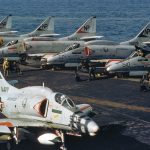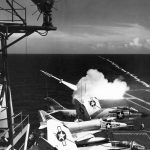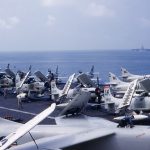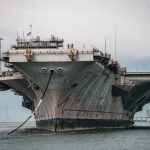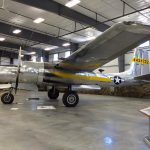


Attack Squadron 145 (VA-145), originally named the “Rustlers” and later the “Swordsmen,” was one of the longest-serving attack squadrons in the US Navy after WWII. It started as Reserve Squadron VA-702 on December 1, 1949, was called to active duty in July 1950, and became VA-145 on February 4, 1953. VA-702 began combat during the Korean War and completed its first mission on March 27, 1951, providing close air support. By September, the situation on the ground changed, leading carrier squadrons to focus less on close air support and more on attacking enemy facilities. The squadron continued to operate in the region, including a deployment aboard the USS Boxer in the Taiwan Strait in April 1951. On October 16, 1952, Commander B. T. Simonds, the squadron’s commanding officer, died when his aircraft crashed into the water right after taking off from the USS Kearsarge. Attack Squadron 145 remained active through the 1950s, including a 1958 deployment aboard the USS Ranger. During this mission, the carrier traveled from Norfolk, went around Cape Horn, and arrived at its new home port in Alameda. In July 1959, the squadron was near Taiwan while the Ranger operated off the island. It was during a time of rising tensions between the Chinese Nationalists and Communist forces. At the time, Attack Squadron 145 had used the Douglas A-1 Skyraider for years, starting with the AD-2 model in 1950. The Skyraider became central to the squadron’s identity until the A-6 Intruder arrived nearly 20 years later.

Attack Squadron 145 joined the conflict in Southeast Asia in the early 1960s. From June 1964 to January 1965, its Skyraider aircraft flew missions to rescue pilots in South Vietnam and Laos under Operation Yankee Team. In August 1964, the squadron’s situation worsened. After the Gulf of Tonkin incident, VA-145 took part in Operation Pierce Arrow on August 5. It attacked targets in North Vietnam, and its Skyraiders targeted torpedo boats at Hon Gay and enemy naval vessels near the Lach Chao Estuary and Hon Me Island. During this operation, Lieutenant (jg) Richard C. Sather was shot down and killed. He became the first US Navy pilot killed in the Vietnam War. The squadron flew some of the toughest missions of the war. On January 31, 1966, Commander H. F. Griffith received the Silver Star for leading attacks against a heavily defended enemy supply route during difficult weather. He also took part in the rescue of a downed naval aviator. The next day, Lieutenant (jg) Dieter Dengler from Attack Squadron 145 was shot down over North Vietnam. He was captured in Laos and held by the Pathet Lao, but he escaped on June 30, 1966, and returned to his squadron on July 21. His escape earned him the Navy Cross. The rescue mission was central to the Swordsmen’s service in Vietnam. From June to November 1967, the squadron spent 120 days on Yankee Station and helped recover 14 downed Navy and Air Force pilots.

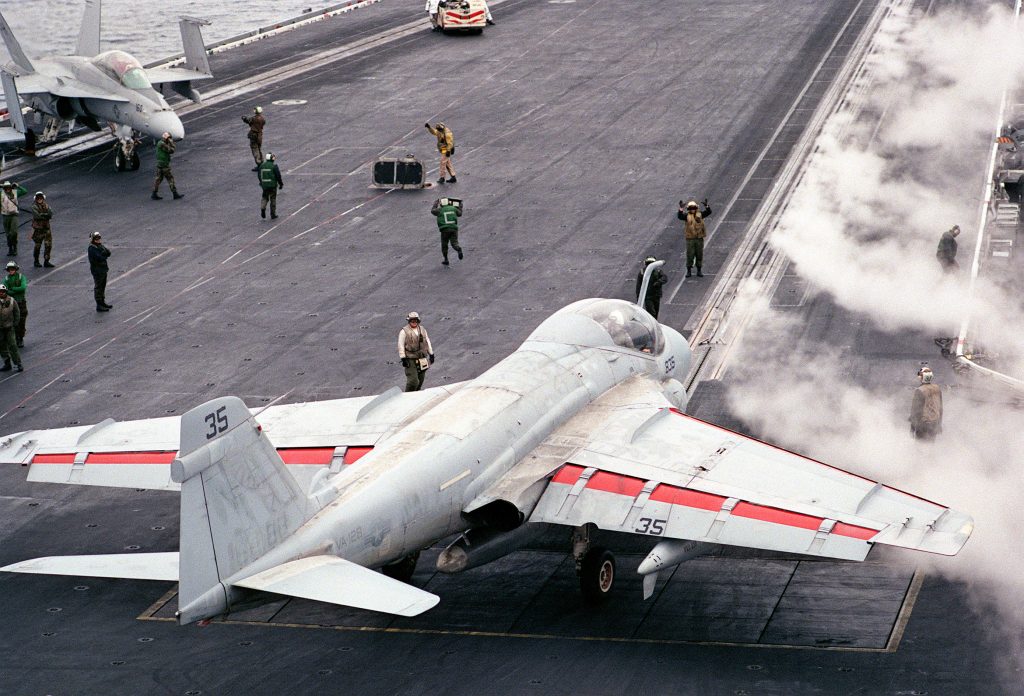
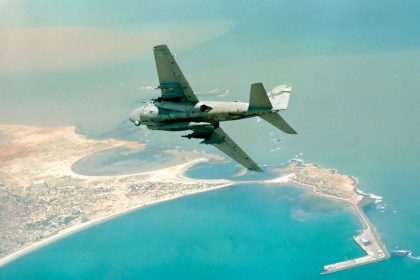
VA-145’s long history with the Skyraider ended as the Navy started using more advanced jet attack planes. On June 4, 1968, the squadron received the Grumman A-6A Intruder, followed by the A-6B in August. Later models included the A-6C, the KA-6D tanker, and the A-6E, which gave the Swordsmen strong all-weather strike capabilities. The new aircraft kept the squadron on the front line. In April 1969, USS Enterprise, with VA-145 on board, was redirected from Yankee Station to Korean waters after North Korea shot down a Navy EC-121 reconnaissance plane. The squadron flew missions over the Sea of Japan and Yellow Sea until May 11. Attack Squadron 145 returned to intense combat during Operation Linebacker II in December 1972, targeting areas around Hanoi and Haiphong. On January 15, 1973, the squadron led a significant laser-guided bombing operation against North Vietnam. Attack Squadron 145’s A-6s used the Pave Knife system to guide attacks along with A-7 Corsairs from other Navy squadrons. This operation destroyed 14 bridges. After the January 1973 ceasefire with North Vietnam, the Swordsmen focused on Laos. The squadron focused on communication routes until they reached a settlement. It also carried out some missions to help Operation End Sweep, which aimed to clear mines from North Vietnamese waters. The Swordsmen demonstrated that carrier aviation could adapt even after the Vietnam War. In July 1976, the USS Ranger, which carried Attack Squadron 145, moved from the South China Sea to the western Indian Ocean, followed by the Israeli raid on Entebbe and the rising tensions between Uganda and Kenya.

More than ten years later, Attack Squadron 145 took part in Operation Earnest Will, which aimed to protect Kuwaiti oil tankers in the Persian Gulf in 1987. In October of that year, the squadron also supported Operation Nimble Archer. It was the US response to an Iranian oil platform that small boats used to attack shipping. In August 1989, one aircraft from the squadron spotted a Vietnamese refugee boat in trouble. It led HS-14 and USS Ranger to rescue 39 refugees. Attack Squadron 145’s last major combat operation was during Operation Desert Storm. On January 15, 1991, Ranger positioned itself in the Persian Gulf. From January 16 to February 28, the Swordsmen flew combat missions against Iraqi and Kuwaiti targets. The squadron completed 621 combat missions, attacking both land and sea targets. The squadron reportedly destroyed 33 tanks, 48 artillery pieces, 41 Iraqi naval vessels, 20 ammunition bunkers, three chemical weapons storage sites, seven command-and-control sites, and a bridge. The squadron had no personnel losses or aircraft damage during this operation. The Swordsmen squadron continued their missions after Desert Storm. In 1992, their planes supported Operation Southern Watch, which enforced the no-fly zone over southern Iraq. In December, they supported Operation Restore Hope in Somalia, part of the global effort to address widespread hunger caused by fighting between factions. By then, Attack Squadron 145 had changed from the Skyraider attack squadron that fought in Vietnam. It used A-6E TRAM aircraft, which were introduced in 1981. These planes had advanced targeting abilities and could carry weapons like the Harpoon anti-ship missile. After more than forty years of service, Attack Squadron 145 was disestablished on October 1, 1993.