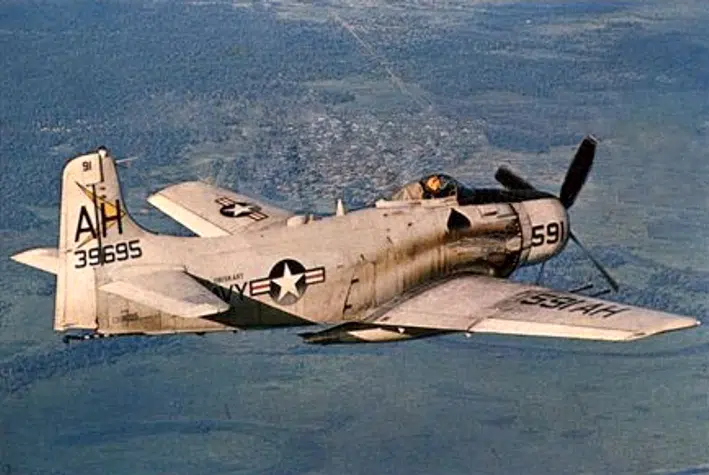

Attack Squadron 152 (VA-152) was a US Navy attack squadron that served during the Korean War, the Taiwan Strait crises, and the Vietnam War. It was known as the “Fighting Aces” from 1953 to 1956, the “Friendlies” from 1957 to 1968, and the “Mavericks” after that. It started as Reserve Fighter Squadron VF-713 in the late 1940s. The squadron was called up for active duty on February 1, 1951, renamed VF-152 in 1953, and became VA-152 on August 1, 1958. Attack Squadron 152 started its combat missions on October 15, 1951, during the Korean War. The squadron flew F4U-4 Corsairs and later FG-1D aircraft from the USS Antietam. One unusual mission happened on December 31, 1951, during Operation Pin Wheel. The aircraft’s engines were kept running while secured on the flight deck, using their thrust to help the Antietam dock. After the Korean War, the squadron continued to operate in the Pacific. In February 1955, its aircraft flew night surveillance missions to support the evacuation of Chinese Nationalist forces from the Tachen Islands during the First Taiwan Strait Crisis. In 1958, the squadron faced another regional crisis.

In March, the USS Hornet, with Attack Squadron 152 on board, moved from Hong Kong to the South China Sea because of unrest in Indonesia and safety concerns for Americans there. Later that year, during the Second Taiwan Strait Crisis, the squadron operated aboard the USS Bennington near Taiwan. In the 1950s, after using the Corsair, the squadron received the F2H-3 Banshee in October 1953, marking its shift to jet operations. By February 1959, the squadron changed to the AD-6 and A-1H Skyraider, replacing jet fighters with one of the Navy’s best piston-engine attack planes. The Skyraider became an important part of Attack Squadron 152’s identity. In January 1961, the squadron deployed on the USS Coral Sea to the South China Sea as tensions in Laos grew. The next year, from July 11 to 12, 1962, Attack Squadron 152 took part in the first US Navy carrier flight operations in the region. From April to December 1964, the squadron’s personnel at Bien Hoa Air Base in South Vietnam trained South Vietnamese pilots to fly the A-1 Skyraider. VA-152’s Skyraiders took part in some of the most dangerous missions during the Vietnam War. In November 1965, several pilots from the squadron received Silver Stars for their bravery while trying to rescue downed airmen deep in enemy territory.

On November 6, Commander Gordon H. Smith led the first night rescue of a downed pilot in enemy territory. He earned the Silver Star for this effort. The next day, Lieutenant Gordon C. Wileen joined another rescue attempt and also received a decoration. On November 13, Commander Albert E. Knutson got the Silver Star after trying to find and rescue a downed pilot, even though his aircraft was hit 26 times during the mission. The squadron faced a setback on October 26, 1966, when the USS Oriskany caught fire while operating at Yankee Station. Attack Squadron 152 lost two members in this disaster, and the carrier had to return to the United States for repairs. Despite the introduction of newer jet aircraft, VA-152 continued to fly the A-1 Skyraider until the late 1960s. From June 1967 to January 1968, the squadron went on its third combat cruise to Southeast Asia aboard the USS Oriskany. It became the second-to-last US Navy attack squadron to use the single-seat A-1H/J Skyraider in combat. On July 15, 1967, VA-152 lost an A-1 Skyraider and its pilot during combat. By early 1968, the squadron began moving away from the Skyraider and started receiving the A-4B and A-4C Skyhawk in February, followed by the A-4E in May 1969. Attack Squadron 152 ended its operations on January 29, 1971.