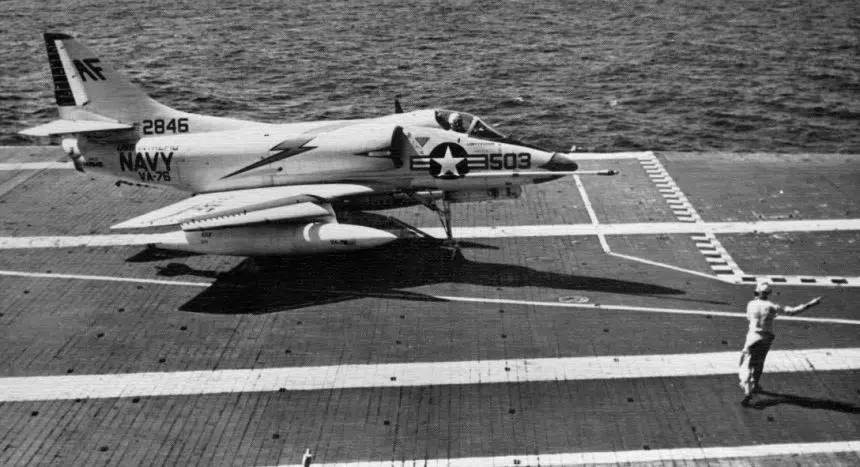

Attack Squadron 76 (VA-76), also known as the “Spirits,” was a US Navy carrier attack squadron that operated from 1955 to 1969. The squadron was based first at Naval Air Station (NAS) Oceana and later at NAS Lemoore. It started with the McDonnell F2H Banshee and Grumman F9F Cougar before switching to the Douglas A-4 Skyhawk. The squadron played an important role in Cold War events and in combat during the Vietnam War. Attack Squadron 76 was established on June 1, 1955. It entered the jet age with the F2H-2 Banshee but transitioned to the F9F-8 Cougar less than a year later. One of its first major missions was during the Suez Crisis in late 1956. The squadron was aboard the USS Forrestal, operating off the Azores, ready to assist in the Mediterranean if needed.

Later, Attack Squadron 76 took part in operations during the Dominican Republic crisis in 1961 and the Cuban Missile Crisis in 1962, deploying aboard the USS Enterprise as US naval forces established a blockade around Cuba. In March 1964, the squadron operated near Cyprus during the fighting between Turkish and Greek Cypriots. Later that year, it participated in Operation Sea Orbit, a 65-day cruise around the globe by a US Navy nuclear-powered task force. Attack Squadron 76 demonstrated its air power on the cruise aboard the USS Enterprise, completed without refueling. By the mid-1960s, Attack Squadron 76 had switched to the A-4 Skyhawk, and its missions began to focus more on combat. In May and June 1965, the squadron operated from Puerto Rico during the Dominican Civil War, carrying out armed reconnaissance missions. The squadron faced its toughest challenges with the escalation of the Vietnam War.

Attack Squadron 76 carried out many combat missions over North Vietnam. On May 11, 1966, Commander James B. Linder received the Silver Star for leading a strike against a moving surface-to-air missile site in Thanh Hoa. Later that year, on December 6, tragedy struck when Commander A. D. McFall died after his aircraft crashed following a night launch from the USS Bon Homme Richard. One of the squadron’s biggest successes happened on May 1, 1967, when it attacked Kép Air Base in North Vietnam. Lt. Cmdr. Theodore R. Swartz shot down a MiG-17 using air-to-ground rockets. It was the first and only time an A-4 Skyhawk shot down a MiG during the Vietnam War, and it earned Swartz the Silver Star. The squadron faced another loss on July 14, 1967. Commander R. B. Fuller, the commanding officer, was shot down during a mission over North Vietnam. He became a prisoner of war and remained captive until March 4, 1973, when the ceasefire agreement with North Vietnam was signed. Attack Squadron 76 was disbanded on September 30, 1969, after 14 years of service.