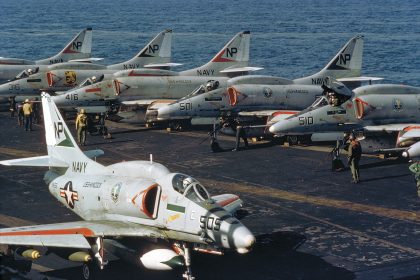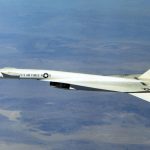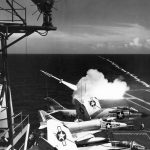
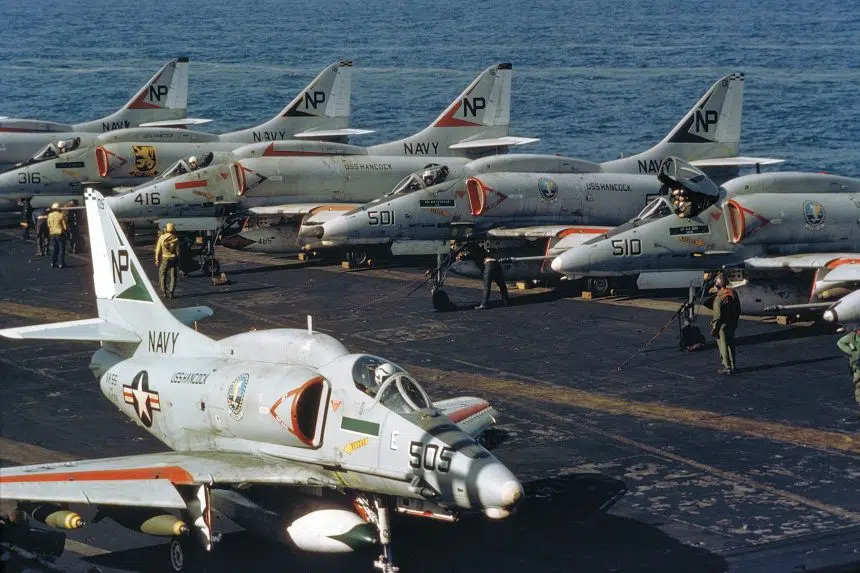

Attack Squadron 212 (VA-212), known as the “Rampant Raiders,” was a US Navy attack squadron that operated during the Cold War and the Vietnam War. It was established as Fighter Squadron 212 (VF-212) on June 20, 1955, and was redesignated Attack Squadron 212 (VA-212) on April 1, 1956. The squadron first used the Vought F7U Cutlass, then moved on to the F9F-8B Cougar and FJ-4B Fury, before switching to the Douglas A-4 Skyhawk in 1961. VA-212 saw many changes in naval aviation during its early years. During this time, aircraft carriers began using more advanced attack planes instead of older jet fighters. On June 6, 1958, the squadron lost its commanding officer, Commander G. W. Staeheli, who died in an aircraft accident. Later that year, VA-212 was deployed on the USS Lexington and operated in the Formosa Strait during the Second Taiwan Strait Crisis. From August to September 1958, the carrier and its air group stayed in the area as tensions rose after Chinese Communist forces shelled the Quemoy Islands. In April 1959, VA-212 became the first operational squadron to use the AGM-12 Bullpup, an early air-to-ground missile that allowed its aircraft to conduct precise attacks. By the early 1960s, VA-212 was more involved in American responses to instability in Southeast Asia. In March 1961, the USS Lexington, which carried VA-212, operated near Thailand. This was during a time when the Laotian government faced issues with Communist forces. While stationed there, the carrier’s aircraft flew reconnaissance missions over Laos.

In April 1962, Attack Squadron 212 flew from the USS Hancock to support the first US Marine Corps advisory unit arriving in South Vietnam. The next month, as the Pathet Lao gained ground, Thailand asked for American assistance. From May 16 to 20, Attack Squadron 212 and other units from Carrier Air Group 21 worked in the area and were ready to provide air support for US Marines sent to Thailand. The squadron continued to respond to regional issues. In September 1963, Hancock and Attack Squadron 212 operated near Taiwan as tensions between China and Taiwan rose. Two months later, the carrier returned to South Vietnam after a coup ousted President Ngo Dinh Diem. VA-212 began sustained combat in February 1965. It followed a Viet Cong attack on the US advisory compound at Pleiku. On February 7, the squadron’s A-4 Skyhawks took part in Operation Flaming Dart, targeting the Đồng Hới Barracks in North Vietnam. Four days later, the squadron joined Operation Flaming Dart II, which attacked the Chanh Hoa barracks. From March to May 1965, the squadron continued operations in Southeast Asia, including Operation Rolling Thunder, the main American air campaign against North Vietnam. VA-212 also supported missions in South Vietnam. In March 1966, its aircraft provided air support during Operation Jackstay, which aimed to clear the Rung Sat Special Zone southeast of Saigon. The squadron excelled by using precision-guided weapons. On June 30, 1966, Commander H. L. Smith received the Silver Star for leading an air strike against the Bắc Giang POL facility. Later that year, Attack Squadron 212’s aircraft were upgraded to carry the AGM-62 Walleye, becoming the first fleet unit to use this new weapon.

On March 11, 1967, Commander Smith carried out the first combat Walleye attack, targeting the Sầm Sơn Army Barracks. For his actions in strikes against the Bắc Giang Thermal Power Plant on May 19 and 20, he received the Navy Cross. Sadly, he died during the mission on May 20. Attack Squadron 212 continued its combat operations into 1968. This included close air support missions for US Marines during the Battle of Khe Sanh in February and March. By this time, the A-4 Skyhawk had become the main aircraft for the Rampant Raiders, helping the squadron through some of the Vietnam War’s most intense moments. In 1972, the squadron resumed major combat operations when North Vietnam began the Easter Offensive. In April, Attack Squadron 212 focused its attacks around An Lộc, providing air support for US and South Vietnamese forces defending the city. In May, the squadron took part in Operation Linebacker I, carrying out significant strikes against targets in North Vietnam. On May 25, 1972, the squadron faced a major loss when its commanding officer, Commander H. H. Strong, died after his aircraft was hit by enemy fire during a strike near Vinh, North Vietnam. After the Vietnam War, Attack Squadron 212 continued its carrier operations. Following the start of the Yom Kippur War and the Arab oil embargo in late 1973, USS Hancock, with Attack Squadron 212 aboard, was deployed to the Indian and Arabian Seas. It was one of the squadron’s final major deployments. After more than 20 years of service, Attack Squadron 212 was disestablished on December 12, 1975.