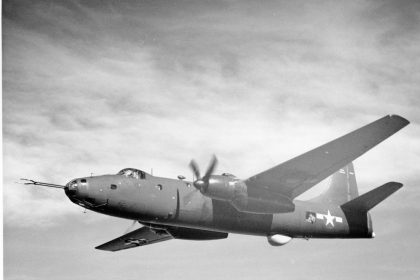
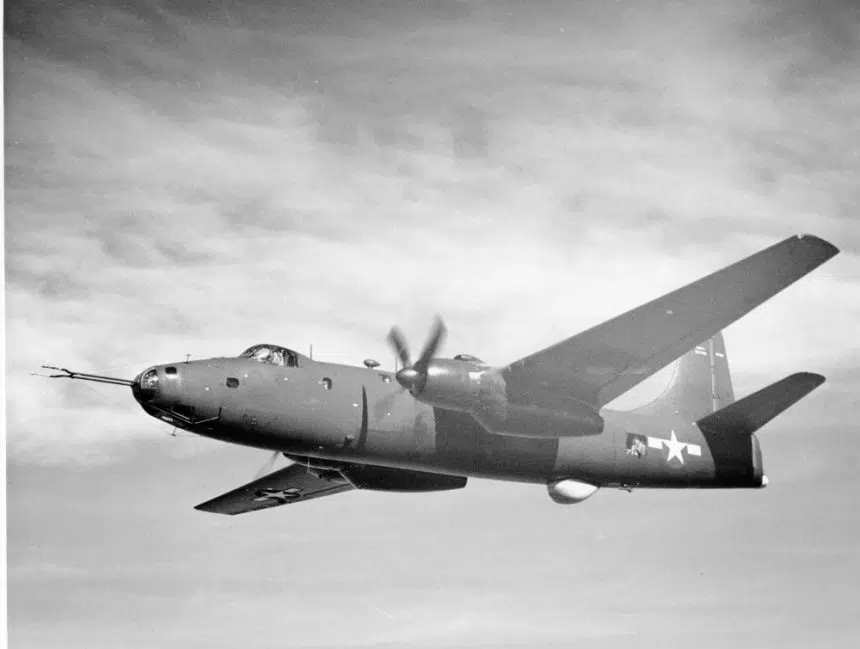


On this day in aviation history, 80 years ago (October 20, 1946), the Martin XP4M-1 Mercator took flight for the first time. Developed for the United States Navy as a long-range maritime patrol aircraft, the Mercator featured an unusual combination of piston and jet power. Two radial engines provided power during normal flight, while a pair of turbojets installed in the rear of the engine nacelles provided additional performance when needed. Development of the Mercator began during WWII in response to a Navy requirement for a new long-range patrol bomber. Martin competed against the Lockheed P2V Neptune, producing a large shoulder-wing aircraft powered by two Pratt & Whitney Wasp Major radial engines. Two Allison J33 turbojets were added to provide additional power for takeoff and combat, with their intakes positioned beneath and behind the radial engines.

Although the Mercator demonstrated impressive performance, the Navy selected the less expensive Neptune for large-scale production. Only 21 production P4M-1s were completed. The Mercator nevertheless found an important second career in electronic reconnaissance, with modified P4M-1Q aircraft conducting intelligence-gathering missions near the Soviet Union, China, and North Korea during the early Cold War. The type was withdrawn from service in 1960, and no complete examples survive today. The P4M-1 measured 85 feet 11 inches in length with a wingspan of 114 feet and was powered by two 3,250-horsepower Pratt & Whitney R-4360 Wasp Major radial engines and two Allison J33 turbojets producing 4,600 pounds of thrust each. The aircraft could reach approximately 410 mph, had a range of around 2,300 miles, and a service ceiling of 34,600 feet. Defensive armament included 20 mm cannons and .50-caliber machine guns, while the patrol bomber could carry up to 12,000 pounds of bombs, mines, depth charges, or torpedoes.