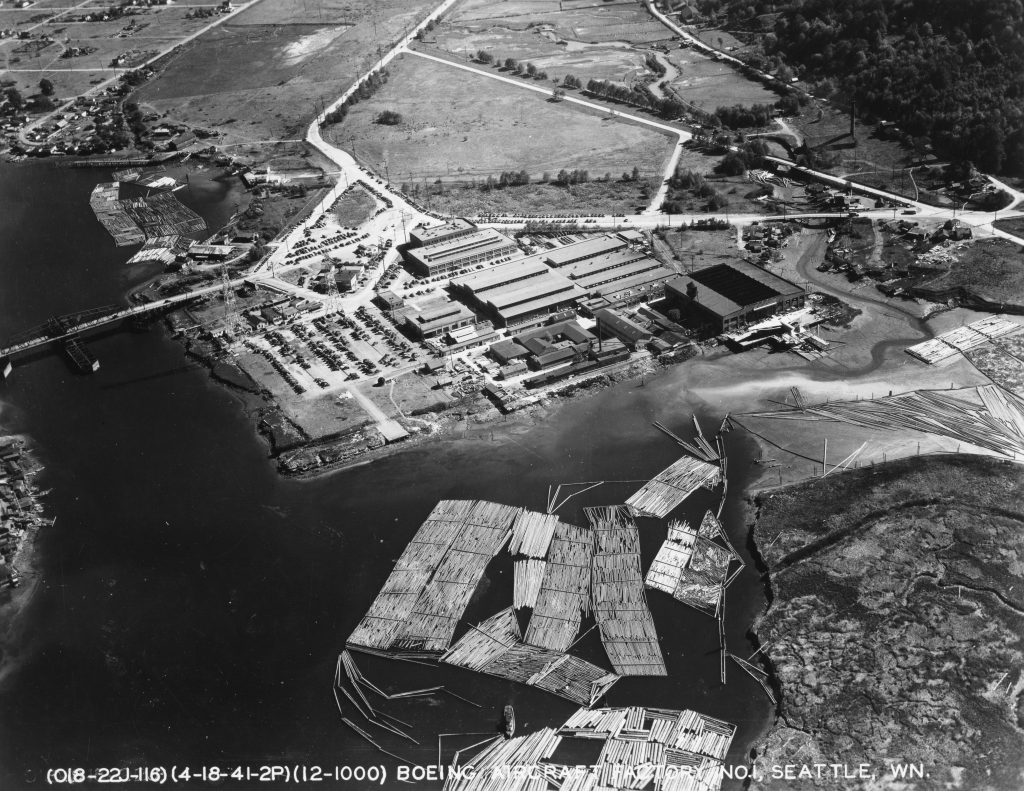




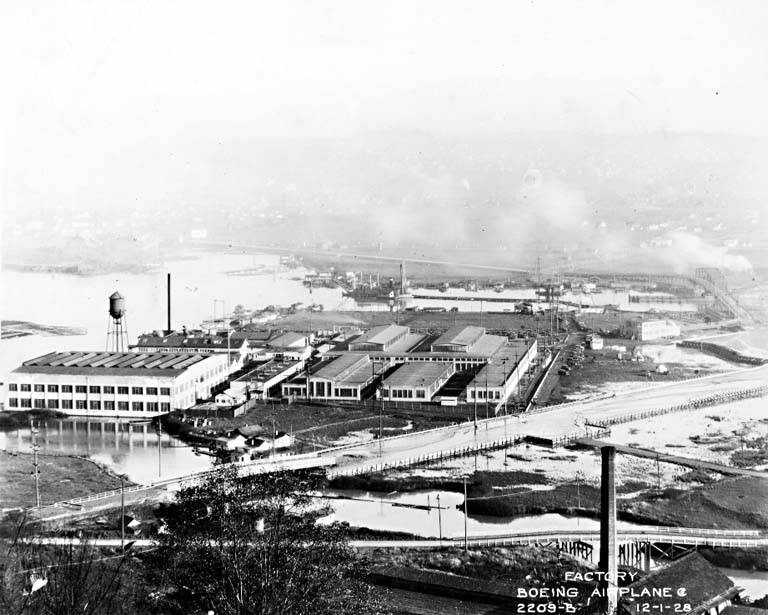
In 1909, Edward Heath built a wooden boat shipyard along an oxbow bend of the Duwamish River. When Heath ran into financial trouble, William Boeing bought the shipyard and the land for ten dollars, agreeing to pay off Heath’s debts. Boeing, who loved airplanes since 1909, bought a Martin “Birdcage” seaplane. He and pilot James Floyd Smith put it together on the shore of Lake Union in Seattle in 1915. After the plane was damaged in an accident and Boeing was unhappy with how long it took to get repair parts, he decided to build his own airplanes. He teamed up with George Conrad Westervelt and used wooden parts made at the Heath shipyard. After finishing two “B&W” seaplanes in 1916, Boeing decided to start a business making airplanes and formed the Pacific Aero Products Company on July 15, 1916. He offered the B&W seaplanes to the Navy for testing, but the Navy was not interested. Regular airplane production did not begin until 1917, when the US entered WWI, and demand for Navy seaplanes increased. In 1917, operations were moved to the Heath Shipyard site. With the Duwamish channelization finished in 1916, the site became suitable for developing and manufacturing aircraft from start to finish. The newly renamed Boeing Company began making planes in a simple barn-like building known as the Red Barn.

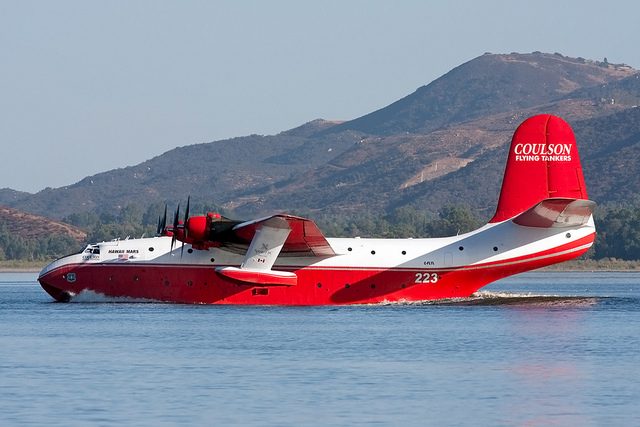
The plant became Boeing Plant 1, also called the Boeing Oxbow Plant, the first airplane production facility for The Boeing Company. All aircraft were built inside this barn. In the first year, Heath led woodworking at the factory until he moved to Portland to start another wooden boat shipyard. Boeing expanded the facility through 1918, adding a large assembly plant and several utility buildings. After WWI, many cheap warplanes became available, and the need for new airplanes dropped significantly. The Boeing Company had to cut its workforce and started making furniture instead of building planes. In the meantime, Boeing concentrated on designing and building airplanes for the airmail business. More people took to the air and sent airmail, and demand for aircraft picked up in the mid to late 1920s. To meet this need, Boeing expanded Plant 1 in 1925 and again in the early 1930s. The expansion included new machine shops, a hammer drop facility, paint-spraying areas, coating shops, and facilities for testing components. Boeing Plant 1 helped build seaplanes that could be launched into the Duwamish Waterway for flight tests. For land planes, workers built and assembled airplanes on site, then took them apart, transported them by barge to Boeing Airfield, flight-tested them, disassembled them again, and finally shipped them to customers. In the 1930s, as Boeing introduced larger all-metal airframes, it needed a facility for metal fabrication and assembly with direct access to the airfield. To meet this need, Boeing opened Plant 2 on the east side of the Duwamish in 1936. The last model made at the Boeing Plant 1 site was the 314 Clipper, a large seaplane assembled on the launching quay of the Plant 1 Assembly Building.
During WWII, the Boeing Plant 1 site produced airplane parts for warplanes and conducted testing. In 1942, Boeing expanded its static test facilities to test new aircraft. After the war, Boeing Plant 1 mostly produced components and tested engines, parts, and fuel systems. The facility conducted various tests, including fuel testing, gun protection, hydrostatic testing, and static testing. From the 1950s to 1967, Boeing Plant 1 mostly worked for Boeing’s Turbine Division. The division designed and made three engine models, ranging from 100 to 300 horsepower. One of these engines powered the Indianapolis 500. The engines also powered drone torpedo helicopters, fire trucks, Swedish S tanks, and minesweepers during the Korean War. The facility started to decay in the 1960s. After the Boeing Bust, the Port of Seattle bought the site as part of the larger Terminal 115 project. Between 1970 and 1976, it demolished the Boeing Plant 1 structures. The well-known red barn was almost torn down but was instead added to the National Register of Historic Places. In 1975, it was moved down the river on a barge and then trucked to its current location at the Museum of Flight. Only two buildings from the original Boeing Plant 1 site still stand. One is Building No. 105, known as the Red Barn, which is now at the Museum of Flight. The other is the administration building built in 1929, which remains in its original location at 200 Southwest Michigan Street, just south of the Terminal 115 site in Seattle. Read more Forgotten Factories articles HERE.