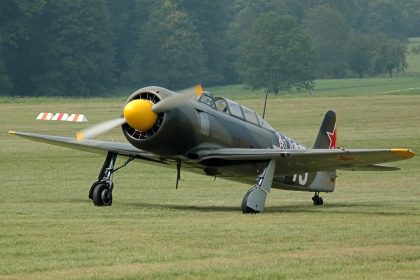
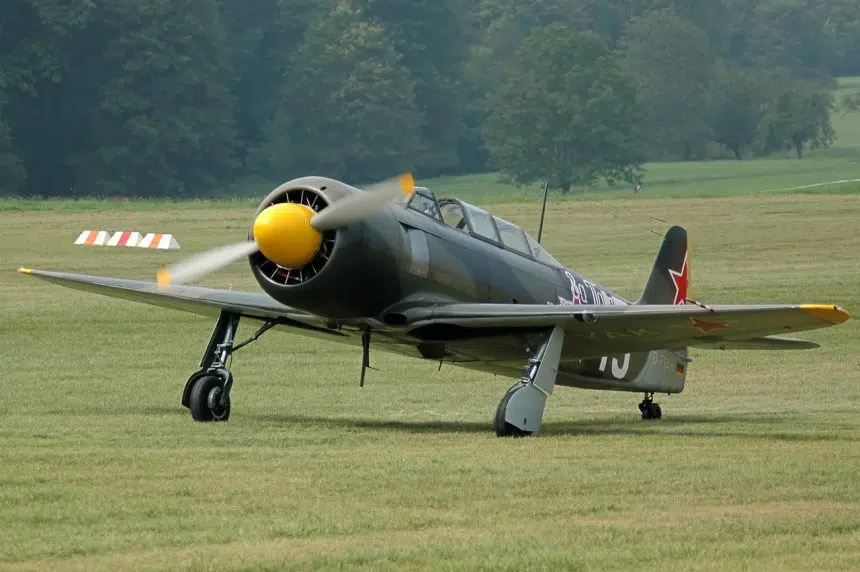

On this day in aviation history, 81 years ago (November 10, 1945), the Yakovlev Yak-11 took flight for the first time. Developed in the Soviet Union as an advanced military trainer, the two-seat aircraft was based on the radial-powered Yakovlev Yak-3U fighter. Known by the NATO reporting name “Moose,” the Yak-11 would become one of the most widely produced Soviet training aircraft of the postwar era. Development began in 1944, as the Soviet Union sought a modern advanced trainer capable of preparing pilots for high-performance fighter aircraft. Initially designated Yak-UTI or Yak-3UTI, the new aircraft incorporated the wings of the Yak-3U, a redesigned fuselage with tandem cockpits, and a Shvetsov ASh-21 radial engine. The aircraft retained many fighter-like handling characteristics while providing dual controls for student and instructor.

Following the first flight in November 1945, an improved prototype was developed and successfully completed state testing in October 1946. Production began in 1947, with the Yak-11 becoming a standard advanced trainer for the Soviet Air Force and DOSAAF flying organizations. The type was exported extensively to Warsaw Pact nations and other Soviet-aligned countries. A total of 3,859 aircraft were manufactured in the Soviet Union, with another 707 produced under license in Czechoslovakia as the Let C-11. The Yak-11 also found limited combat use, including ground-attack operations with the Egyptian Air Force during the North Yemen Civil War. The Yakovlev Yak-11 measured 26 feet 10½ inches in length with a wingspan of 30 feet 10 inches and was powered by a 700-horsepower Shvetsov ASh-21 seven-cylinder radial engine. It could reach a maximum speed of 289 mph, cruise at approximately 230 mph, and had a range of 795 miles. Its service ceiling was 23,295 feet, with a rate of climb of approximately 1,600 feet per minute. Armament consisted of a single 12.7 mm UBS or 7.62 mm ShKAS machine gun, with provisions for two 220-pound bombs beneath the wings.