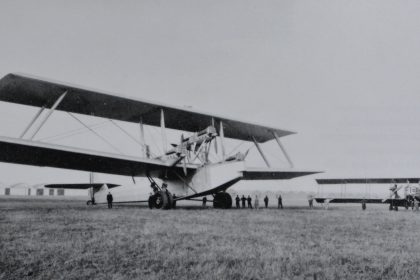
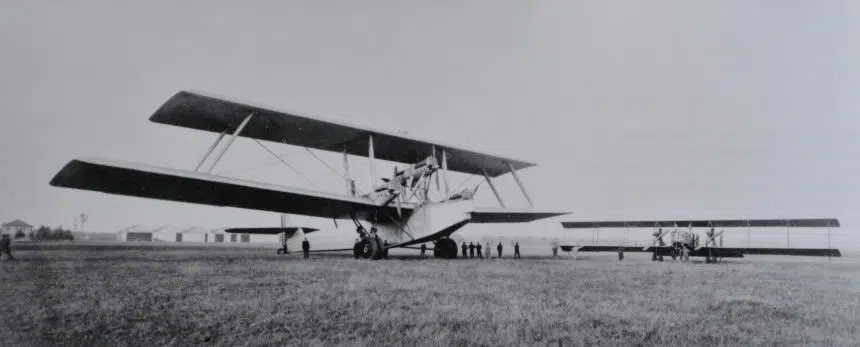

In the 1920s, the Italian aircraft manufacturer Caproni developed a prototype heavy bomber, the Caproni Ca.90. The Caproni Ca.90 was a six-engine aircraft designed as a heavy bomber. It was built mainly from strong steel tubing, which was tougher and more flexible than aluminum or duralumin. The main joints were made from solid pieces of chrome-nickel steel. Most of the fuselage and wings were covered with simple doped fabric, but the front part used corrugated duralumin sheeting. The aircraft had a large square-shaped body that was part of its central section and hung from the lower wing. The front part was a turret with a machine gun. Behind the turret was a large fuel tank, and above it was the flight deck where the pilot flew the plane. The bomb bay and additional fuel tanks sat farther back. The bomb racks could carry different bomb sizes for a total of 8,000 kg (17,637 pounds) of explosives during a typical mission. At the rear of the fuselage, extra defensive positions provided heavy fire in all directions. Normally, the aircraft had seven machine guns.
Design of Caproni Ca.90

The Caproni Ca.90 was powered by six Isotta Fraschini Asso 1000 W-18 piston engines. It had two pairs of engines mounted above the lower wing, each pair driving a four-bladed pusher propeller and a two-bladed tractor propeller. The last pair of engines was placed above the fuselage. The Asso 1000 engines were powerful for their time, but they had a moderate power-to-weight ratio and were fairly fuel-efficient. They were water-cooled, and the pilot could control the airflow to the radiators to keep them at the right temperature. The aircraft stored large amounts of fuel in both the wings and fuselage. Caproni noted that having too many engines complicated design and safety, making the aircraft harder to control. During flight tests, people suggested that future engines producing up to 2,000 horsepower might allow the Caproni Ca.90 to use as few as three engines. The Caproni Ca.90 had large wings for its time. It used a monoplane tail unit with balanced control surfaces. The rudder’s balanced surface helped correct the vertical fin while flying. The aircraft had a wide undercarriage, which made it easier to move across rough ground. It had two pairs of large wheels on ball bearings with oleo-rubber springs. Additionally, a tail wheel was located under the back of the fuselage.
The Cancellation

On October 13, 1929, the Caproni Ca.90 made its first flight. At the time, it was the world’s largest land-based aircraft, only slightly smaller than the Siemens-Schuckert R.VIII, a World War I aircraft. Despite this, only one prototype was ever built. The giant biplane became obsolete given the pace of development in aircraft technology, the beginning of the Great Depression, and the evolving nature of military strategy, so the Caproni Ca.90 project was canceled. Italo Balbo, head of the Italian Air Ministry, did not support heavy bombers and chose not to fund or order the Ca.90. Further, the global economic crisis cut military budgets. Caproni tried to sell a commercial or mail-plane version and teamed up with the Curtiss Airplane and Motor Company in the United States, but both efforts failed because of a lack of funding and buyer interest. Although the 1929 prototype showed that a biplane of this size could fly, the industry shifted from large wooden-fabric biplanes to sleek all-metal monoplanes. Read more Grounded Dreams articles HERE.