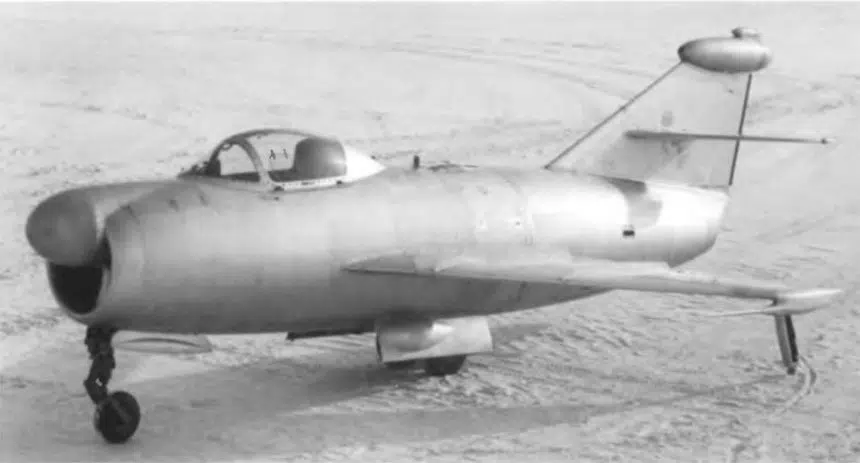


Attacking a warship has always been challenging for military aircraft. Facing multiple defensive weapons, bombers and torpedo bombers often had little chance of hitting their targets or escaping unharmed. To strike targets beyond the reach of ship-based air defenses, crews needed guided weapons, which the Soviet Union began developing in the early 1950s. One such weapon was the KS flying missile, carried by Tu-16KS aircraft used by Naval Aviation for many years. During development, engineers had to test guidance systems and electronic equipment to ensure they worked correctly. The Mikoyan-Gurevich K was a manned aircraft built to test the design and guidance systems of the missile prior to building an unmanned version. The government began developing the new aircraft under a decree dated March 25, 1949. The first version of the guidance system for the future KS missile was tested using a Li-2 flying laboratory and, later, the MiG-9L. Research continued with the K aircraft. The missile used a combined guidance method. First, the carrier aircraft’s radar detected the target and guided the missile toward it. When the missile came close enough, its own radar homing head picked up the reflected signal and guided it automatically toward the target. In October 1949, a team began work on the Tu-4 carrier and the KS missile aircraft, dubbed Mikoyan-Gurevich KSK.
Design of Mikoyan-Gurevich KSK

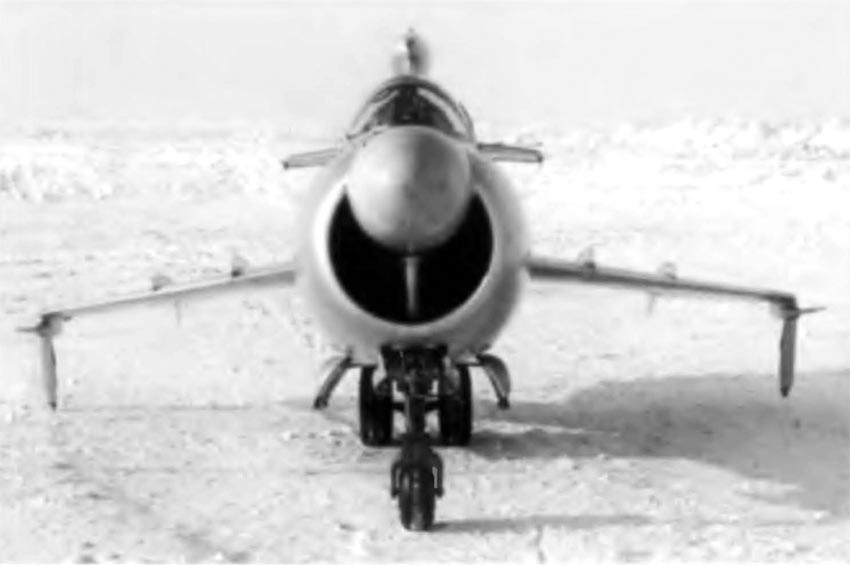
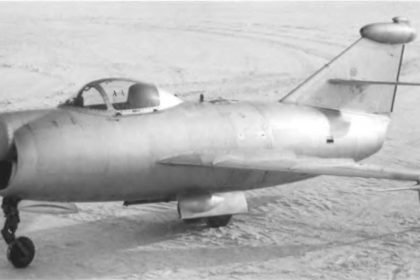
The Mikoyan-Gurevich KSK had a shape similar to the MiG-15 fighter, though its weight and dimensions differed. Its wings stood out with a steep 57.5-degree sweep angle along the leading edge. Like other designs of the period, the aircraft was developed at the OKB-155 branch led by A. Ya. Bereznyak, under the guidance of M. I. Gurevich, deputy to A. I. Mikoyan. The design team faced a difficult challenge. It had to fit a pilot’s cockpit, flight controls, an ejection seat, landing gear, flight and navigation instruments, control equipment, and a braking parachute into a missile-shaped aircraft. All this had to be achieved without exceeding the aircraft’s weight limits. The only available space for the cockpit was the missile’s warhead compartment. Since the aircraft was not expected to fly above 13,000 feet, there was no need to install oxygen equipment or pressurize the cockpit. The cockpit contained basic flight and navigation instruments, including an altimeter, an airspeed indicator and an artificial horizon. It also included a KI-13 compass, an RSI-6 radio, and an SPU-14 intercom, which let the K aircraft’s pilot communicate with the Tu-4K carrier crew. The pilot and carrier crew had to coordinate the aircraft’s release, engine start, and guidance during the test flights. To help the aircraft land, the designers added simple wing flaps. It used bicycle-type landing gear, supported by additional gear under the wings. The main and nose landing gear retracted into the fuselage, while the wing supports folded into the wingtips in the direction of flight.
The Cancellation
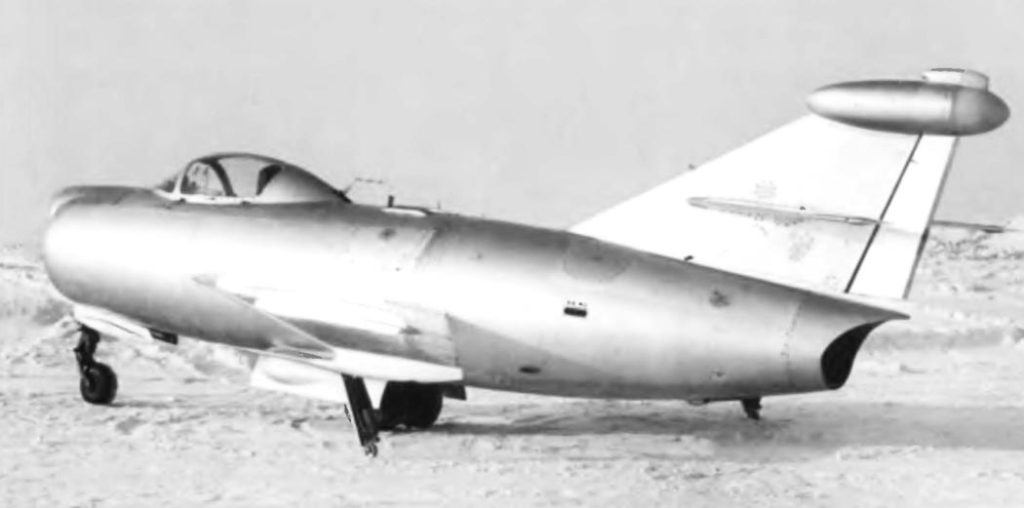
The aircraft used an RD-500 engine that generated 3,500 pounds of thrust at maximum power and 3,000 pounds at normal power. It had a single-mode RD-500K engine specifically for missiles. The wing loading was much higher than that of the MiG-15 fighter, making landings more difficult. The aircraft needed high approach speeds, nearly 250 mph, and landing speeds were about 170–180 mph. Four prototypes were built, designated K-1, K-2, K-3, and K-4. Testing involved both airborne releases from the Tu-4K carrier aircraft and ground takeoffs. The first aircraft, the K-1, began taxiing in December 1950 at the Air Force Research Institute airfield in Chkalovskaya. On January 4, 1951, test pilot Sultan Amet-khan made its first flight from the ground. The K-2 was then tested to a reported altitude of 9,850 feet at 403 mph. By May 1951, the first test flights were completed, and work continued on the improvement of the flight characteristics of the aircraft. Engineers worked on both the guidance system and the airframe as development progressed. These experiments helped advance the design toward the standard unmanned version, designated K-4. In the Grounded Dreams series, the Mikoyan-Gurevich KSK aircraft was an unusual step in the development of Soviet guided weapons. By putting a pilot aboard a missile-shaped aircraft, engineers could test its flight characteristics and guidance equipment before moving toward an unmanned design. Read more Grounded Dreams articles HERE.