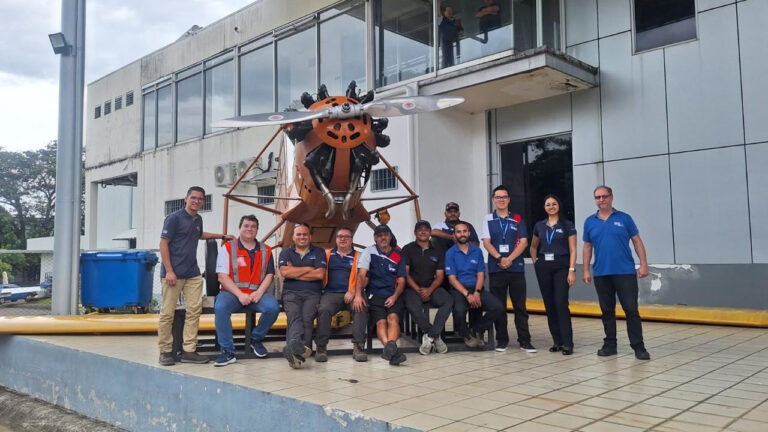


In May 2025, the Academy of Aeronautical History and Air Mail of Costa Rica signed an agreement with the Macaya families to take temporary custody of Don Carlos Macaya’s Curtiss Robin aircraft. On September 1, the Latin American Aviation Historical Society reported this agreement, which ensures the aircraft’s restoration and preservation while its permanent home is determined, halting the accelerated deterioration caused by partial exposure to the elements and past acts of vandalism at Juan Santamaría Airport. With the dedicated collaboration of Rodolfo and Jorge Valverde from the Instituto de Formación Aeronáutica (IFA), and with the approval of the General Directorate of Civil Aviation and AERIS, the Curtiss Robin was carefully disassembled and transferred to IFA. There, specialized mechanics will restore the aircraft, which will then be displayed in a static exhibition. The exhibition will be complemented by commemorative events marking the historic arrival of Don Román Macaya in Costa Rica. On October 5-6, 1933, Don Román flew from Oakland, California, in a Curtiss Robin named Espíritu Tico I—a flight that laid the foundation for Costa Rican civil aviation and is now honored through this restoration project.

The aircraft currently registered as TI-BGZ, Espíritu Tico II, was acquired by Don Carlos Macaya to honor his father’s pioneering flight. Manufactured in 1929 by the Curtiss-Robertson Airplane Manufacturing Company (serial number 428), it was originally registered as NC59H (later NR59H) and became internationally famous as the “St. Louis Robin.” In July 1929, pilots Dale Jackson and Forest O’Brine flew the aircraft continuously for 17 days, 12 hours, and 17 minutes—totaling 420 hours—over St. Louis, Missouri, establishing a world endurance record. The flight required 48 aerial refuelings, consuming 3,500 gallons of gasoline and 158 gallons of oil, demonstrating the reliability of both the Curtiss Robin design and its Curtiss Challenger engine, and helping to build public confidence in civilian aviation during the golden age of flight.

In 2016, Carlos Macaya Ortiz brought the aircraft to Costa Rica, renaming it Espíritu Tico II to honor his father, Román Macaya Lahmann, the first Costa Rican pilot to fly from the United States to Costa Rica in his own Curtiss Robin in 1933. Due to health concerns for Carlos Macaya, the team opted to transport the aircraft in a 40-foot container rather than fly it. Upon arrival, the plane was carefully reassembled, and local caretakers were trained to maintain it. The aircraft was unveiled in San José, Costa Rica, in April 2016 in front of over 250 attendees. Tragically, Carlos Macaya Ortiz passed away just ten days later, leaving the project to be carried forward by his nephew, Román Macaya Hayes, then serving as Costa Rica’s ambassador to the United States.

The Academy of Aeronautical History and Air Mail and IFA thank the Macaya families for entrusting the aircraft to the Association and supporting efforts to preserve and share the legacy of Don Román Macaya. Through his airline Aerovías Nacionales and later ventures as an aeronautical entrepreneur, Don Román was a pioneer in Costa Rican aviation. The temporary custody of the Espíritu Tico II fulfills the wishes of his sons, Don Carlos and Don Ernesto Macaya, and his grandson, Dr. Román Macaya Hayes, ensuring that his contributions are remembered and celebrated. Founded in 2021, the Academy is a non-profit organization dedicated to preserving and promoting the role of aviation and air mail in Costa Rica’s socio-economic development. Its members include aviation historians, writers, pilots, engineers, mechanics, lawyers, entrepreneurs, philatelists, and other enthusiasts committed to safeguarding the country’s aeronautical heritage. The Academy organizes exhibitions and conferences, maintains a virtual museum at www.museoaeronauticocr.com, and is developing a physical museum to house its extensive collection of aviation documents, graphics, and artifacts.