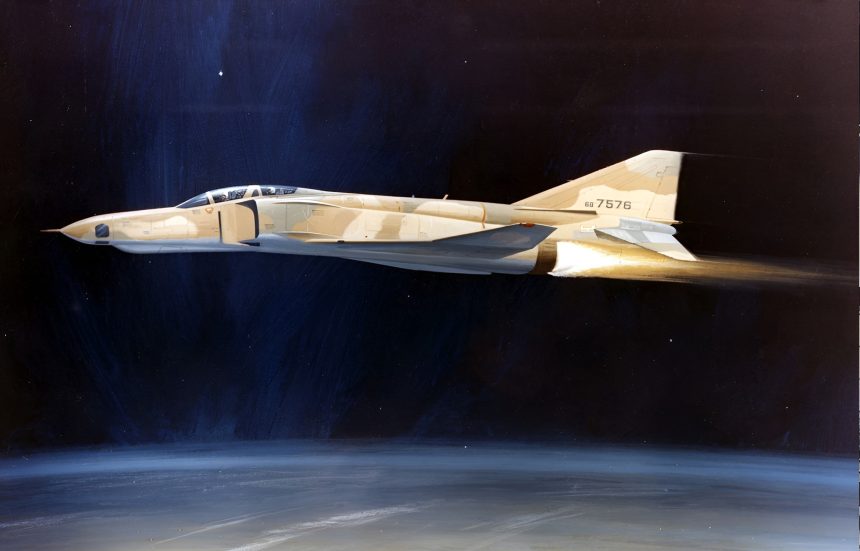


During the 1970s, Israel needed an aircraft to intercept the Soviet supersonic interceptor and reconnaissance aircraft MiG-25 ‘Foxbat.’ In 1971, the Foxbat was deployed to Egypt and became a major operational challenge for the Israeli Air Force (IAF). The aircraft often flew at speeds approaching Mach 3 and at altitudes of 70,000-80,000 feet over the Israeli-held territory of Sinai and mainland Israel. The IAF’s F-4 Phantoms failed to intercept them due to the lack of speed on various occasions. Even with head-on approaches, the Phantom’s radar and AIM-7 Sparrow missiles could not lock onto or catch the Foxbats, which operated near the edge of space. To find a solution, Israel and the US initiated working on a high-speed version of the Phantom.
Rise and Fall F-4X Phantom
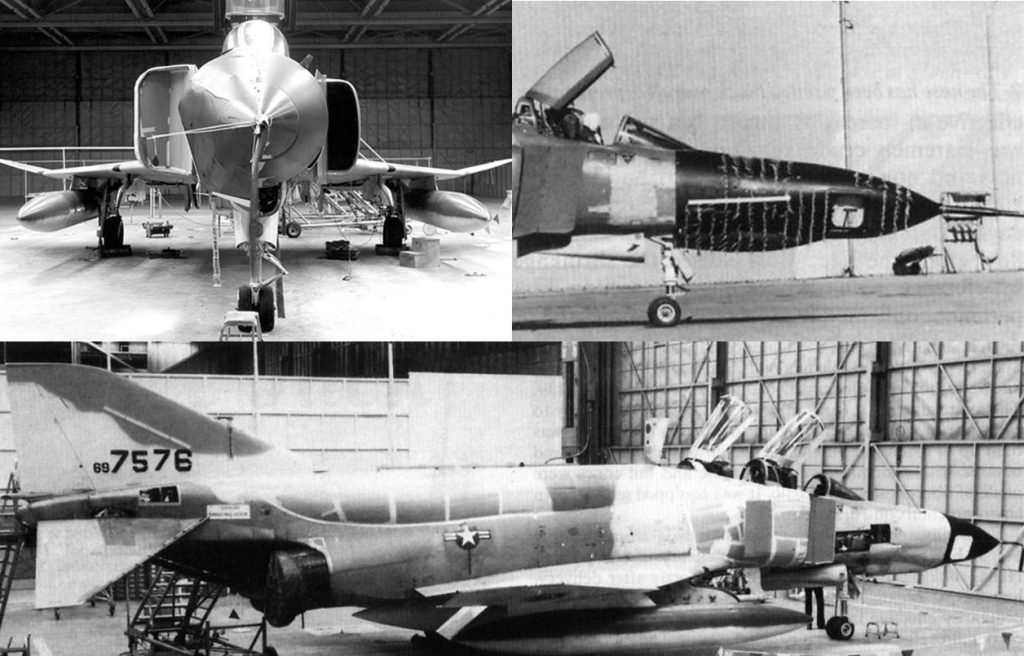
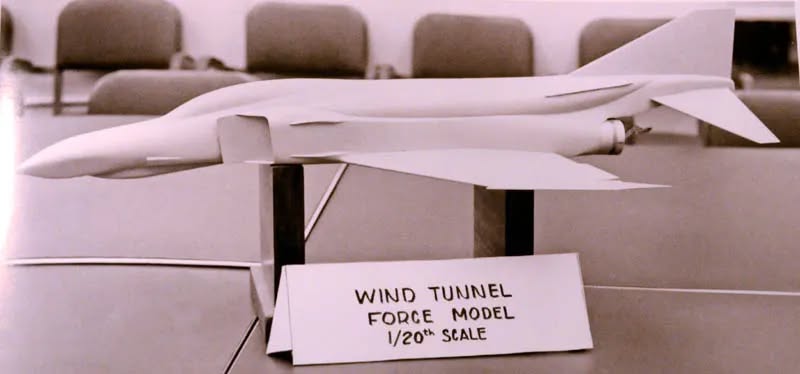
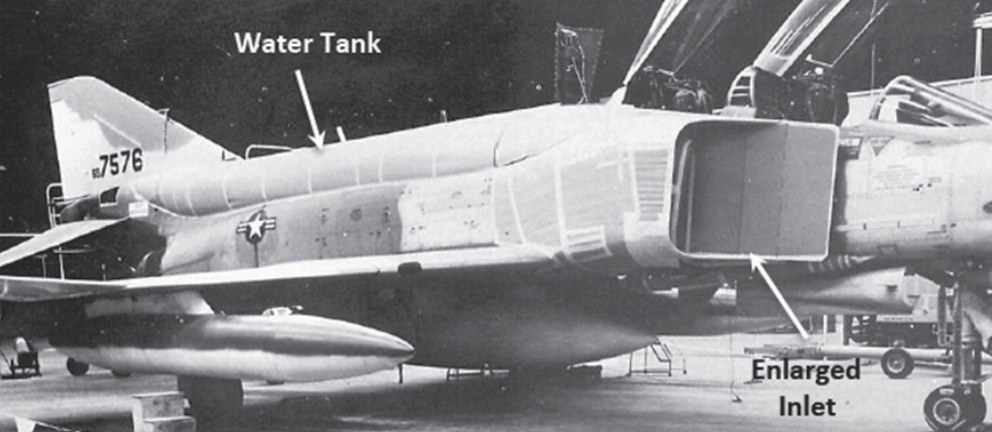
To achieve Mach 3 speeds, the Phantom was to be equipped with water injection pre-compressor cooling (WIPCC) technology to increase the thrust of its General Electric J79 engine as part of the Peace Jack project. The US Air Force contracted General Dynamics to develop a Phantom with WIPCC. According to a NASA report, the objective of Peace Jack was to modify an F-4E aircraft to enable it to operate at higher altitudes and speeds. This was to be achieved with pre-compressor cooling (PCC) for thrust augmentation at supersonic speeds. PCC could be installed as a kit without major aircraft modification. The enhanced capability of the F-4E, in conjunction with PCC, was achieved through an increased inlet size to accommodate the additional airflow or capture area required at high Mach numbers and high altitude, and through a bypass for air when necessary. Water tanks carrying 2,500 gallons of water were mounted on the F-4E fuselage, and the aircraft was designated F-4X. In the NASA research, the WIPCC successfully boosted J79 engine thrust on the F-4X at extreme supersonic speeds and altitudes. Injecting water into the inlet before it enters the compressor increases the air’s density and mass flow, and reduces the heat caused by drag. As a result, this method enabled more than a 150% increase in thrust at high altitude compared to the unmodified baseline J79 engine. In addition, these refinements on the F-4X supported sustained Mach 3+ flights, and the aircraft was expected to reach a maximum speed of Mach 3.2, with a cruise speed of Mach 2.4. The aircraft was planned to be equipped with the HIAC-1 LOROP camera for reconnaissance and a weapon carriage, potentially similar to that of the F-4 Phantom. By then, the US had already introduced the SR-71 Blackbird, which is still the fastest aircraft in the world. The speed and performance of the F-4X were similar to those of the SR-71, and the US did not want such a crucial technology in the hands of a foreign customer. In addition, the inclusion of weapons in an aircraft flying at Mach 3+ was a capability the US itself didn’t have at the time. Soviet human intelligence was also very active at the time, and sending the aircraft into a conflict would mean the Soviets could get their hands on the technology to make a similar aircraft. Hence, the US Department of State cancelled the project and handed it over to Israel.
Curious Case of RF-4X Phantom
As a result, General Dynamics modified the F-4X by removing its weapons and hardpoints, allowing it to bypass the weapons ban. Instead of a fighter jet, the aircraft would now carry the HIAC-1 LOROP camera in its nose and be renamed the RF-4X. Although this was not the fighter Israel wanted, it met its reconnaissance needs. In 1974, after receiving permission to sell the RF-4X to Israel, the IAF lent General Dynamics an F-4E as a mockup and later as a testbed for the RF-4X. Work on the RF-4X began shortly after the plane’s delivery and continued into the next year. The IAF urgently wanted General Dynamics to complete the PCC system, but the engineers realized they needed more time than Israel could allow. But the US remained wary of delivering this technology, and as the aircraft was being built, the US Air Force stopped supporting the RF-4X in favor of the McDonnell Douglas F-15 Eagle. Without US Air Force funding, the RF-4X program was canceled. But the IAF needed an aircraft urgently, so the F-15 Eagle was acquired quickly and entered service with the IAF in 1976. The F-15 proved successful when an Israeli F-15A shot down the first of several Syrian MiG-25s in February 1981 using AIM-7F Sparrow missiles, leading to the RF-4X program ending without ever flying or going past the mockup stage. An aircraft that was way better than the fighters the modern aviation world even flies today was cancelled despite showing phenomenal results. In the Grounded Dreams series, many aircraft were cancelled as misfits, but the RF-4X was not a misfit; it was so perfect that the country that developed it became too suspicious to hand it to even friends. Read more Grounded Dreams articles HERE.