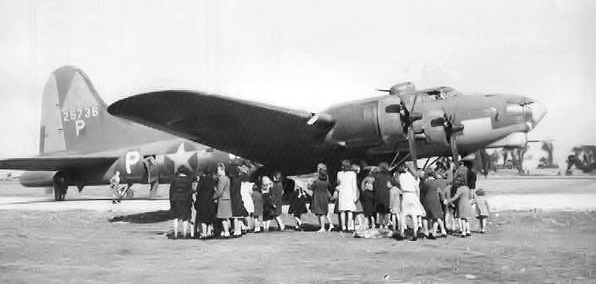

During World War II, as the US military began flying heavy bombers over Europe, the service faced a serious problem. The four-engined heavy bombers could not defend themselves against fast German fighter interceptors, resulting in major losses. At the time, no long-range fighters were available to escort the bombers. A logical solution was to increase the range of fighters, such as the P-38 Lightning and the P-51 Mustang, and make them suitable for escort roles. But that would require a complete redesign, which would be time-consuming. As a result, an unusual idea of converting bombers such as the B-17 Flying Fortress and the B-24 Liberator into escort fighters was pursued. As the bombers were ready and flying long-range missions, there was no need to redesign them; the service just needed to add defensive capabilities. Two prototypes were built, one based on the B-17, called YB-40, and another based on the B-24, designated the Consolidated XB-41 Liberator.
XB-41 Liberator’s Design
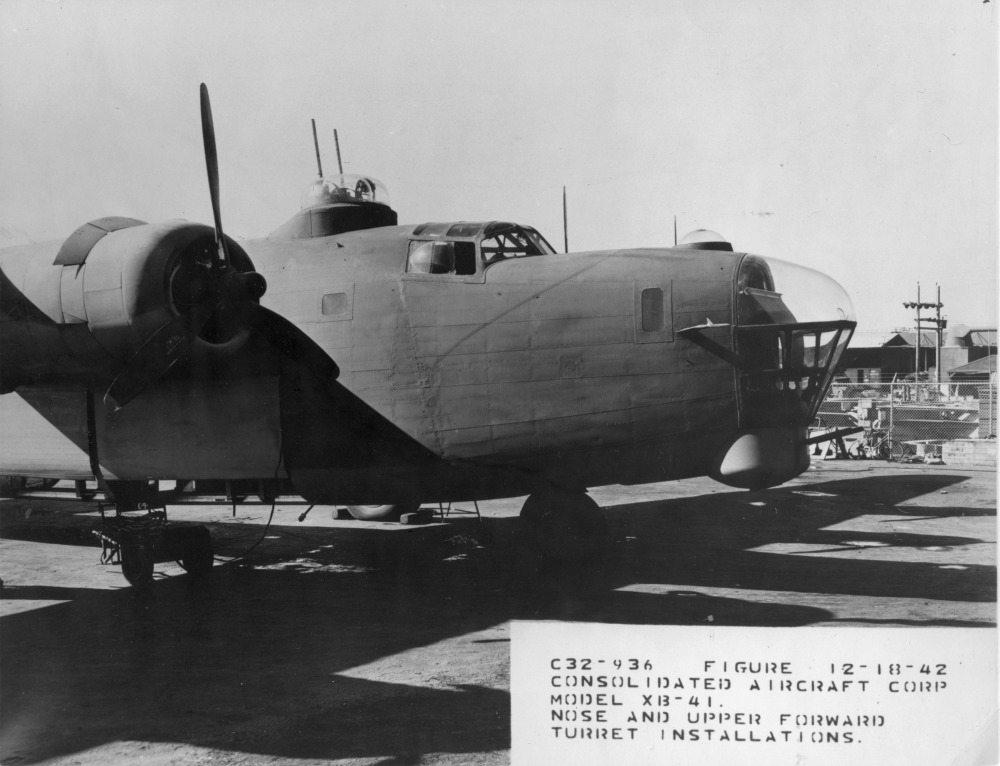
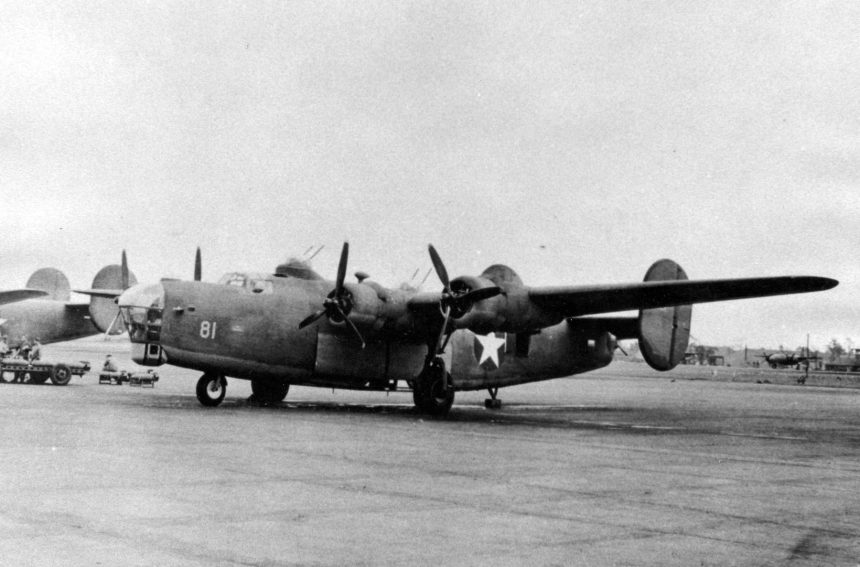
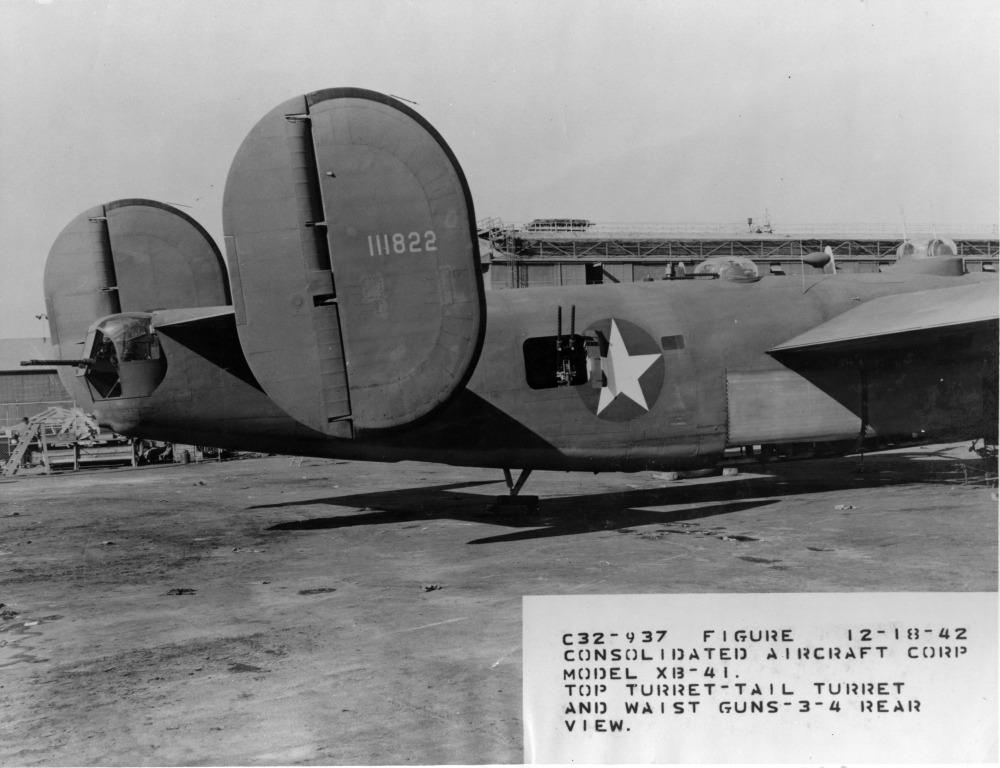
To escort bombers, the XB-41 Liberator and YB-40 were equipped with several defensive guns to provide sufficient firepower. Development of the XB-41 began in 1942, and it was armed with 14 .50-caliber (12.7 mm) M2 Browning machine guns. At the time, the B-24 carried 10 such machine guns, two each in the nose, dorsal, ventral, and tail turrets, and two in the waist positions. So the XB-41 had three to five more guns than the B-24, achieved by adding additional turrets, including a second dorsal turret and a remote-controlled Bendix turret under the chin, similar to the one used on the B-17. It also had a standard twin-gun tail turret, a twin-gun retractable ventral ball turret, and twin-mount guns at each waist window. The XB-41 Liberator was powered by four Pratt & Whitney R-1830-43 radial engines, each producing 1,250 horsepower. It could carry 12,420 rounds of ammunition and was 6,000 pounds heavier than the B-24. The U.S. Army Air Force (USAAF) received the XB-41 prototype on January 29, 1943, at Eglin Field, Florida, for trials, and the design was approved on March 16, paving the way for the conversion of 13 B-24s into XB-41s. But suddenly, just five days later, on March 21, the project was cancelled, and no B-24s were converted to XB-41s, apart from a single prototype. Initially, experiences with the YB-40 led to XB-41 Liberator’s sudden cancellation due to two major problems that the aircraft was already experiencing in combat in Europe. The YB-40 was delivered to the USAAF in late 1942, and it took its first flight on November 10, 1942. By January 1943, nearly 25 YB-40s were ordered to take part in the combat. But as it flew in combat, the USAAF identified two major problems with the aircraft. First, the heavy YB-40 could keep up with the B-17s while they were still loaded with bombs, but once the bombers dropped their bombs, they could fly faster, and the YB-40 could not keep up.
The Cancellation
Second, even with all the extra weight, adding more guns to the bombers did not reduce their combat losses. Experience showed that these extra guns made little to no difference in the number of bombers that survived. Because of this, the idea of a heavily armed gunship escort was replaced by traditional escort fighters. To solve the problems, Consolidated tried to reduce the XB-41’s weight by removing armor and equipped the aircraft with wide-blade propellers to improve takeoff performance, climb rate, and efficiency at high altitude. The USAAF resumed testing this modified XB-41 Liberator in July 1943, but the problem persisted, and the added weight of guns and ammunition kept the aircraft slow to keep up with the bomber stream. As a result, the XB-41 program was cancelled, and the aircraft was converted into an instructional airframe for B-24 mechanic training. On February 2, 1945, the aircraft was scrapped at Maxwell Field, Alabama. The XB-41 was not a bad aircraft, but it was born of a flawed concept. Turning bombers into escort aircraft was never feasible due to their size and weight, and they couldn’t maneuver like fighters, making them highly vulnerable targets and easy prey for enemy interceptors. At the end, the escort aircraft role was given to fighters such as the P-51 Mustang, P-47 Thunderbolt, and P-38 Lightning. The range issue was curbed by drop tanks, which enabled P-51 Mustangs to fly from London to Berlin and back. In the Grounded Dreams series, the XB-41 Liberator serves as a reminder that, despite its great performance, converting bombers into escort aircraft is not feasible. Read more Grounded Dreams articles HERE.