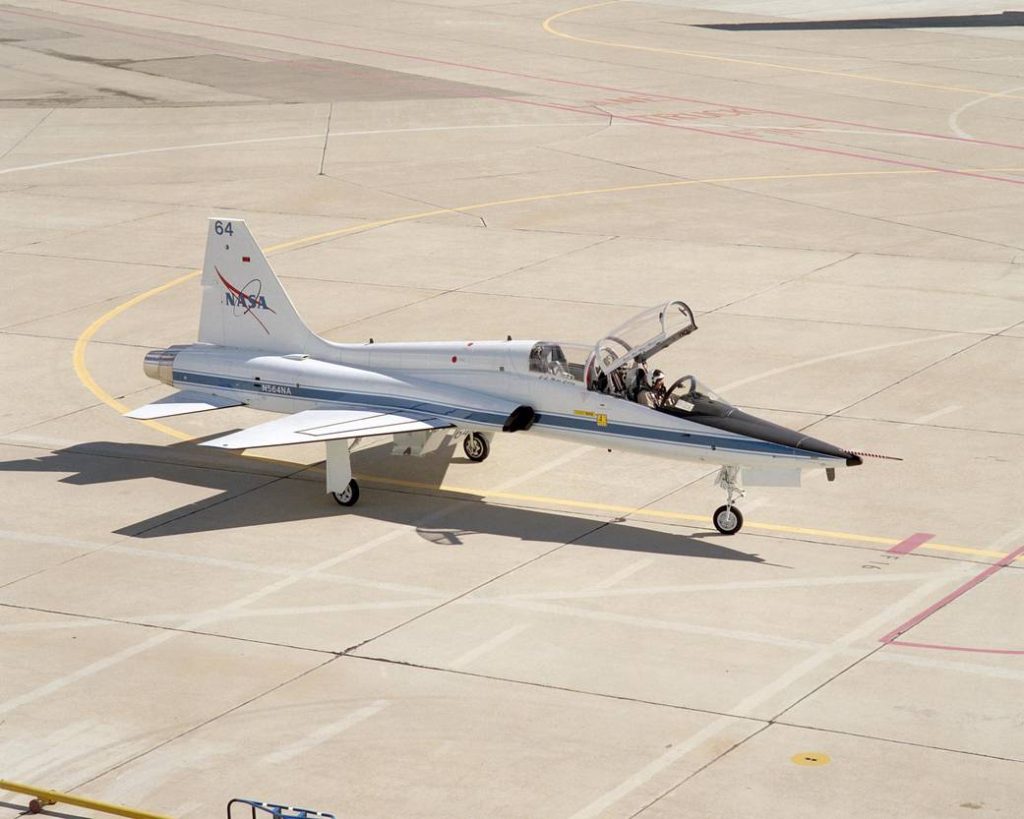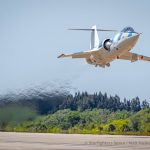
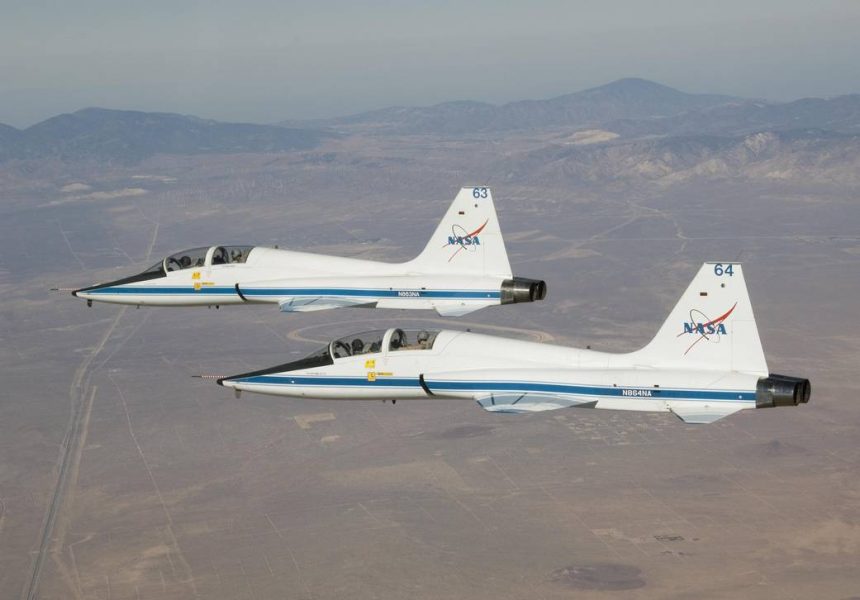

When the US Air Force was transitioning from subsonic to supersonic aircraft, such as the F-100 Super Sabre, F-102 Delta Dagger, and F-104 Starfighter, it needed pilots to train on these platforms as well. Trainers such as the Lockheed T-33 Shooting Star performed well at subsonic speeds, but to transition to the early supersonic age, a new aircraft was needed. To meet this requirement, Northrop built the T-38 Talon, the US Air Force’s first supersonic trainer, which served for 6 decades, training both fighter pilots and NASA astronauts. The development of the T-38 Talon began in 1954, and the early concepts originated from Northrop’s N-102 Fang and N-156 “hot-rod” fighter concepts, powered by compact General Electric (GE) J85 engines to create a lightweight supersonic design. In the 1950s, most jet fighters were larger and heavier, but the GE J85 engine, which was small, light, and powerful, weighed only 500 pounds and produced roughly 2,900 pounds of thrust, prompting Northrop to rethink jet size.
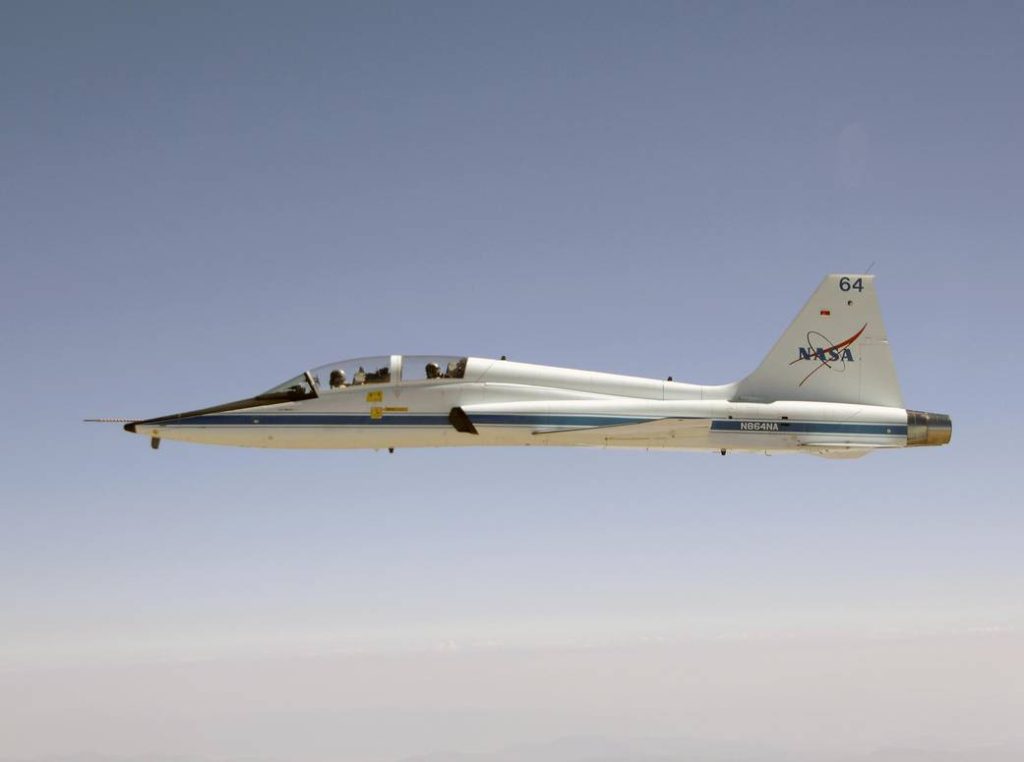
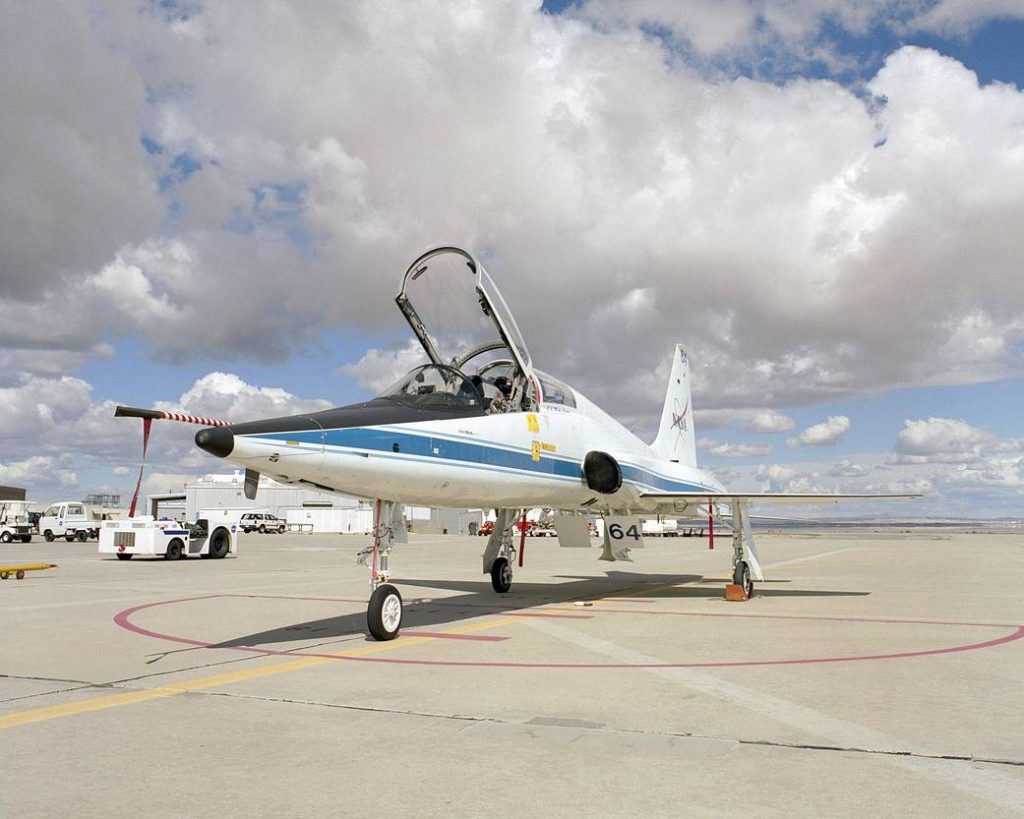
Northrop won a US Air Force trainer competition in June 1956 with its T-38 Talon, and the first prototype, YT-38, made its debut flight on April 10, 1959. The T-38 entered service on March 17, 1961. The T-38 Talon could fly at speeds of Mach 1.3, with an altitude ceiling of over 55,000 feet. The T-38 could take off in as little as 2,300 feet of runway and can climb to almost 30,000 feet in just one minute. The T-38A had swept wings and a streamlined fuselage shaped like a “coke bottle,” a design inspired by Richard Whitcomb’s “area rule.” It had tricycle landing gear with a steerable nose wheel, and the flight controls were powered by two separate hydraulic systems. The trainer jet was made for easy maintenance, with major parts accessible at waist height. The wings were a single unit made from aluminum alloys and had a honeycomb structure to strengthen the control surfaces. The Talon had tandem seats for the instructor and student, both equipped with rocket-powered ejection seats. As a trainer, the Talon did not carry weapons, but some upgraded models, known as AT-38B, were modified for weapons training.
Though the Air Force used the T-38 Talon to close the subsonic-to-supersonic trainer gap, NASA has been using the T-38 since 1965 primarily for astronaut proficiency training, high-speed proficiency flights, inter-center transport, and chase aircraft duties during experimental test flights. NASA’s interest in the T-38 Talon arose in the mid-1960s, when Gemini- and Apollo-era astronauts required supersonic proficiency beyond the capabilities of the T-34C and T-33 to simulate high-g maneuvers and rapid visual acquisition. In early 1964, the Air Force lent NASA 5 T-38s, but NASA quickly bought 25 more. NASA maintained this fleet at the former Ellington Air Force Base near Johnson Space Center. Both professional pilot astronauts and scientist-astronauts used the T-38s for spaceflight readiness training (SFRT), which helped them develop and keep the skills they needed for safe and successful space missions.
However, on February 28, 1966, NASA faced a tragedy when Elliot M. See and Charles A. Bassett, the prime crew members of Gemini-IX, were flying a T-38 Talon aircraft from Houston to St. Louis. They were on their way to attend a rendezvous simulation at the McDonnell Aircraft Corporation’s plant, which made the Gemini spacecraft. While trying to land in poor weather at Lambert International Airport, their plane hit the roof of a McDonnell building and then crashed into an outside storage area. Both See and Bassett died instantly, and a few McDonnell employees had minor injuries, but the Gemini spacecraft was not damaged. However, backup crew members Thomas P. Stafford and Eugene A. Cernan, flying in a separate T-38, landed safely. The incident led to the grounding of the T-38s for some time, but an investigation ruled out pilot error as the major cause due to the inability to maintain visual reference during landing. As the spacecraft was undamaged, Stafford and Cernan flew the Gemini IX mission in June 1966.
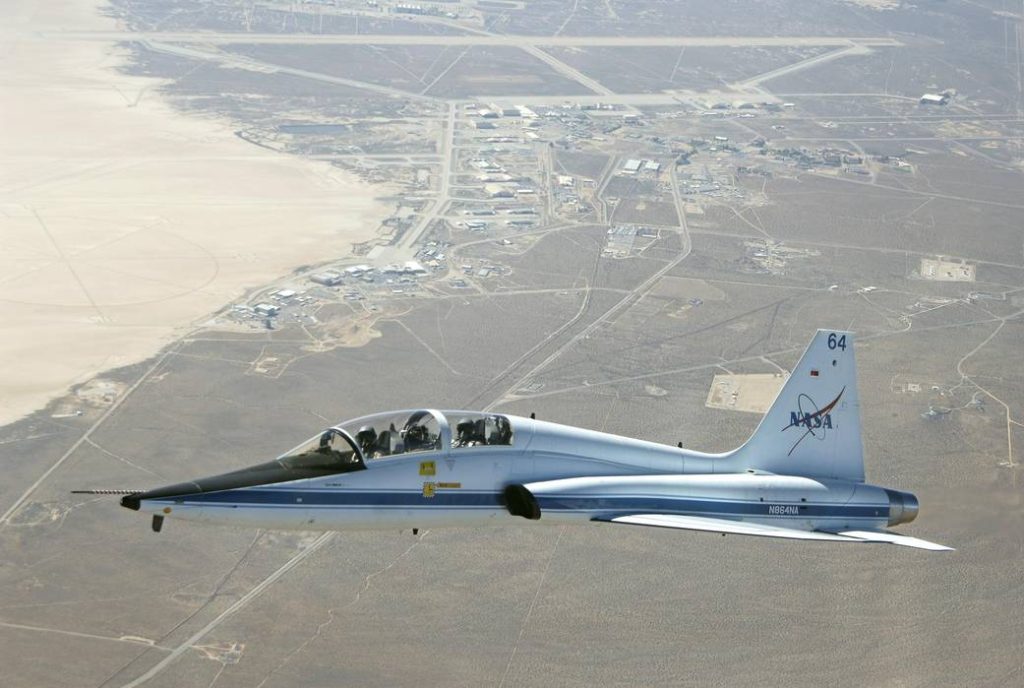
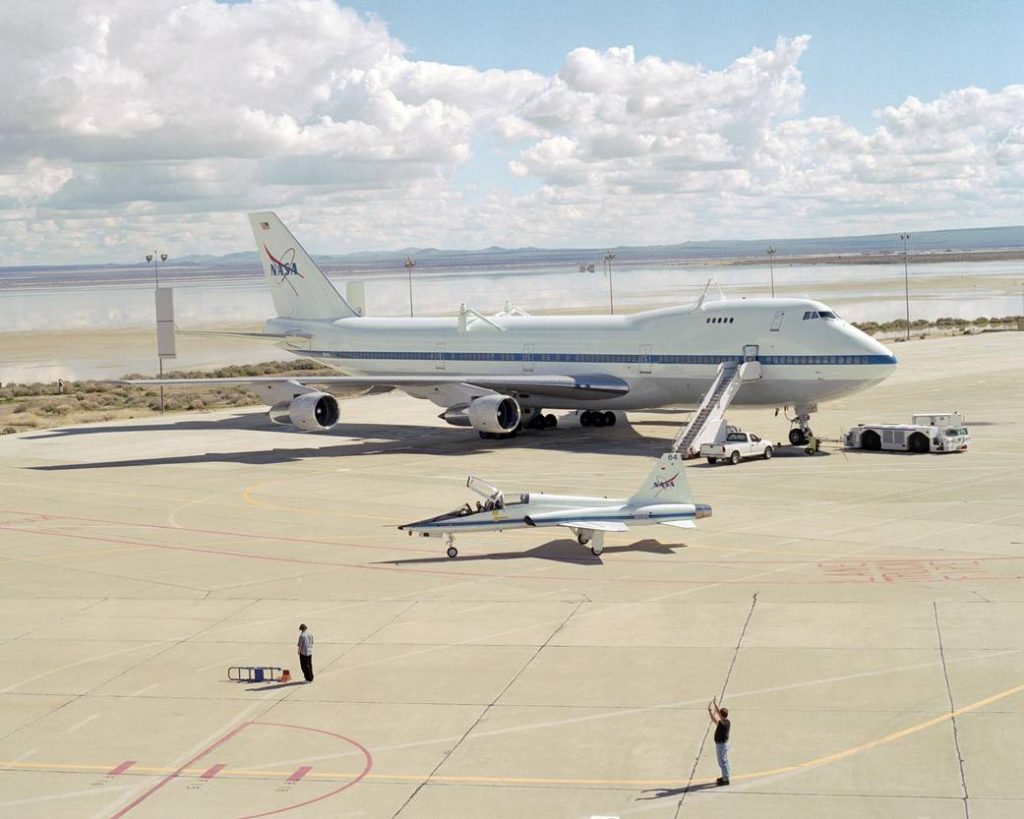
In the 1970s, the T-38 Talon helped the F-8 Digital Fly-By-Wire at Dryden Flight Research Center validate an electronic flight-control system coupled with a digital computer for the space shuttles. The 1977 Space Shuttle Enterprise Approach and Landing Tests (ALT) at Edwards AFB utilized NASA T-38 Talon jets as chase planes to photograph and monitor the unpowered glider’s behavior. During free flights, such as the September 23, 1977, test, three or more T-38s followed Enterprise after it released from the Boeing 747 carrier. The T-38 also served as a companion trainer for none other than the legendary SR-71, one of the fastest aircraft ever built. After the 1980s, the T-38 was used as a chase aircraft in several programs, including STS-3 and X-29. Currently, the trainer is used for missions such as Artemis and for building an experimental aircraft for NASA, the X-59 Quiet Supersonic Technology (QueSST), among others. For the last six decades, the T-38 has quietly sat at the forefront of aviation technology modernization. At NASA, it matured various concepts and astronauts for flights, and in the US Air Force, it trained 50,000+ pilots for frontline fighter and bomber aircraft such as the F-15E Strike Eagle, F-15C Eagle, F-16 Fighting Falcon, B-1B Lancer, A-10 Warthog, and F/A-22 Raptor. In the Flight Test Files series, many aircraft proved valuable for a single mission, some for two or more, but the T-38 Talon stands out as the one that has seen most of the ideas become reality at NASA since the 1960s. Read more Flight Test Files articles HERE.