

(Image credit: VAN)
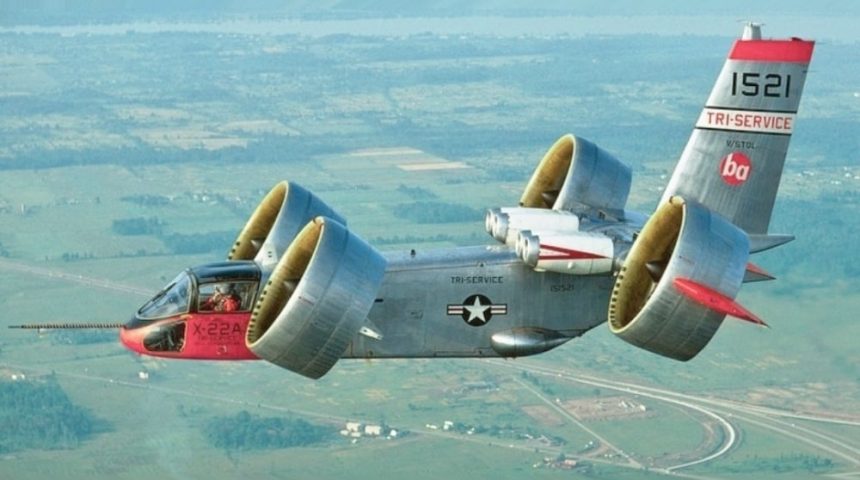
On this day in aviation history, 60 years ago (March 17, 1966), the Bell X-22 flew for the first time. The X-22 was an experimental vertical and/or short take-off and landing (V/STOL) aircraft, developed by Bell Aircraft in Buffalo, New York. Bell’s X-22 program provided useful data about the possible tactical application of vertical takeoff troop transporters. Development of the X-22 began in 1962, after a United States Navy request for two prototype aircraft with V/STOL capability, to be powered by four ducted fan nacelles. Bell already had a stockpile of VTOL data from their helicopter division’s achievements. The company already had a test mockup that could be used as a prototype. Known internally as the Bell Model D2127, the prototype was ordered by the US Navy in 1964. Shortly after the order, the aircraft’s designation became X-22. The X-22 was unveiled at an event in Niagara Falls in May of 1965.

The X-22’s unique design featured four wing-mounted General Electric-YT58-GE-8D turboshaft engines, with 1,250 shaft horsepower each. These turbines spun four 3-bladed Hamilton Standard propellers, which were mounted in wingtip swiveling ducts. Control of the aircraft was achieved by tilting the propeller blades in combination with the elevators and ailerons located in the thrust stream of the propellers. Takeoff could occur with the propellers tilted vertically upwards, or on a short runway, with the nacelles tilted forward 45°.

Flight testing of the X-22 showed promise for the design. Transitions between hovering and horizontal flight were successful “right out of the box.” Interest in VTOL and V/STOL flight technology increased, but Bell’s X-22 did not garner the same level of interest itself. The original prototype crashed due to a failure of the propeller control. A second prototype was built from the remains, and it first flew on August 26, 1967. Cornell Aeronautical Laboratory participated in the development of the “new” prototype, adding a variable flight control and stabilizer system that improved overall flight performance. The X-22 was considered the best aircraft of its type at the time, but the program was ultimately cancelled. The required maximum speed of 525 km/h (326.2 mph) was never attained, although 515 km/h (320 mph) was reached in flight testing. The second and final prototype last flew in 1968. This final X-22 survives today, in storage at the Niagara Aerospace Museum in Niagara Falls, New York.