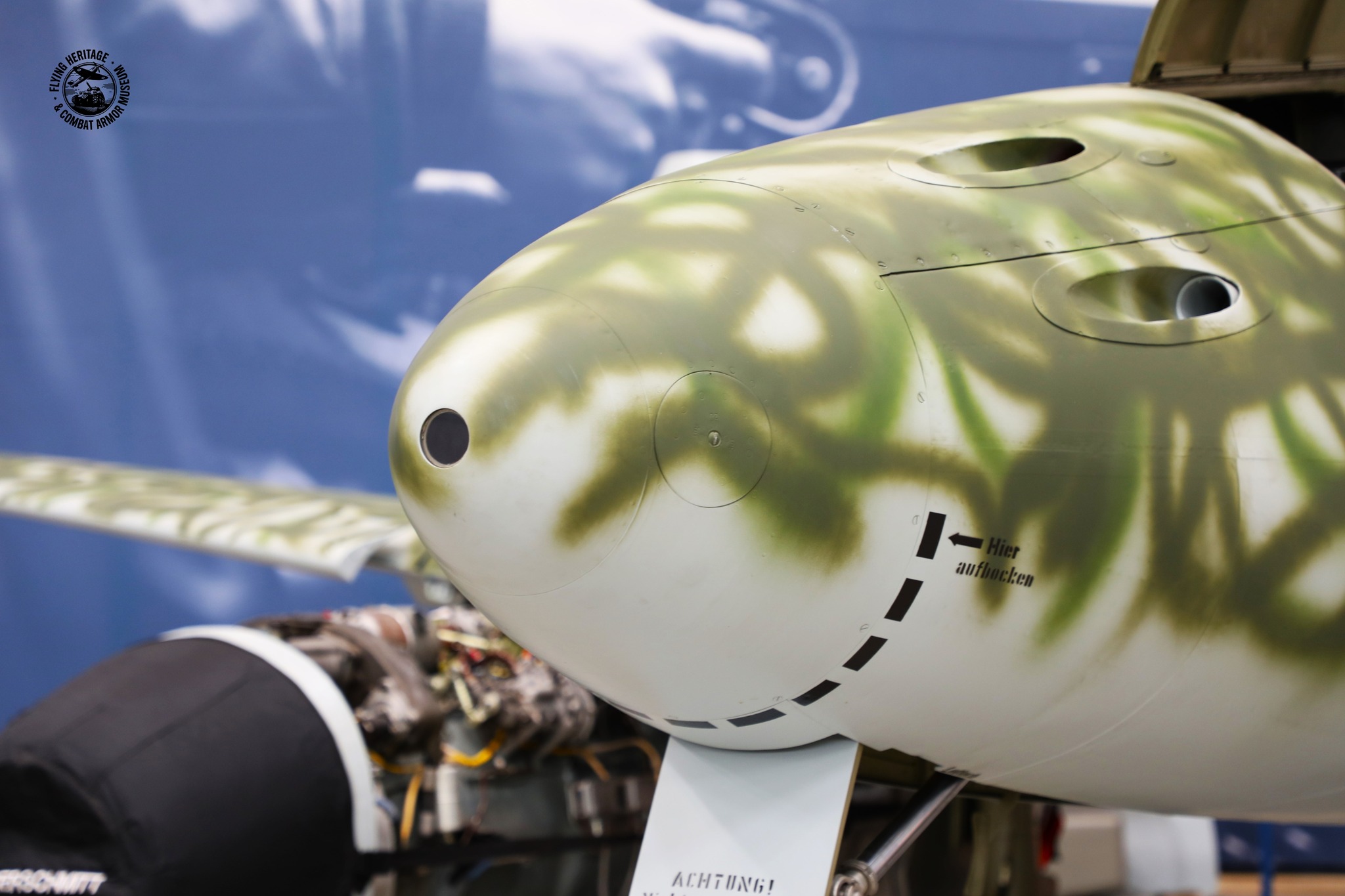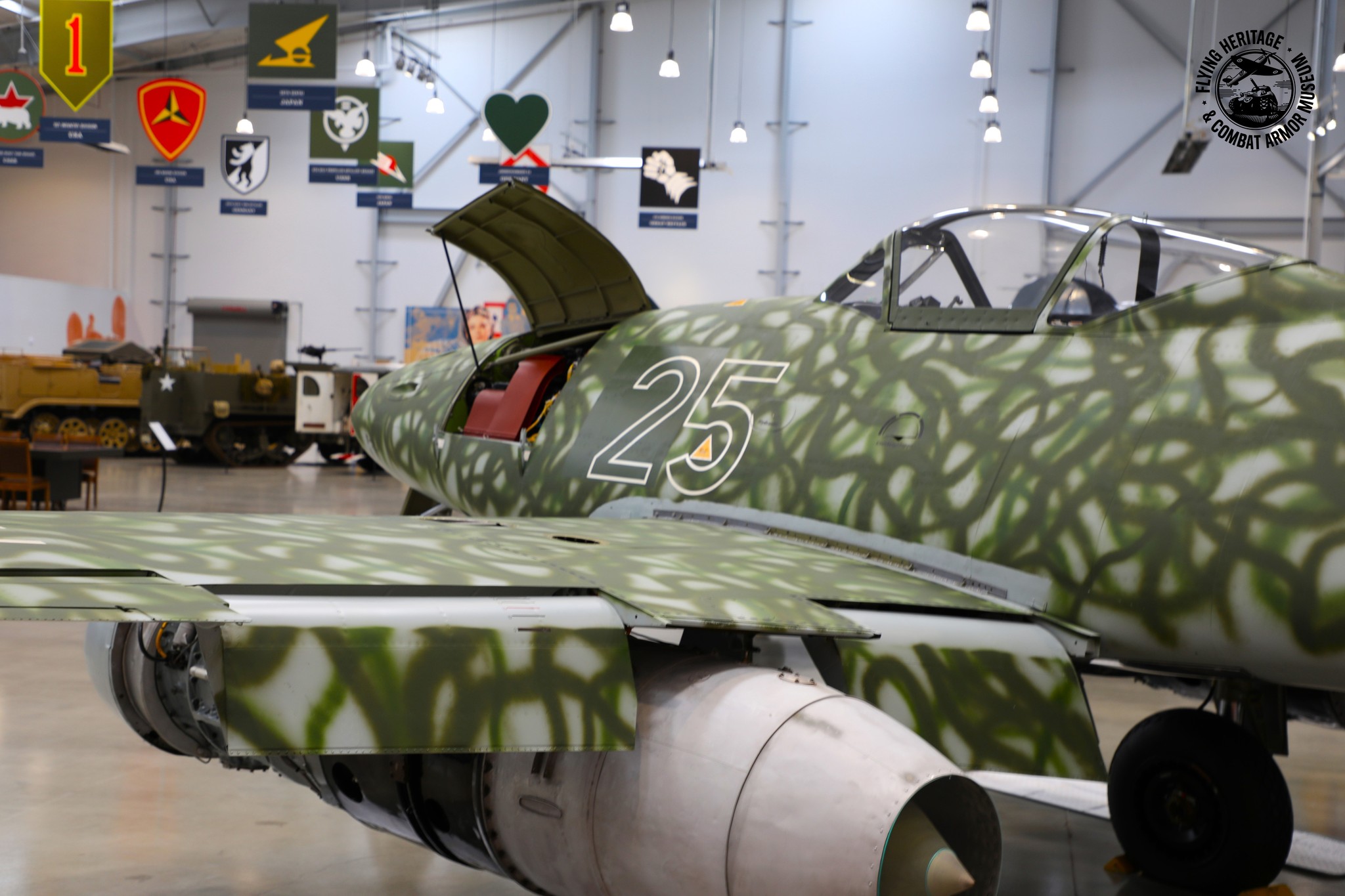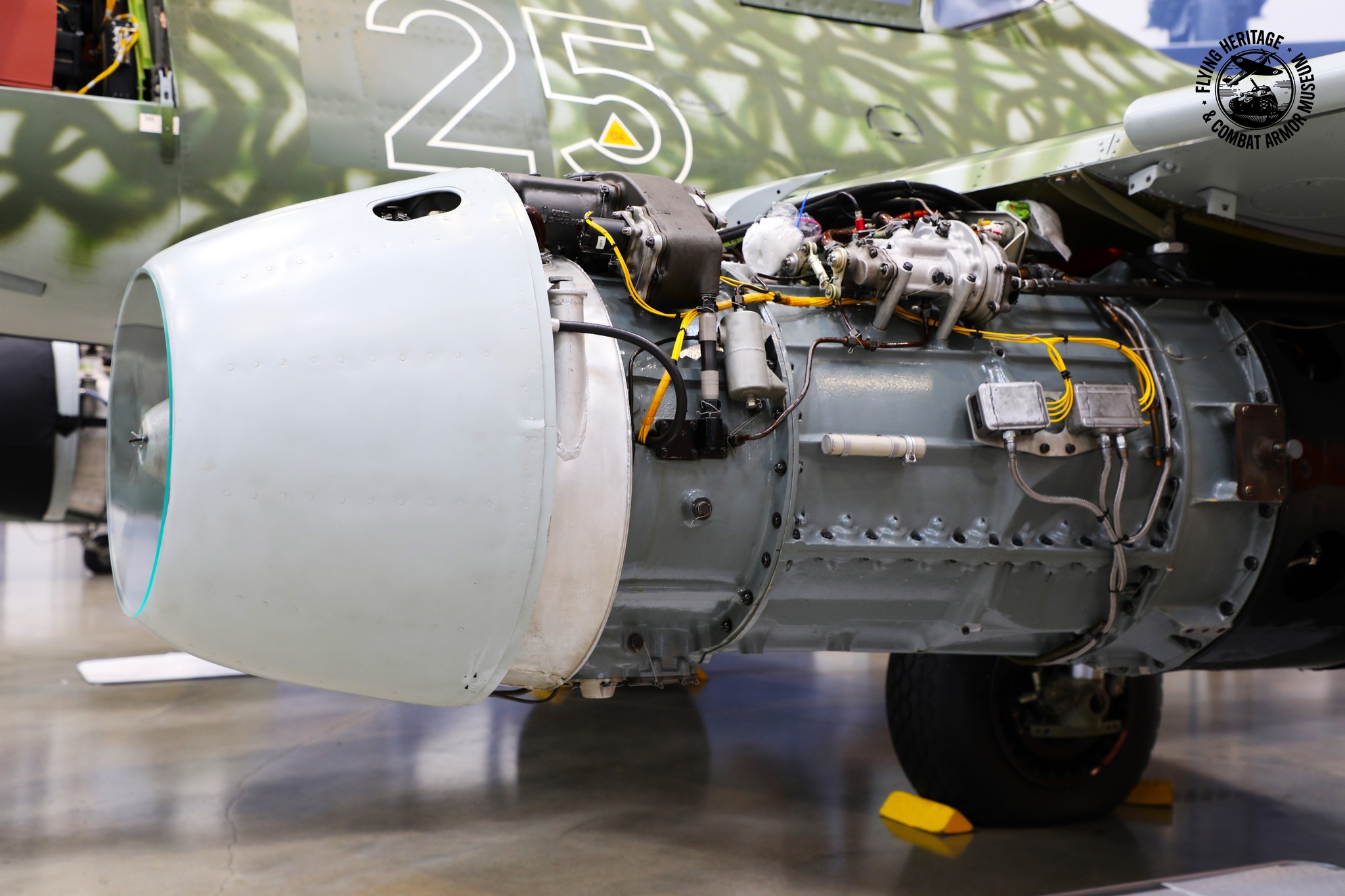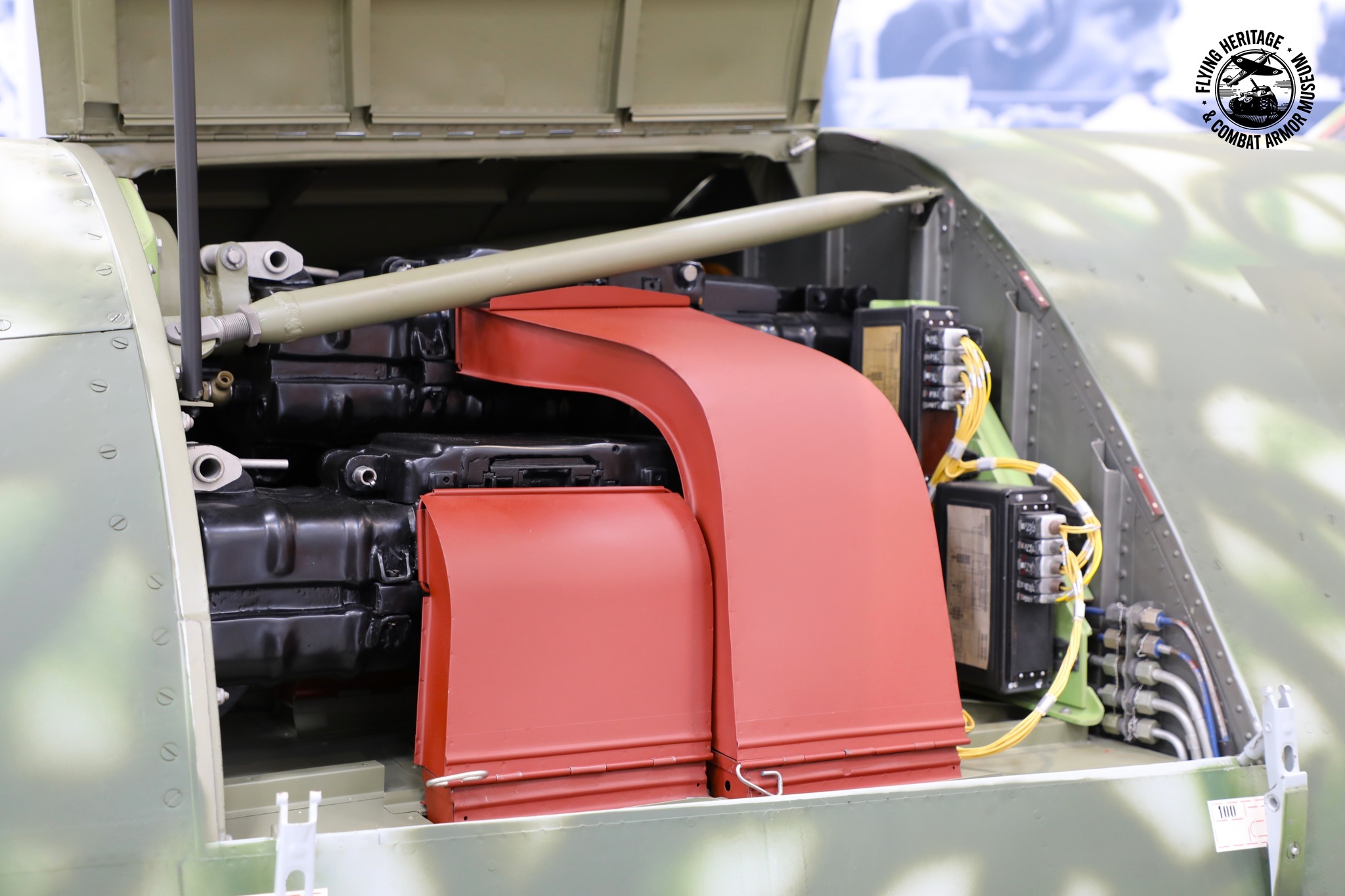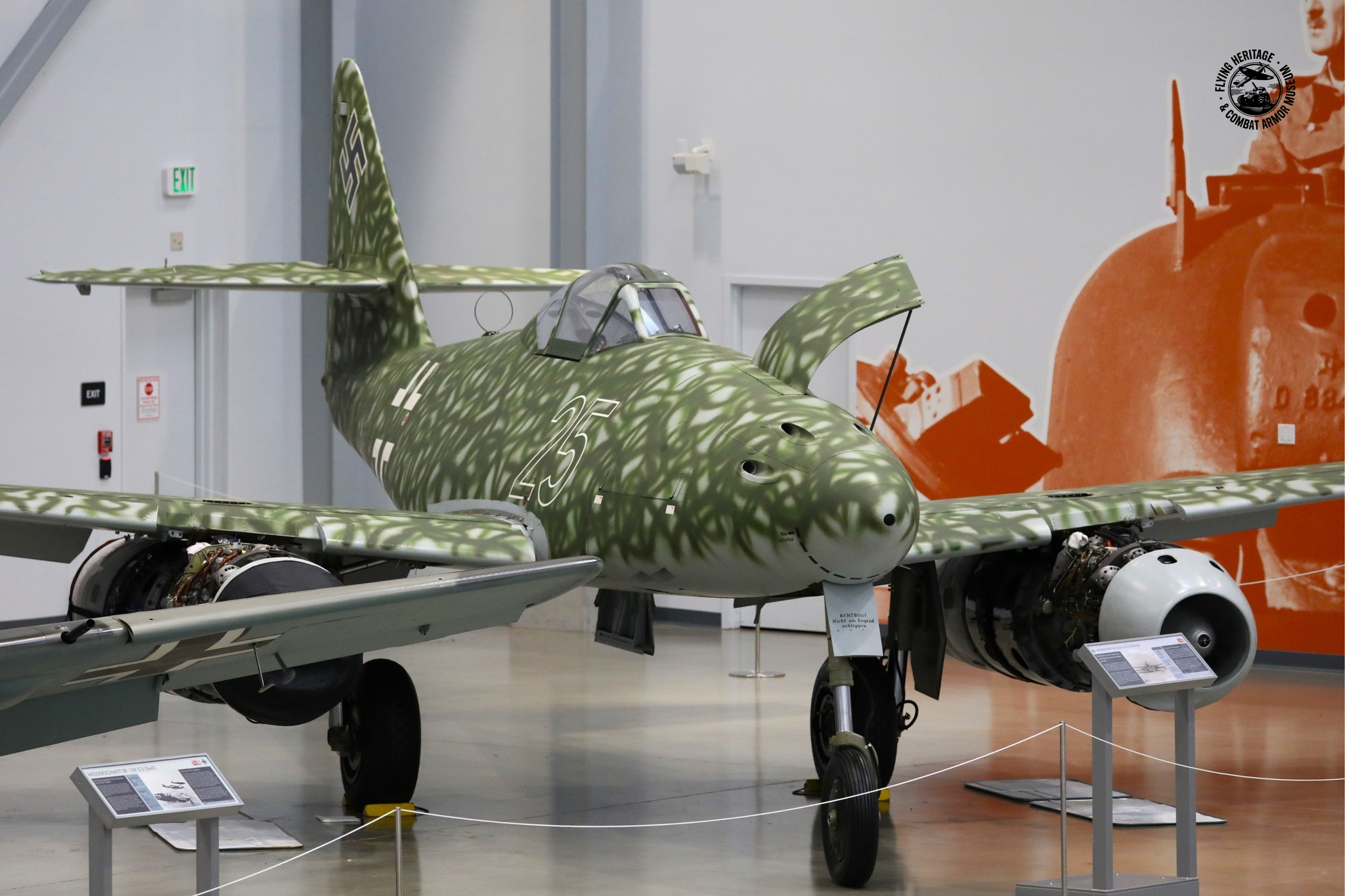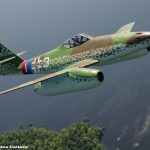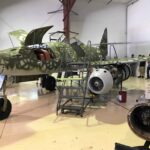
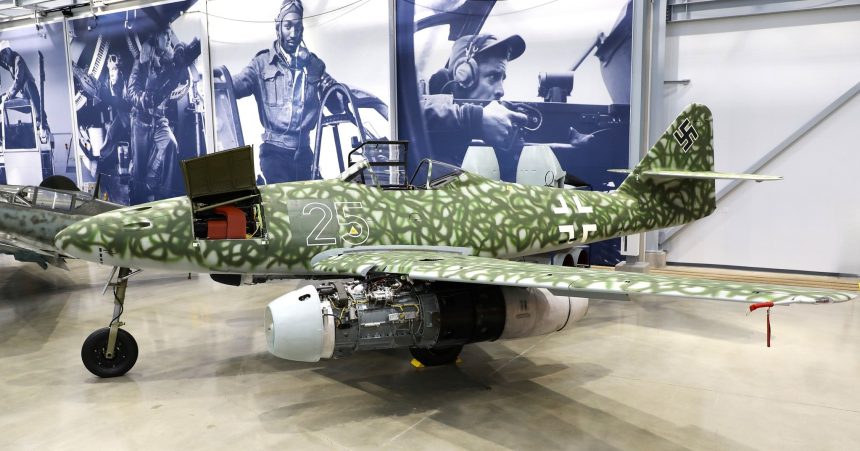

In discussions on the most advanced German aircraft of the latter half of World War II, no aircraft stands out in the public consciousness as prominently as the Messerschmitt Me 262 Schwalbe (Swallow). With its two underslung jet engines and four 30mm MK 108 cannons, the first fighter jet to see air to air combat would become the Luftwaffe’s last hope of regaining air superiority in the face of greater quantities of Allied fighters and bombers, but would have a short service life that ultimately no impact on the wider outcome of the most destructive conflict in human history. Yet it signaled the dawn of the Jet Age, and as the Americans, British, and Soviet armies advanced into Germany from the West and the East, the Me 262 would become the most sought-after German fighter aircraft to be studied, flight tested, and evaluated, and its influence on the designs of postwar jet aircraft would be seen in the construction and deployment of the first jet fighters of the Cold War. While 1,430 examples were built, only nine original Me 262s remain in existence around the world (with the exception of two postwar examples built in Czechoslovakia (the Avia S-92) being on display at the Kbely Aviation Museum in Prague, Czech Republic). One of these, however, stands as the only example restored to airworthy condition. This is Me 262A-1a/U3, Werknummer 500453, now on display at the Flying Heritage and Combat Armor Museum at Paine Field in Everett, Washington. Its journey from war-torn Germany was a long and twisting one, but it reveals a fascinating account of the need to evaluate weapons of war, and the efforts of individuals with the foresight and determination to preserve this aircraft for future generations.
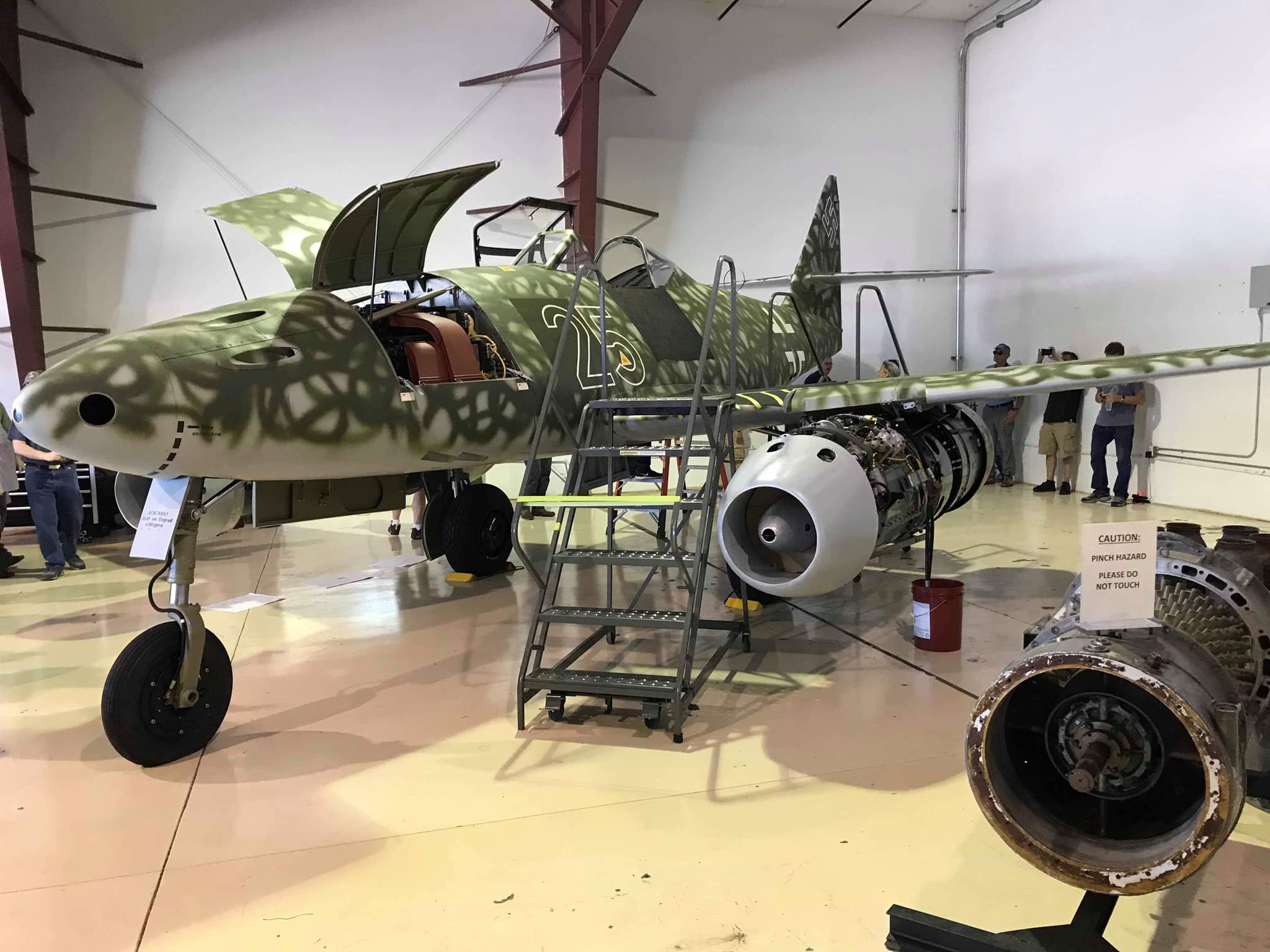
The story of the world’s only original Me 262 in airworthy condition began in the dying days of the Third Reich. By March 1945, the Allies were advancing deeper into Germany proper, and the days of the “Thousand Year Reich” were numbered. In the west, the Americans and the British crossed the Rhine and were also prepared to drive out the last pockets of German resistance in northern Italy. To the east, the vast armies of the Soviet Union were in East Prussia, and after crossing the Vistula River in Poland, they were now preparing to cross the Oder, the last natural barrier before Berlin. With the Allies possessing air superiority over Germany, conventional factories stood vulnerable to aerial bombing raids, and the desperate Germans began distributing areas of production to underground mines and tunnels, small workshops in rural settlements, and forest factories called Waldwerke, often conscripting slave labor from concentration camps for this work. It was in the Waldwerke in Obertraubling, just south of Regensburg, Bavaria, that Me 262A-1a Werknummer 500453 was built by slave laborers from the Flossenbürg concentration camp. Originally, the aircraft was built as an A-1a fighter variant before it was moved nearly 200 kilometers away by rail to Memmingen for completion. There, on March 14, 1945, Messerschmitt factory test pilot Oberfeldwebel (roughly equivalent to Sergeant) Otto Kaiser made a 15-minute test flight to break in the aircraft before it would be assigned to one of the remaining Luftwaffe units.
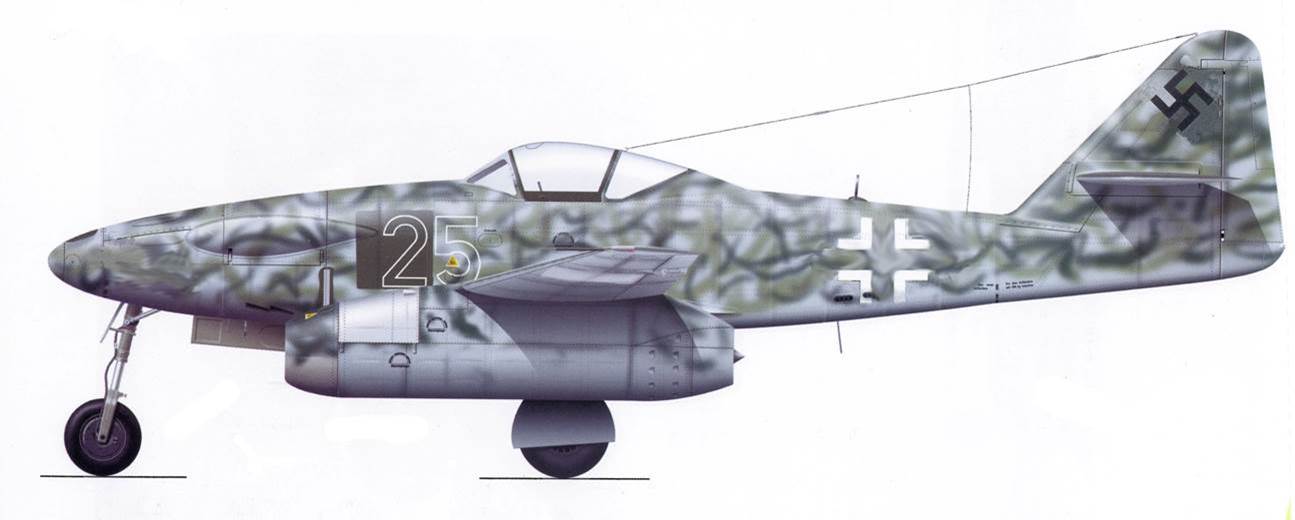
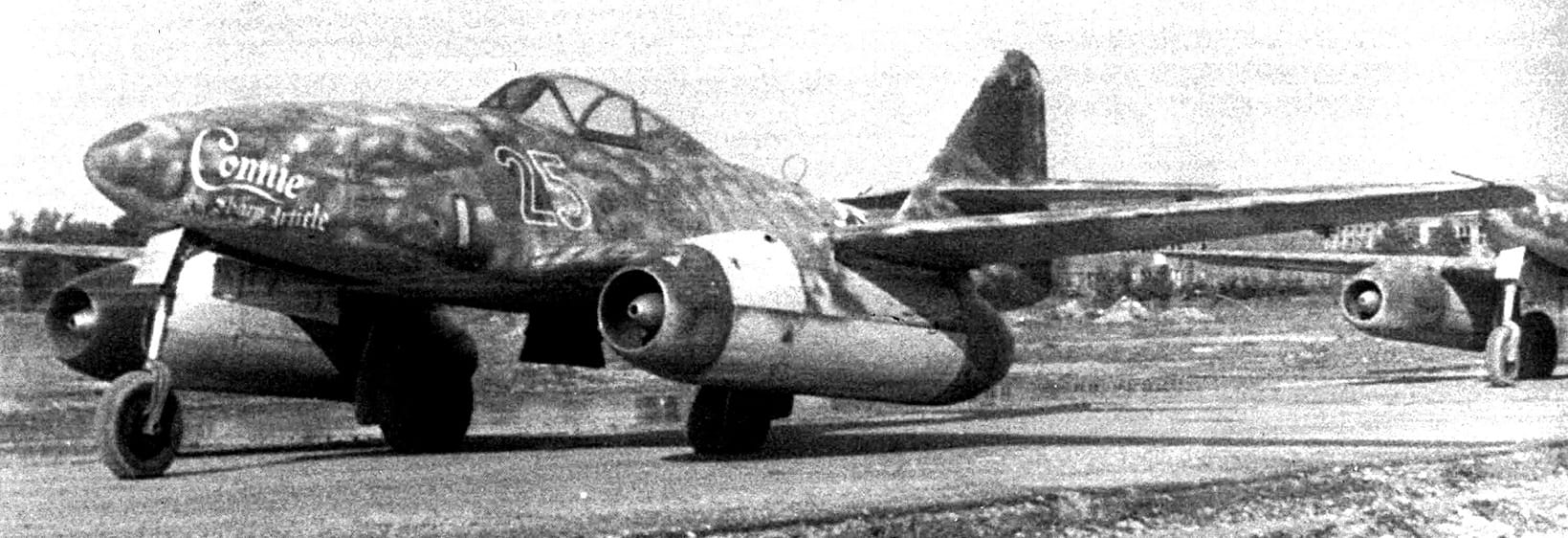
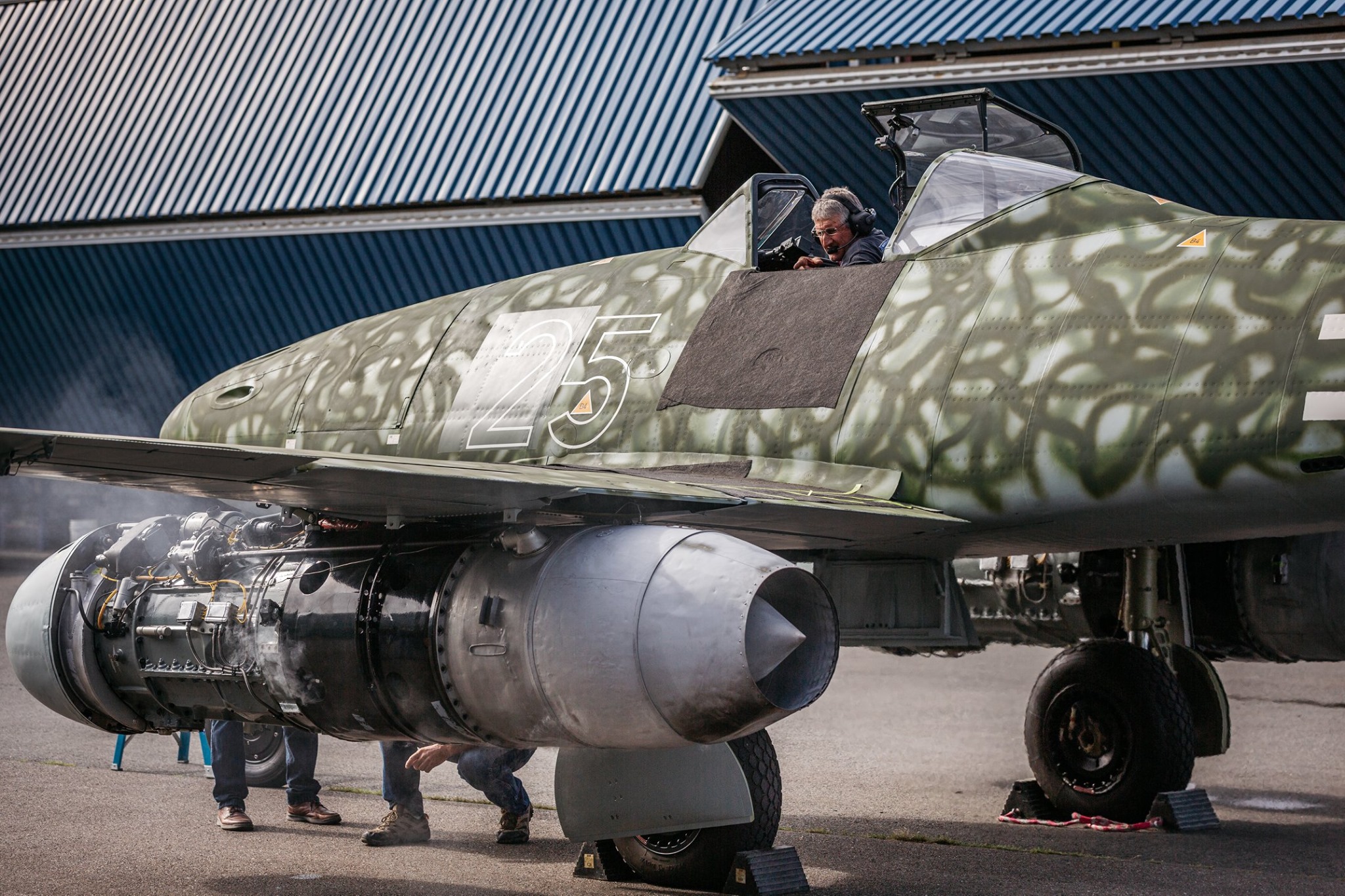
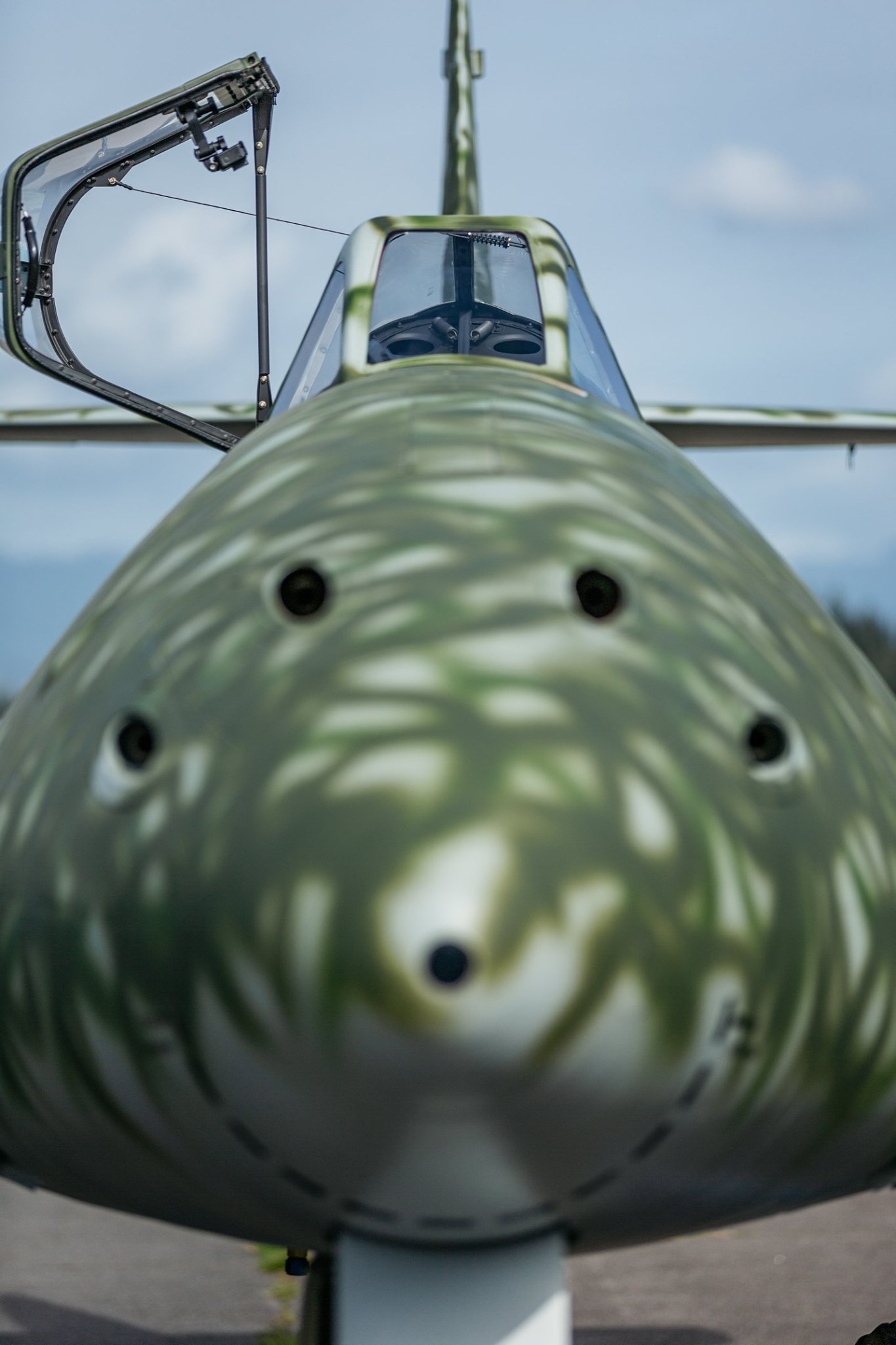
Shortly after Kaiser’s flight, Me 262 500453 was transferred to Cheb, Czechoslovakia, where it was converted to an A-1a/U3 photo-reconnaissance aircraft, with the four 30mm MK 108 cannons replaced by cameras and film compartments. The U3 subvariants (U3: Umrüst-Bausatz 3, Factory Modification Kit No. 3) were not only distinguished from their fighter cousins by having their gun ports fared over, but also by the large bulges on either side of the nose to accommodate the Rb 20/30 cameras, which were placed vertically to capture images of the ground below the aircraft. After this conversion, Me 262A-1a/U3 500453 was assigned to Nahaufklärungsgruppe 6 (NAGr. 6 (“Close Reconnaissance Group 6”)) at Lechfeld in April 1945 and was coded as “White 25”.
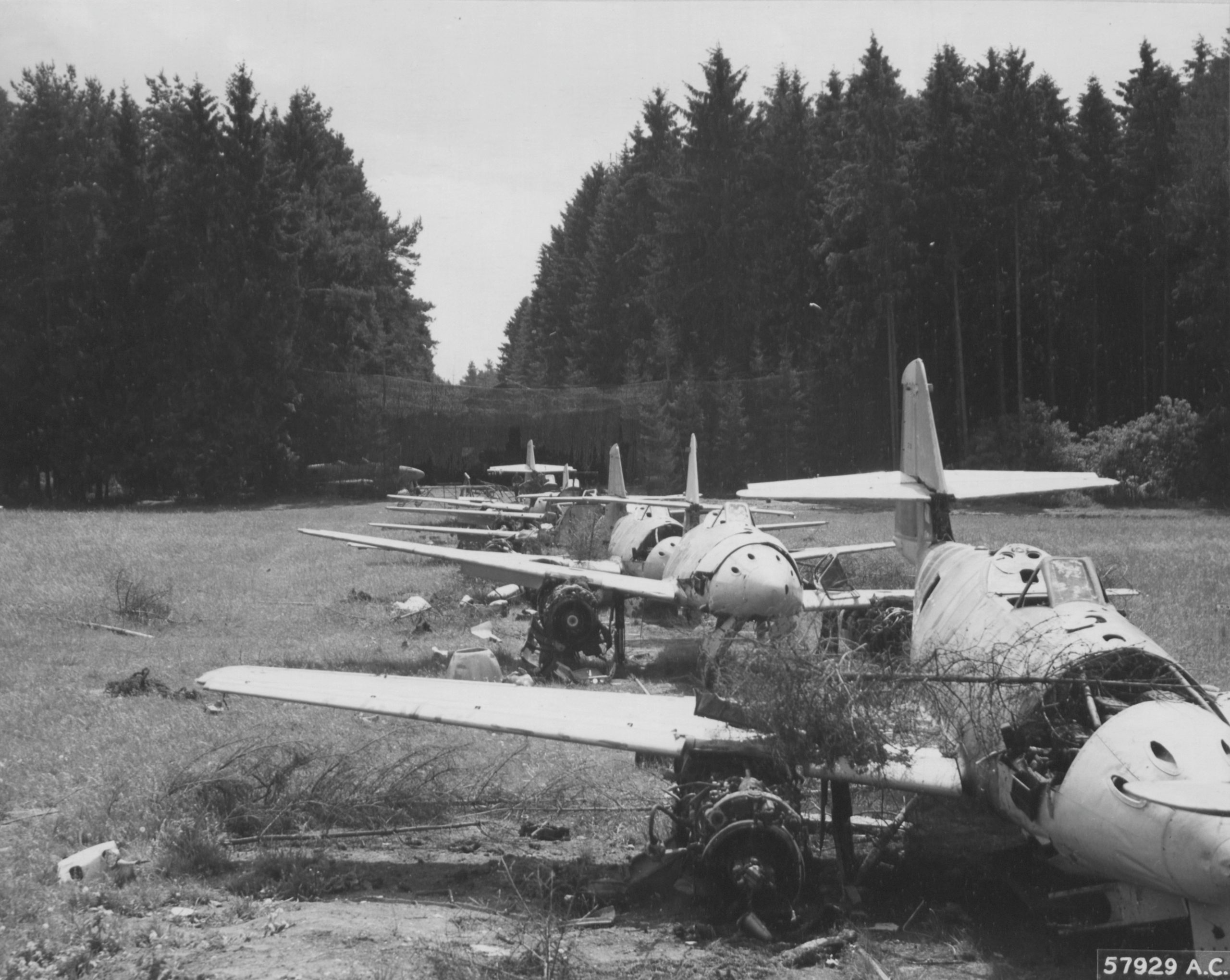
By now, though, the war was clearly lost, and the pilots of NAGr. 6 all decided to take their chances with the Americans rather than the Soviets for more lenient treatment. On May 4, 1945, just four days before the official surrender of Germany on May 8, American forces arrived in Lechfeld to little or no opposition. Much of the airfield’s facilities were destroyed by recent Allied air raids. The wreckage of German planes lay scattered around the airfield, including many Me 262s that also lay in the nearby forests to avoid being caught by American bombers and fighters. Now the U.S. Army’s 54th Air Disarmament Squadron took charge at Lechfeld and began preparing the airfield for the arrival of a crack team of American pilots and mechanics known as Watson’s Whizzers. Led by U.S. Army Air Force test pilot Colonel Harold Watson, this group of American pilots, crew chiefs, engineers, and mechanics was specially selected by Colonel Watson to scour war-ravaged Europe for signs of advanced German aircraft to be brought to the United States for technical evaluation and flight testing as part of Operation LUSTY (Luftwaffe Secret TechnologY). The Messerschmitt Me 262 Schwalbe jet fighter was at the top of their list, and Lechfeld would provide a base of operations to get the temperamental jets ready to be shipped to the USA. Though Watson and his men were among some of the most qualified personnel in the U.S. Army Air Forces in Europe, the men had little to no experience working with jet aircraft of any kind, let alone the aircraft of their vanquished counterparts.
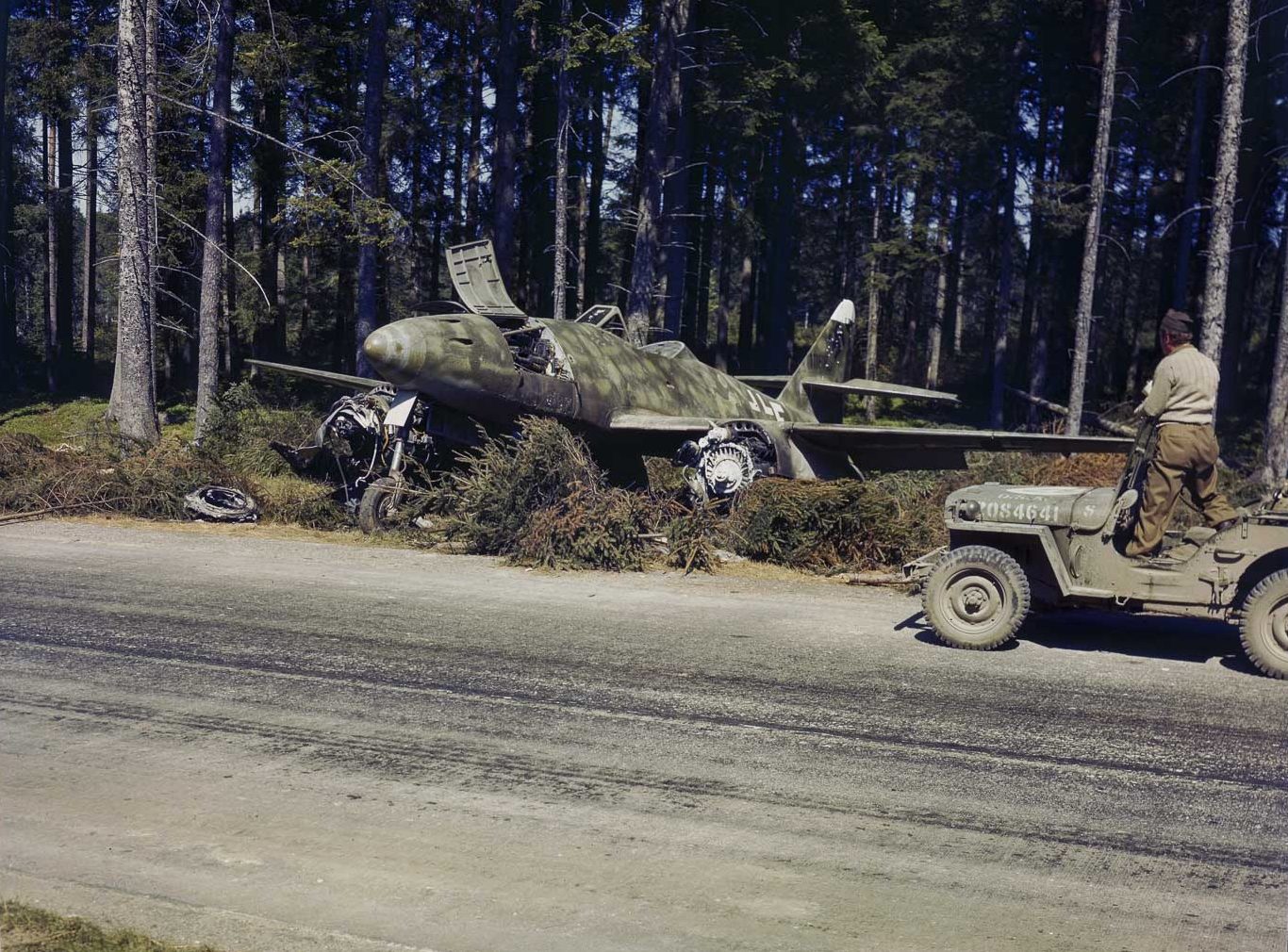
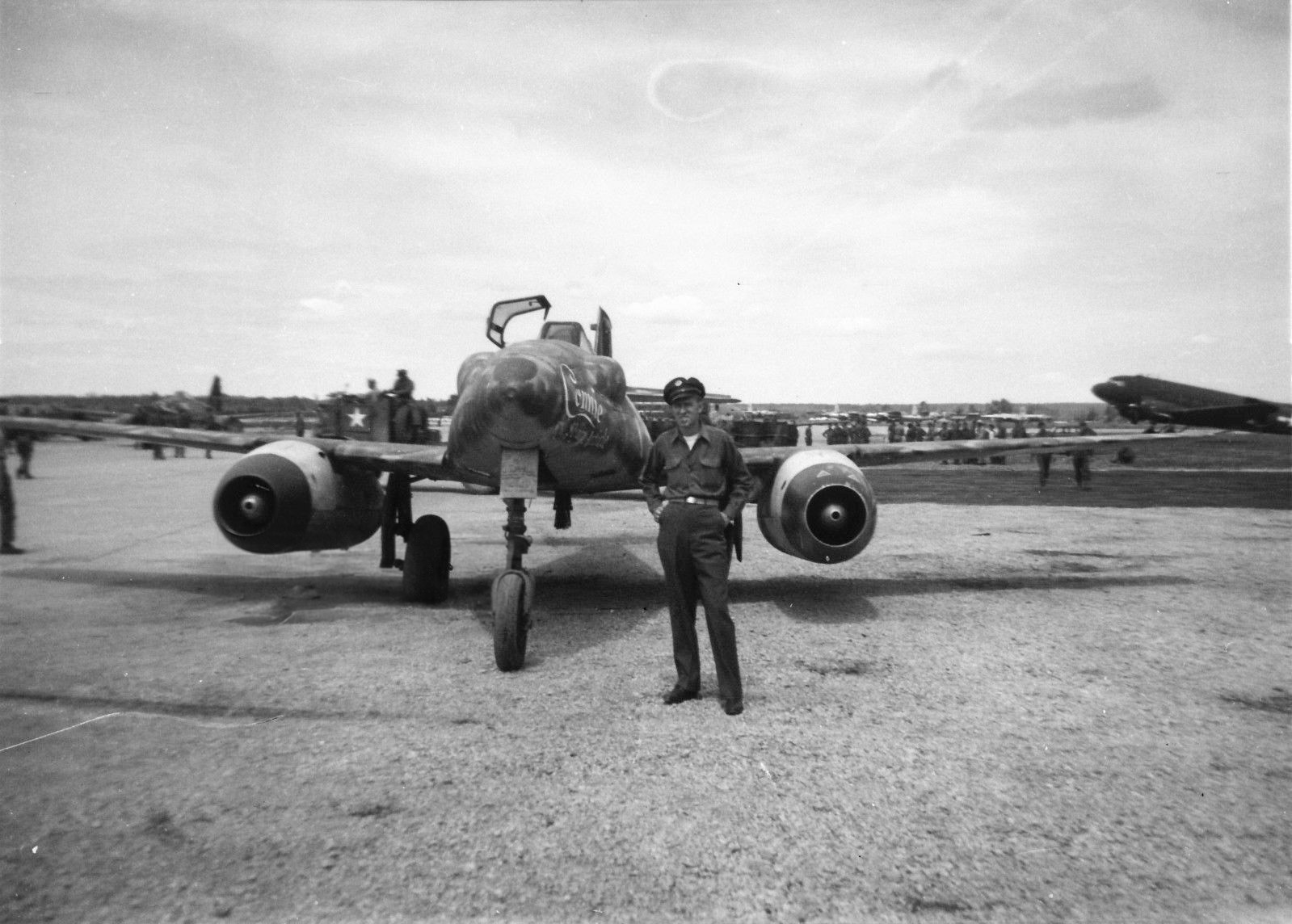
In an effort to expedite the process, Watson and his men turned to the German Me 262 pilots and mechanics. In exchange for helping the Americans get the Me 262s ready to fly out of Germany, the Germans would get preferential treatment, meaningful work, and a source of rations. After being vetted for security, several of the German mechanics agreed to stay on, where they worked alongside the American mechanics. Meanwhile, the two Messerschmitt test pilots, Karl Baur and Ludwig Hofmann, provided the American pilots with invaluable expertise on the operational procedures and risks associated with the Me 262s. The American crews affectionately nicknamed Karl “Pete” and Ludwig “Willie,” and Hoffman’s informal approach made him popular with both the American and German crews. Around this time, the American crews not only painted over the German Balkenkreuz and swastikas with USAAF roundels but also gave the Me 262s names and new three-digit serial numbers. Me 262A-1a/U3 became aircraft #444, while crew chief Master Sergeant H.L. Preston named the German jet Connie, the Sharp Article after his wife back in the States. As the German/American crews worked into the summer of 1945, Colonel Watson began making arrangements for the aircraft captured by his “Whizzers” to be transported to the continental United States. Me 262 #444 “Connie, the Sharp Article” assigned to Lt. Roy W. Brown Jr., who had previously flown P-47s in combat with the 526th Fighter Squadron, 86th Fighter Group, 1st Tactical Air Command.
By June 1945, the aircraft were ready to be flown out of Germany. The plan was for all the captured German aircraft collected from Europe by American units to be brought to the port of Cherbourg, France, and be loaded on ships bound for the United States. A total of nine Me 262s were restored to airworthiness to make the flight on June 10, 1945. Because of the limited range of the Me 262s, they had to make two stops on the way to Cherbourg, with the first being at Saint-Dizier Airfield (Advanced Landing Ground A-64), and the second at Melun Villaroche Aerodrome (Advanced Landing Ground (ALG) A-55).
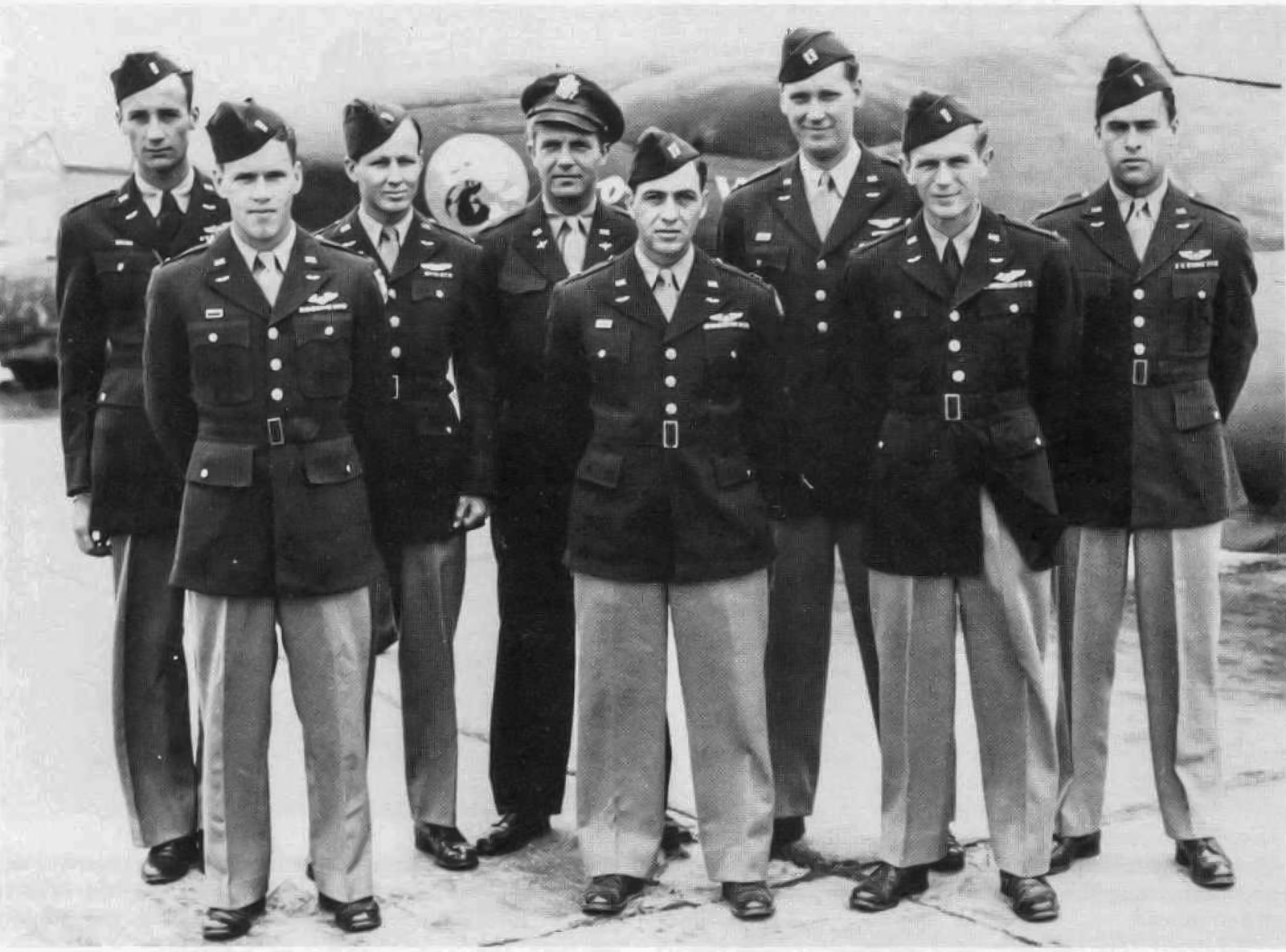
However, in examining the auxiliary fuel tank of Connie, Roy Brown, an engineer by training, felt that if he could get the Me 262 to 10,000 feet for cruising altitude and switch to his auxiliary tank immediately after leveling off, he could make a direct flight from Lechfeld to Melun. Brown discussed his idea with Colonel Watson and Bob Strobell, another P-47 pilot, who allowed him to make the direct flight, but on the condition that if anything went wrong, he should divert to St. Dizier. Fortunately for all the pilots, the Me 262s arrived in Melun without incident, but they would remain there to give General Carl Spaatz, commander of the U.S. Strategic Air Forces in Europe, a demonstration of the captured German jet fighters that was held on June 27, and for the aircraft to be serviced before the flight to Cherbourg. Besides the nine from Lechfeld, an additional two Me 262s originally surrendered to the British but transferred to the USAAF were also flown to Melun for the demonstration.
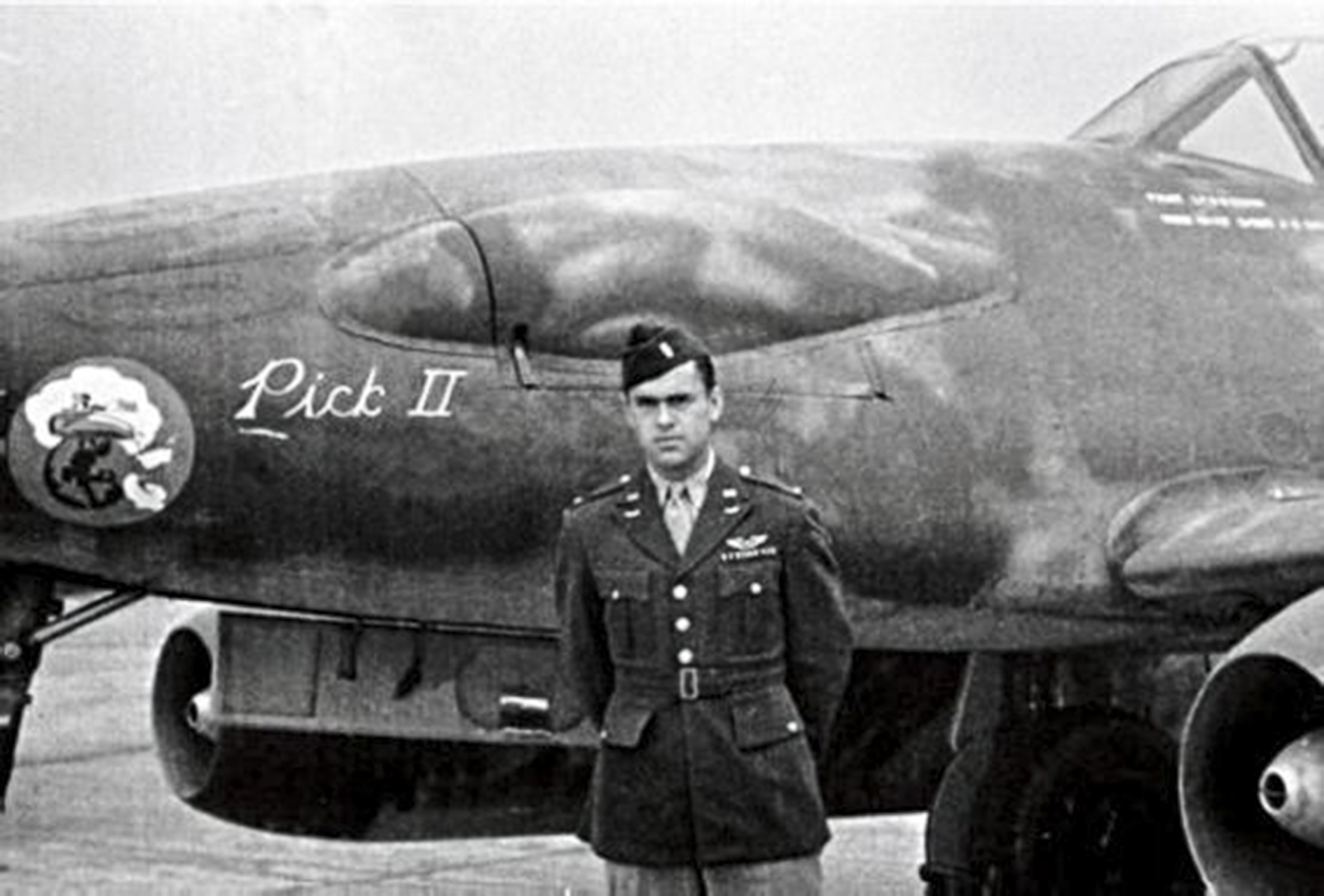
While at Melun, all of the Me 262s that were given names by the crew chiefs who fixed them up would see the pilots get a turn to put their own personal touches on the aircraft. For example, Lt. Brown would give “Connie the Sharp Article” another name, “Pick II,” since his old P-47 was also named “Pick” after his wife’s maiden name. Following the demonstration for General Spaatz and some maintenance, the Me 262s began their flight to Querqueville Airfield, just outside the western edge of the Port of Cherbourg, on June 29th, 1945. Though Lt. Brown and aircraft #444 would arrive safely at Querqueville, two of the Me 262s did not make it. One of these, Me 262A-1a/U4 Werknummer 170083 “Willa Jeanne”/ “Happy Hunter II”, equipped with a special 50mm autocannon, was being flown by Ludwig Hofmann when one of the aircraft’s turbine blades broke off mid-flight, causing such severe engine vibration that Hofmann had no choice but to bail out at high speed. Hofmann was struck by the aircraft on the way out, but survived, though the same could not be said of the aircraft. Meanwhile, the group’s only two-seat armed trainer, Me 262B-1a Werknummer 110639 suffered a nose gear collapse on landing, which resulted in the aircraft being fitted with a new nose section flown in by a C-47, and Me 262A-1a Werknummer 110637 (US #333), flown by Bob Anspach, overshot Cherbourg in inclement weather, but managed to land on the Isle of Jersey while on his minimal reserves of fuel. Fortunately, the aircraft was undamaged, and after a load of fuel was transported by a C-47, Anspach and his Me 262 made it to Querqueville.
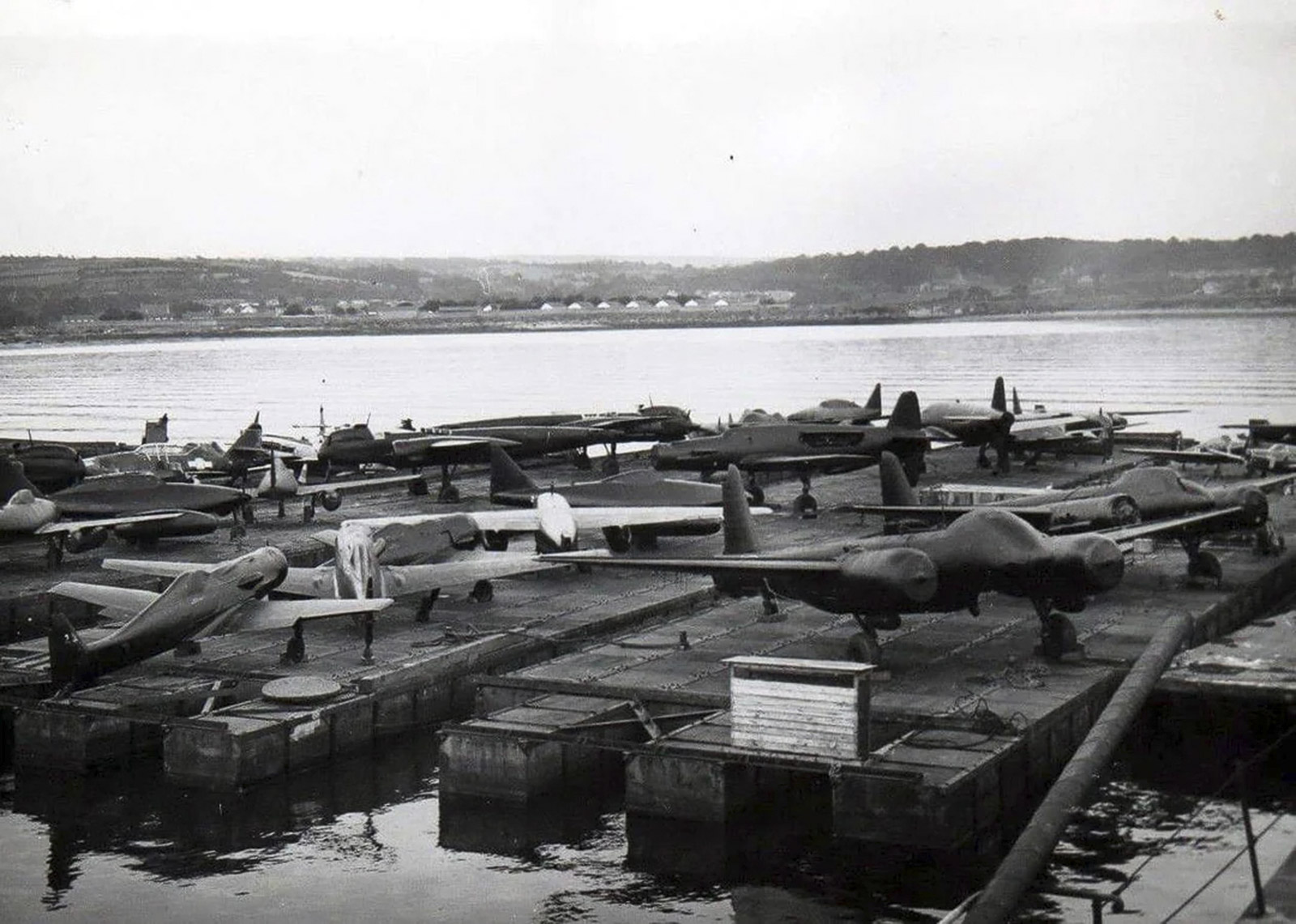
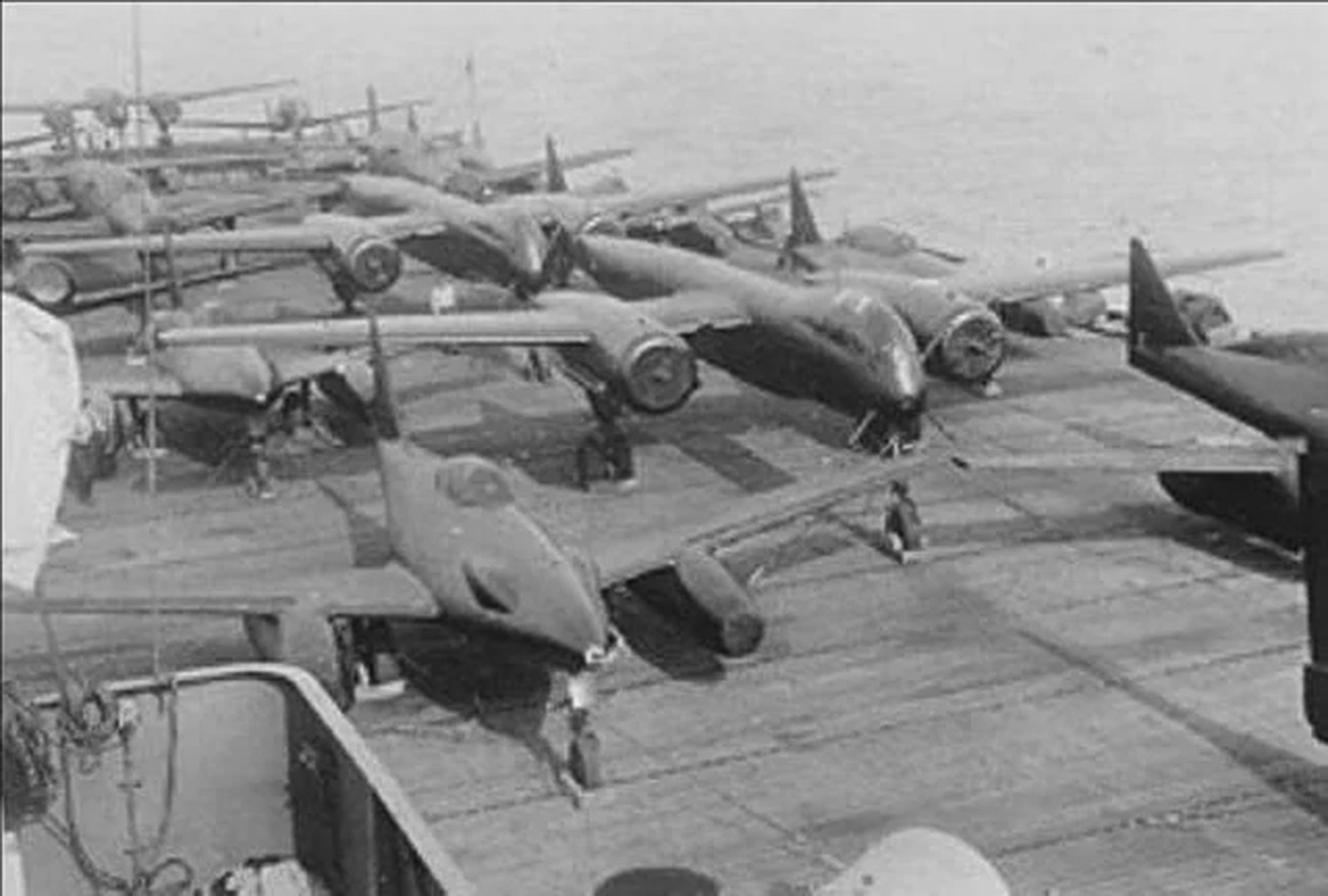
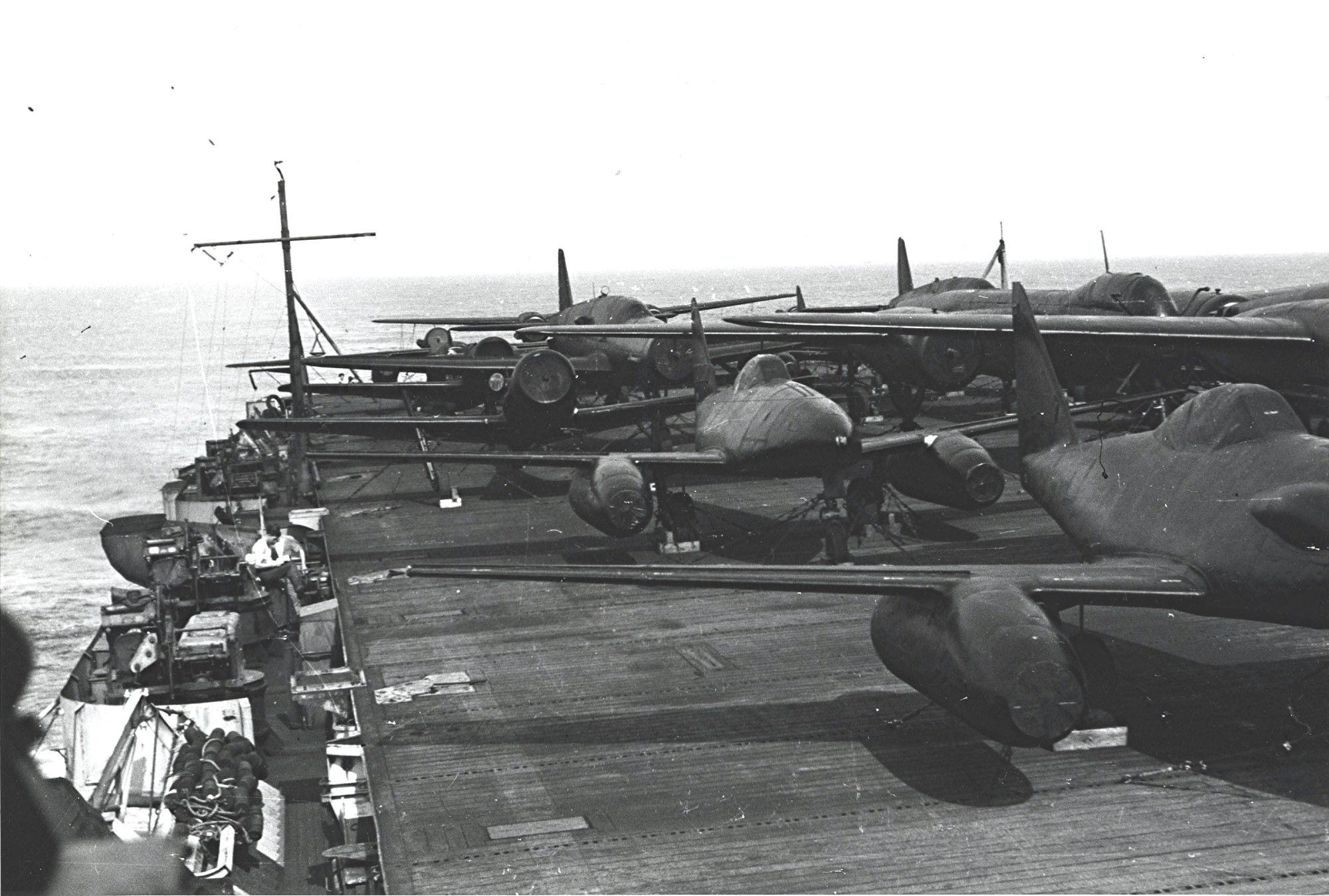
With the captured German aircraft secured at Querqueville, the next phase of Operation LUSTY would begin. This was to be Operation Seahorse, the shipment of the aircraft from Cherbourg to Newark, New Jersey. Most of the aircraft were to be transported aboard the American-built British escort carrier HMS Reaper (D82), while several other disassembled aircraft, along with thousands of documents and pieces of equipment, were to be shipped aboard the Liberty ship Richard J. Gatling. In total, the Reaper was to transport no less than: Ten Messerschmitt Me 262s, four Arado Ar 234 jet bombers, three Heinkel He 219 Uhu night fighters, two Dornier Do 335 Pfeil heavy-fighters, four Focke-Wulf Fw 190Ds, five Focke-Wulf Fw 190Fs, one Focke-Wulf Ta 152H, three Messerschmitt Bf 109s, two Bücker Bü 181 trainers, two Flettner Fl 282 helicopters, one Junkers Ju 88G, one Junkers Ju 388, one Doblhoff WNF 342 helicopter, one Messerschmitt Bf 108, and one North American F-6D Mustang (photo-reconnaissance variant of a P-51D).
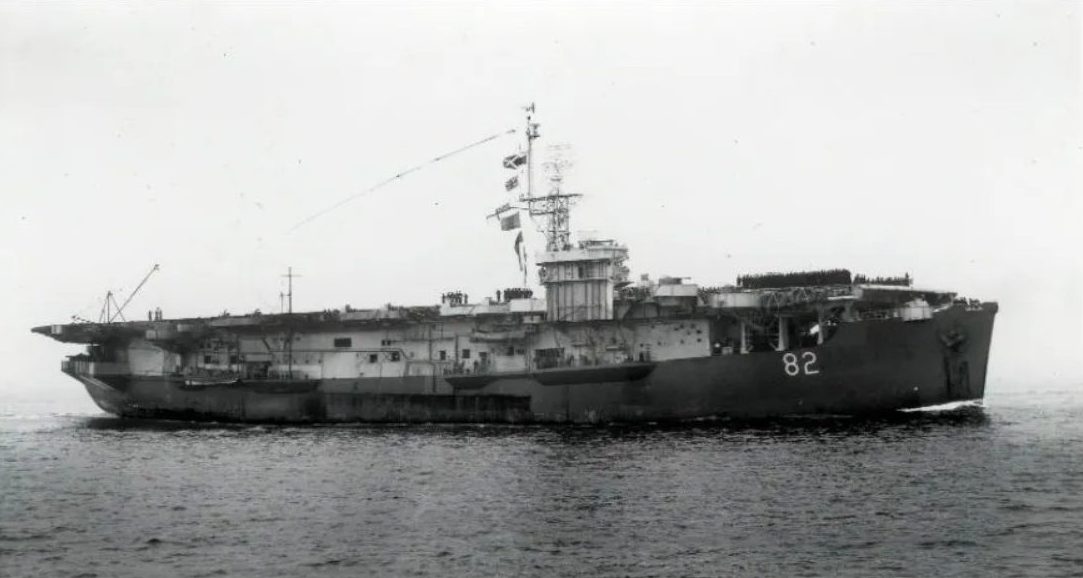
Ground personnel were tasked with shrink-wrapping the airplanes to protect them from the sea spray, for the ship’s hangar deck was filled with her full complement of combat aircraft, and many of the larger aircraft could not be stored below the flight deck either. After being loaded on barges at Querqueville and towed to the port, the German aircraft were hoisted aboard HMS Reaper by crane, and the ship left port on July 19, 1945. On July 31, the Reaper arrived in New York Harbor, and the German aircraft were barged to Newark Airport, which was still under the control of the U.S. Army Air Force after being requisitioned from the civilian authorities. Meanwhile, HMS Reaper began its next journey for the Panama Canal to join the British Pacific Fleet in the ongoing fight against Japan, but before the carrier transited the locks, it received news of the Japanese surrender and the end of WWII.
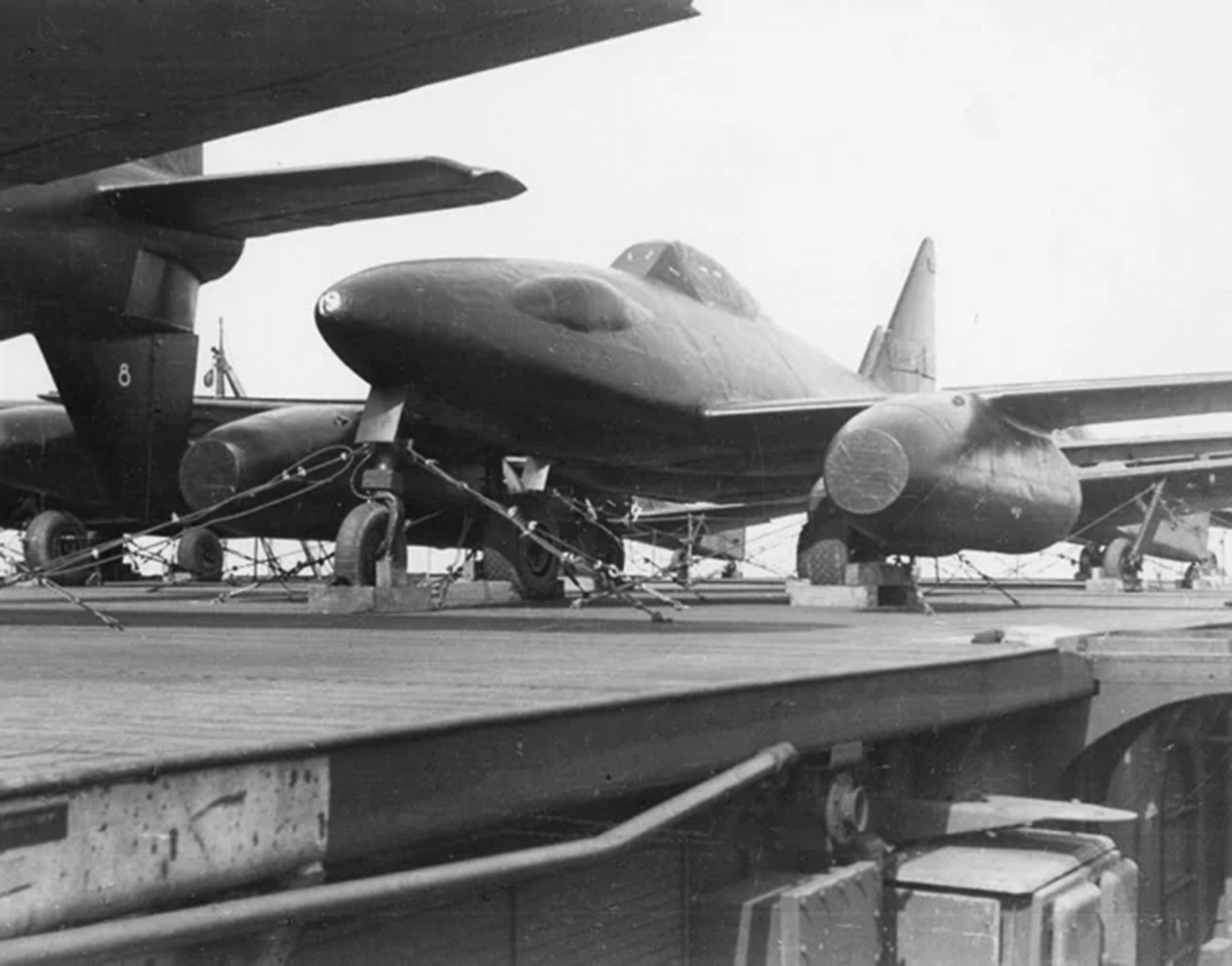
By August 1945, the captured Germans brought to America aboard the Reaper were being divided up between the U.S. Air Force and the U.S. Navy for separate series of evaluations. Me 262-1a/U3 Werknummer 500453 was among the aircraft selected for evaluation with the USAAF, and on August 19, 1945, Colonel Harold Watson himself flew the aircraft from Newark to Freeman Army Airfield near Seymour, Indiana, with a refueling stop in Pittsburgh along the way. Freeman Field had been established in 1942 and named for Captain Richard S. Freeman, an Army Air Corps pilot from Winamac, Indiana, who was killed in the crash of a B-17B Flying Fortress in Nevada on February 6, 1941. For much of the war, Freeman Field served as a training base, where from February 1943 to June 1944, Beech AT-10 Wichita twin-engine advanced trainers taught thousands of USAAF pilot cadets to fly multi-engine aircraft before flying bombers and transports. Freeman would also become the first USAAF installation to train helicopter pilots, and from July 1944 to February 1945, pilots learned to fly the Sikorsky R-4, the first American mass-produced helicopter. After the R-4s were later transferred to Chanute Field in Rantoul, Illinois, Freeman Field would become assignment for the 477th Bomb Group, the first all-African American bomber group in the USAAF, with its members forming a seldom-remembered branch of the famed Tuskegee Airmen.
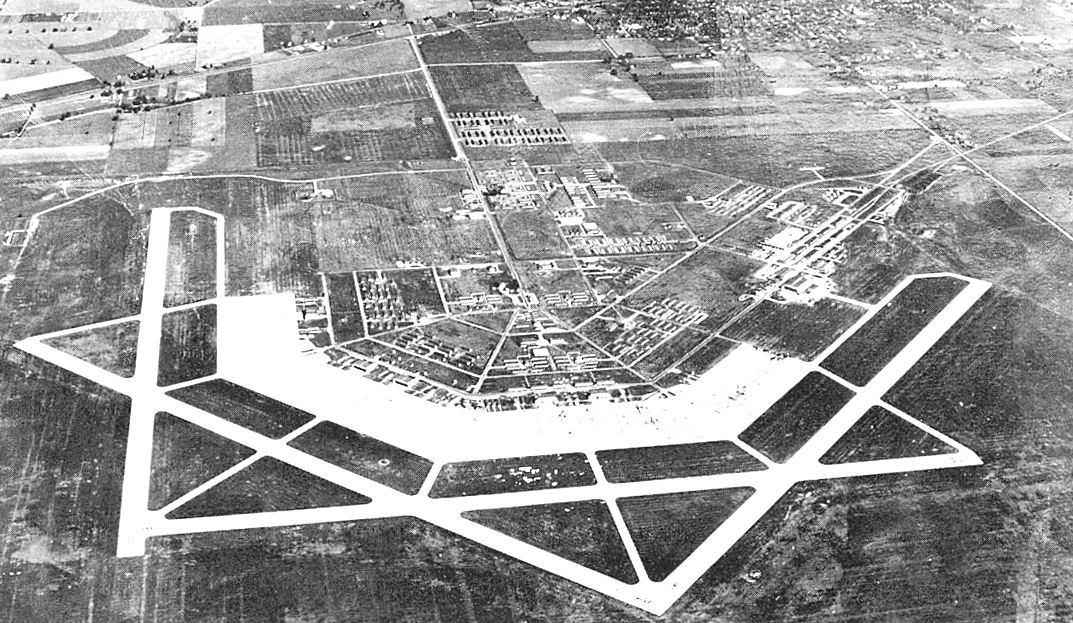
Though the men of the 477th were being trained to fly and service the North American B-25 Mitchell bomber, all of the men had faced segregation at their initial assignment at Selfridge Field, Michigan, and their next assignment, Godman Field at Fort Knox, Kentucky, did not have the facilities adequate for training B-25s. When the officers arrived on April 5 and 6, 1945, they attempted to integrate the all-white officers’ club, which led to the incident known to history as the Freeman Field mutiny. In all, 162 officers were arrested (some twice) for refusing the orders of superior officers in a time of war, leading to three court-martials and one conviction that was not overturned until 1995. Following this incident, the 477th Bomb Group was reassigned to Godman Field, but the Freeman Field mutiny became a milestone in the push to desegregate the US military. After this, Freeman Field was rendered inactive from May 2 to June 11, 1945, when the Air Technical Service Command (ATSC) made it the USAAF’s Foreign Aircraft Evacuation Center (FAEC), freeing up resources from Wright-Patterson Army Airfield in Dayton, Ohio.
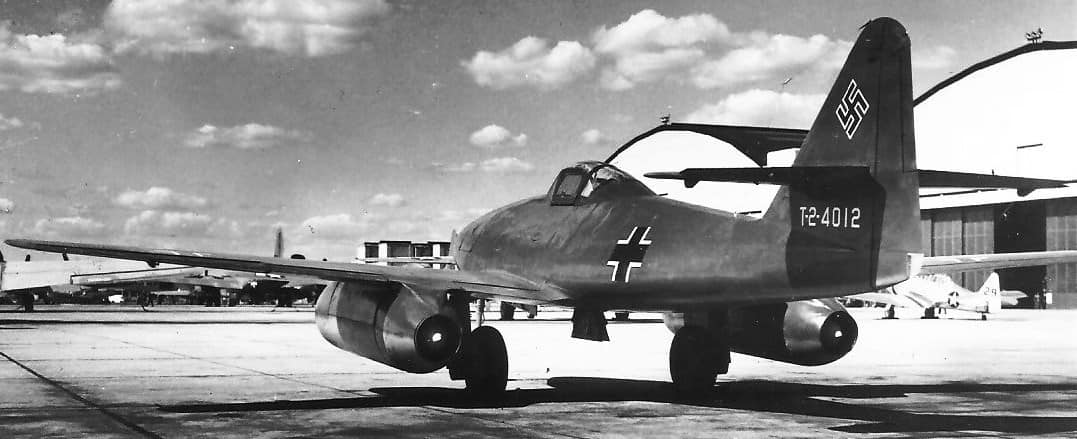
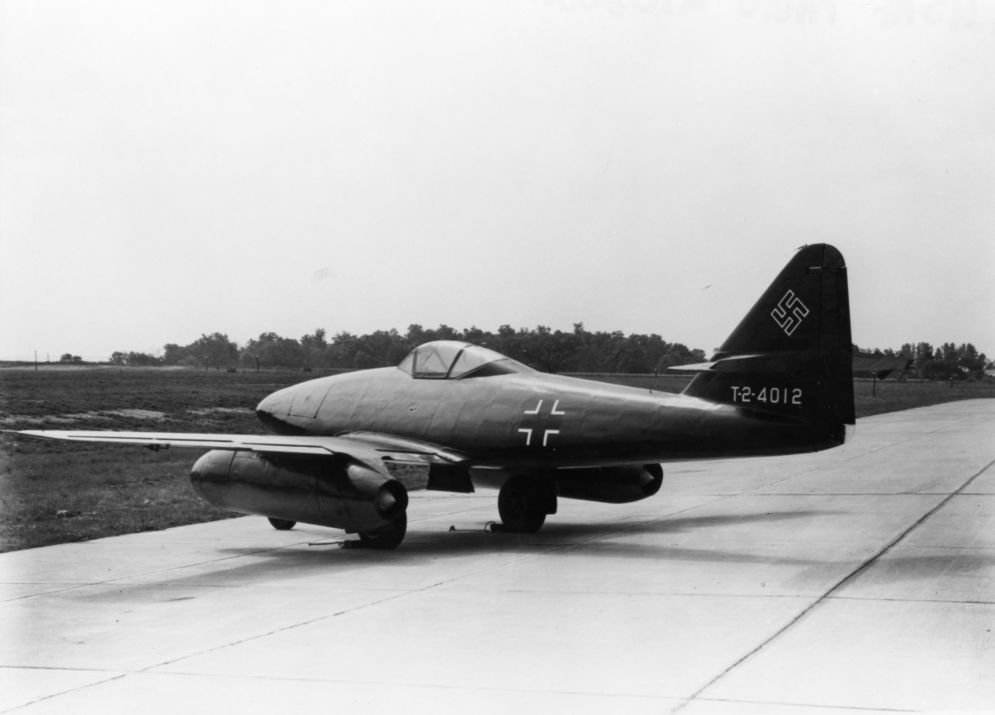
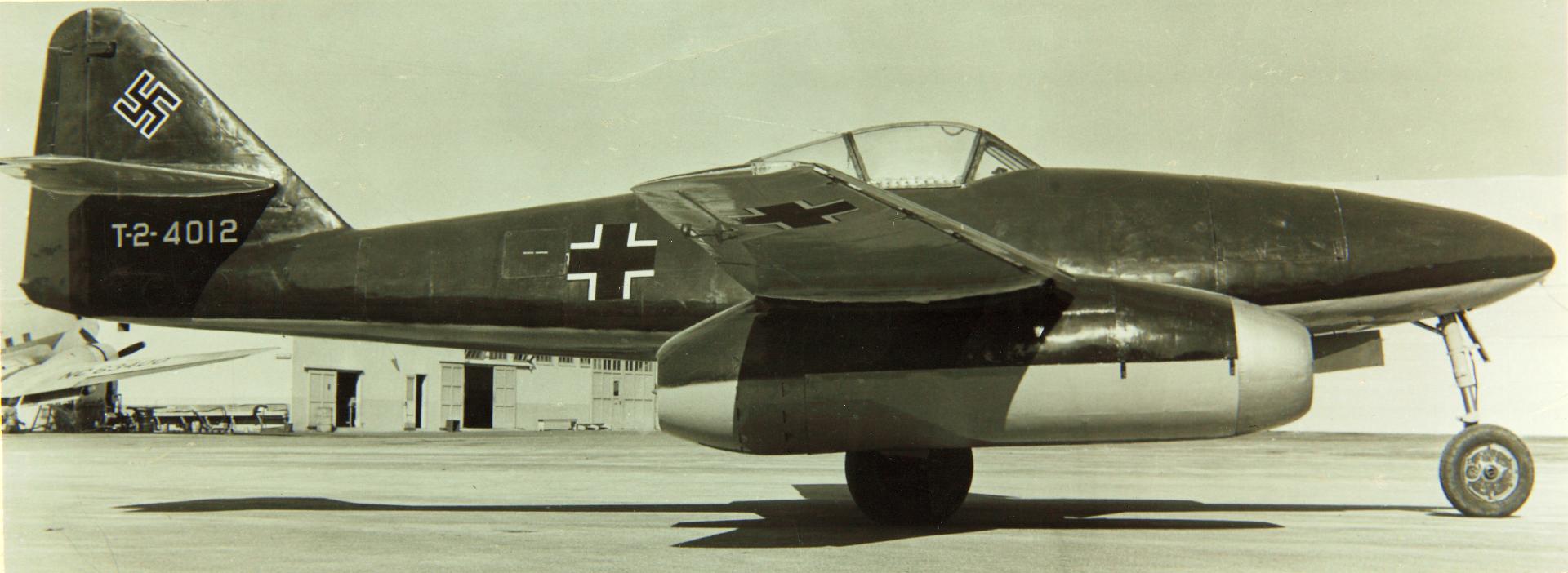
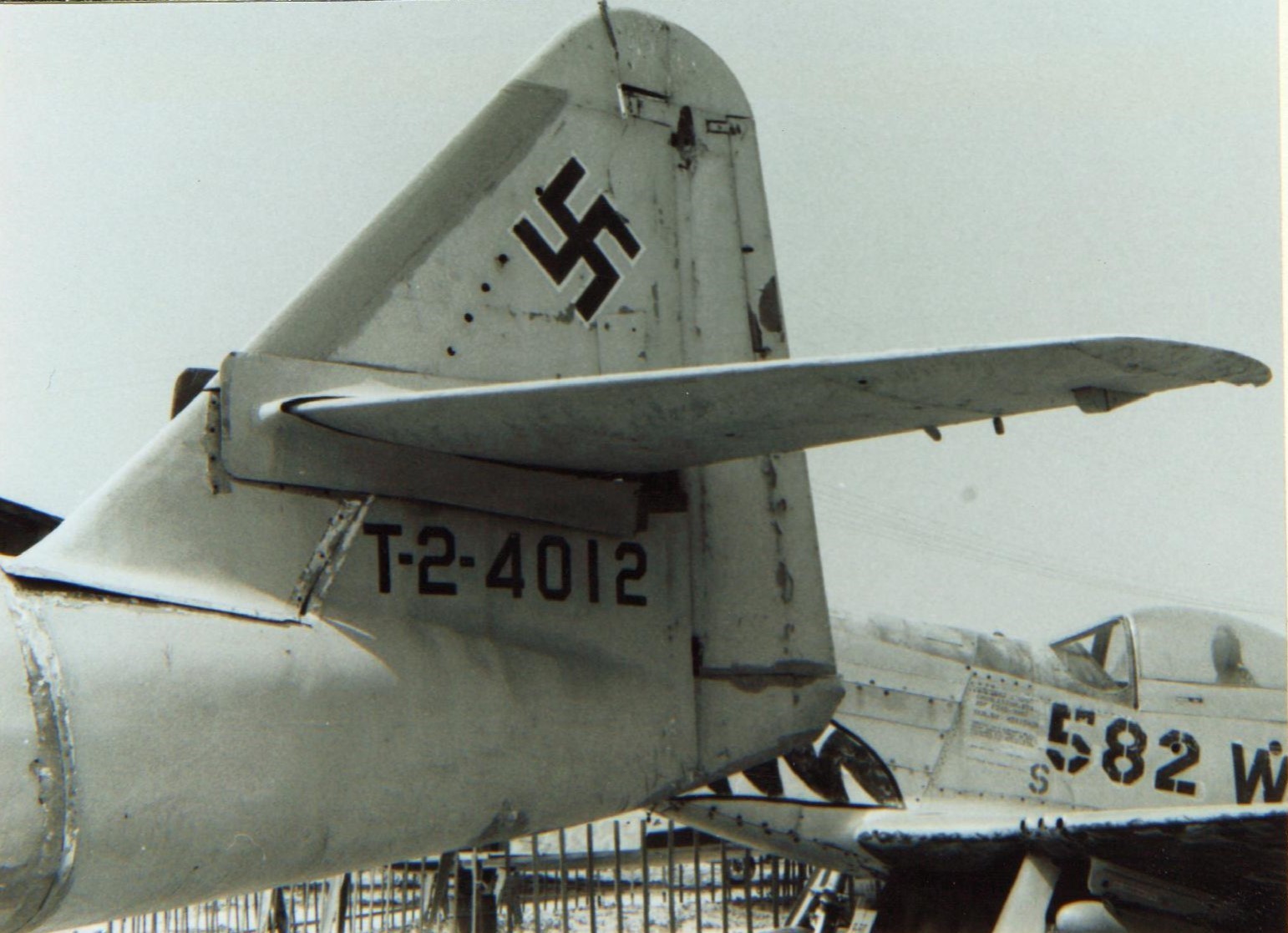
It was at Freeman Field that Me 262A-1a/U3 Werknummer 500453 was given the Foreign Equipment (FE) number FE-4012. For the remainder of 1945 to early 1946, Me 262 FE-4012 was used for flight testing at Freeman Field and was given a smooth finish for performance comparison with the Lockheed P-80 Shooting Star, the first operational American jet fighter. With the end of WWII, Freeman Field became one of many military airfields now deemed surplus less than five years after their construction. Freeman Field still stands as Freeman Municipal Airport, but on May 17, 1946, Colonel Watson flew FE-4012 to Wright-Patterson Army Airfield for further trials. With the USAAF being reincorporated as the T-2 Intelligence Department, FE-4012 became T2-4012. To conduct further research, the photo-reconnaissance nose of T2-4012 was swapped for the fighter nose from Me 262A-1a Werknummer 500491 (Watson number 888, code FE-111/T2-111). Interestingly, 500491 was later transferred to the Smithsonian Institution’s National Air and Space Museum, and the photo-recon nose from 500453 was modified to a standard fighter nose before the aircraft went on display at the National Air and Space Museum in Washington, D.C. (though this example is at present in storage due to ongoing museum renovations).
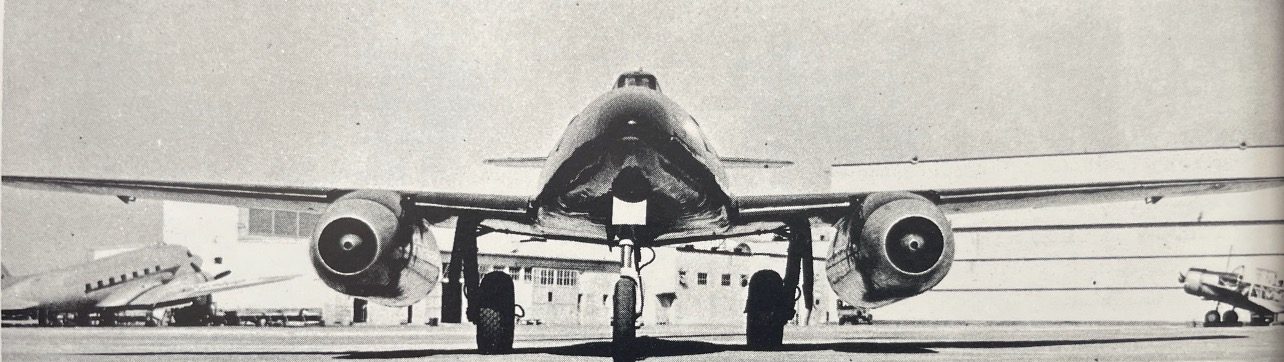
At Wright-Patterson, T2-4012 made 8 test flights in 1946 that lasted a combined 4 hours and 40 minutes. This was because the aircraft’s two Junkers Jumo 004 axial-flow turbojet engines had been constructed with suboptimal materials by the Germans in the late stages of the war, with a brand new engine having a service life of at worst ten hours before requiring a complete overhaul. T2-4012 would make two single-engine landings and had to go through four engine changes. As more lessons were learned from the Messerschmitt Me 262s, American aircraft manufacturers built new jet fighters and new engines, combined with the information shared by British engineers, which included production licenses for British jet engines in American jet fighters. The more experience the U.S. aeronautical industry earned with jet engines, the less exotic the wartime German jets became. But in the story of T2-4012, there was to be a most unusual twist when the German jet came to the attention of Howard Hughes.
Known for his ambition in aviation, Hughes had been the developer of several aircraft projects during WWII, from the Hughes H-4 Hercules flying boat (known by its derisive nickname the Spruce Goose) to the XF-11 photo-reconnaissance aircraft. When the USAAF flight trials on T2-4012 at Wright Field ceased in August 1946, the German jet was disassembled and shipped to a government warehouse in Los Angeles. In late 1947, the Hughes Aircraft Company, headed by Howard Hughes, got a contract from the U.S. government to bring the Me 262 to Hughes Airport in Culver City, California, just north of Los Angeles International Airport. Me 262 Werknummer 500453 was reassembled there, and ground engine runs were carried out, but no further flights were made. Rumors spread that Hughes wanted to have the Me 262 compete against the USAAF’s P-80 Shooting Stars in the Thompson Trophy Air Races to race from Los Angeles to Cleveland. Some theorists have even suggested that the only reason the aircraft did not participate in the races was that General Henry “Hap” Arnold intervened to prevent the Me 262 from upstaging the Shooting Stars.
However, there has never been any substantial evidence that the Me 262 was ever considered for the Thompson Trophy Races. As pointed out in a 2013 post on the blog Vintage Air, Hughes did not have access to the supply of spare parts and German expertise that Watson’s Whizzers had acquired in Germany in 1945 to get the jet to operate, and even then, the Jumo 004 engines remained unreliable in short local flights, let alone trying to fly in a cross-country race from Los Angeles to Cleveland. It should also be considered that the Hughes Aircraft Company never gained outright ownership of the aircraft, but rather the Army Air Force (later reformed as the USAF) retained custody of the German aircraft, and Hughes was a contractor for the U.S. military, with the intent that the aircraft be stored and overhauled at Hughes’ facility. Plus, Hughes himself had barely survived a near-fatal accident in Beverly Hills while test flying the XF-11 photo-reconnaissance aircraft, and after leaving the hospital, Hughes was more focused on the completion and first flight of the H-4 Hercules flying boat. By 1948, the P-80 Shooting Star (now F-80 since the USAF became an independent military branch) had been upgraded to the F-80C model, and the North American F-86 Sabre was being prepared to enter service with the USAF.
According to Edward T. Maloney, founder of the Planes of Fame Air Museum, Me 262A-1a/U3 500453 was brought from Hughes Airport to Edwards Air Force Base in 1948 to conduct high-speed flight trials, but no evidence verifies whether or not these tests were actually conducted. By the late 1940s, however, the aircraft was now considered obsolete and was stricken from the USAF inventory. Howard Hughes, still involved in moviemaking, would request to have the plane featured for his planned aviation film Jet Pilot, but delays in production meant that the film would not be released until 1957, and in any case, the Me 262 never appeared in the movie that ended up having a Cold War-themed plot. Following its time with the USAAF/USAF and with Howard Hughes, Me 262A-1a 500453 was sold to the Cal-Aero Technical Institute at Grand Central Airport in Glendale, California.
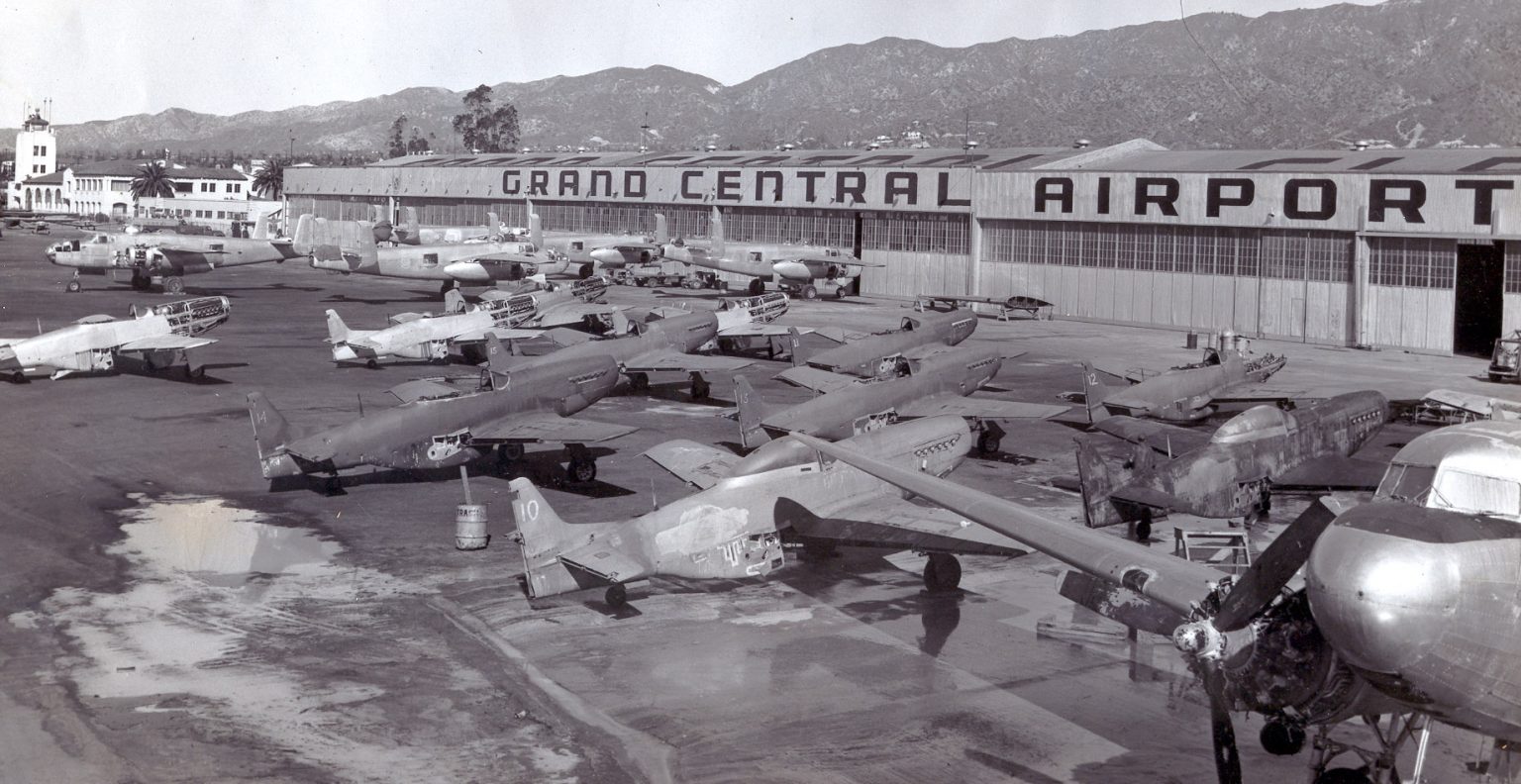
During the 1930s, Grand Central Air Terminal, as it was known, had been one of the busiest airports in Los Angeles, being the main commercial hub for air travel in and out of Los Angeles, a favorite spot for Hollywood movies and serials, and a place where new pilots and mechanics learned their trade at the Curtiss-Wright Technical Institute (which eventually became the Cal-Aero Technical Institute). During the war, the airfield was entirely closed for civilian purposes and used as a training base managed by the Cal-Aero Flying Academy. After the war, other airports in Los Angeles, such as Mines Field (now LAX) had been greatly expanded beyond the scale of the facilities of Grand Central Air Terminal, and by 1959, the airport was closed down and the site is now home to the Walt Disney Company’s Grand Central Creative Campus, with the former runway turned into Grand Central Avenue. At Glendale, Me 262 500453 was one of several WWII surplus aircraft used as instructional airframes at the Cal-Aero Technical Institute for aircraft mechanics to learn their trade, but with the pending closure of the airport and the need to find more modern aircraft for the trade students to work on, it seemed that the aircraft’s days would soon be numbered.
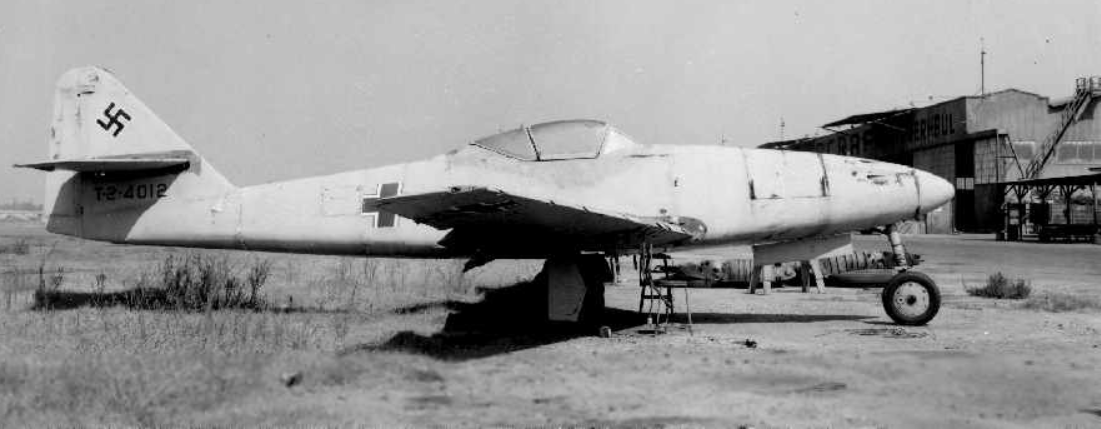
But luckily for the former Luftwaffe fighter, it would be saved from the scrapper’s torch by a young aircraft collector named Edward T. Maloney. Having grown up during the 1930s with a passion for aviation and filled with a drive to save as many historic aircraft as possible from the scrappers, Maloney would acquire Me 262 WkNr 500453 from Glendale and have it shipped to his home in Pomona as he worked to find a property to display this and other aircraft he saved. Among these were three more WWII fighters he had saved from Grand Central Airport (Bell P-63A Kingcobra 42-69080 (later acquired by the Yanks Air Museum in Chino, California and flown as “Fatal Fang”), Curtiss-built P-47G Thunderbolt 42-25254, and North American P-51A Mustang 43-6251, with the latter two being maintained today in airworthy condition. In 1957, Maloney opened his first air museum at a former lumberyard in nearby Claremont under the name The Air Museum. While some aircraft were displayed inside the sheet metal building, others, including the Me 262, still wearing its T2 number, remained on outdoor display until the Air Museum moved to Ontario Airport in 1963.
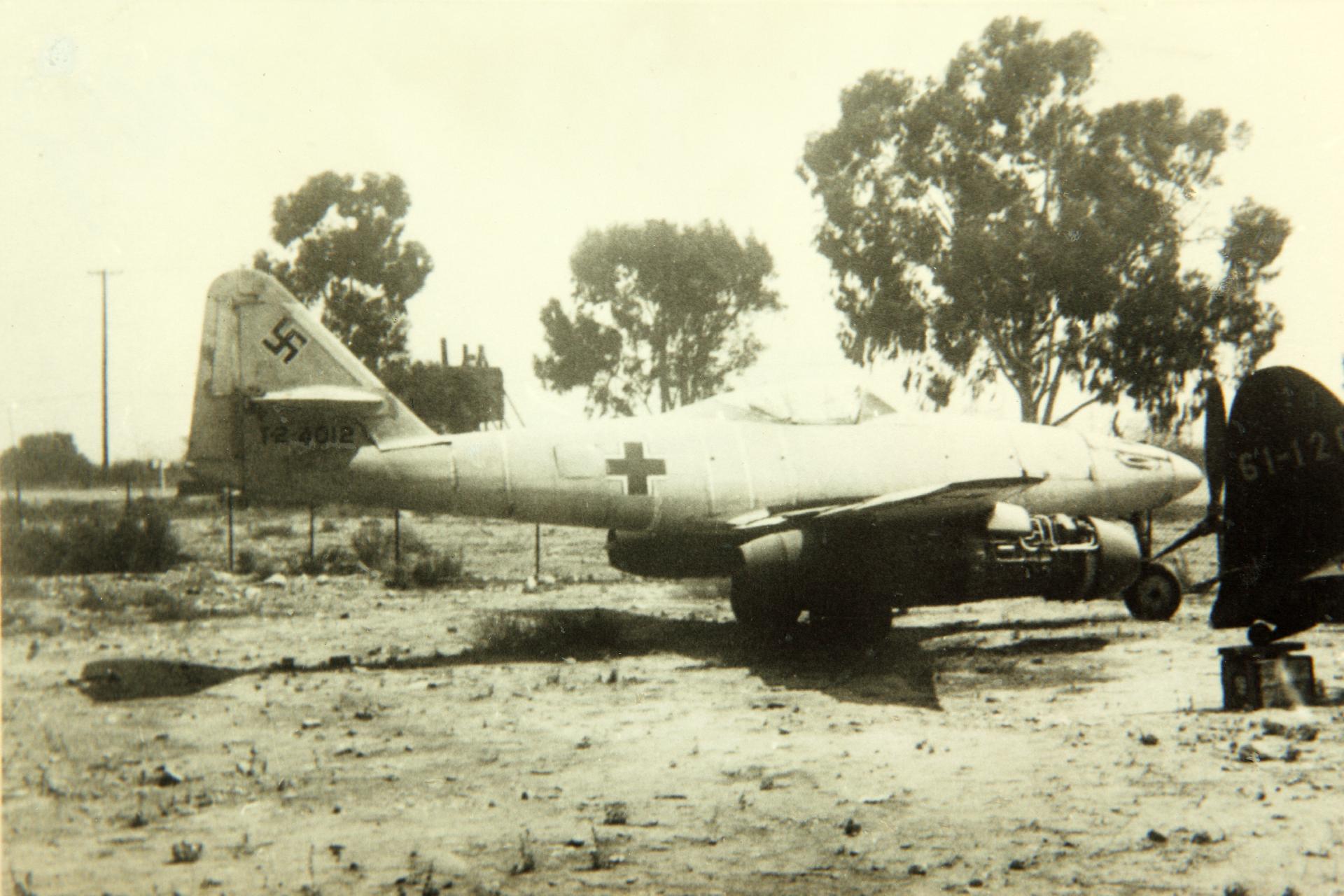
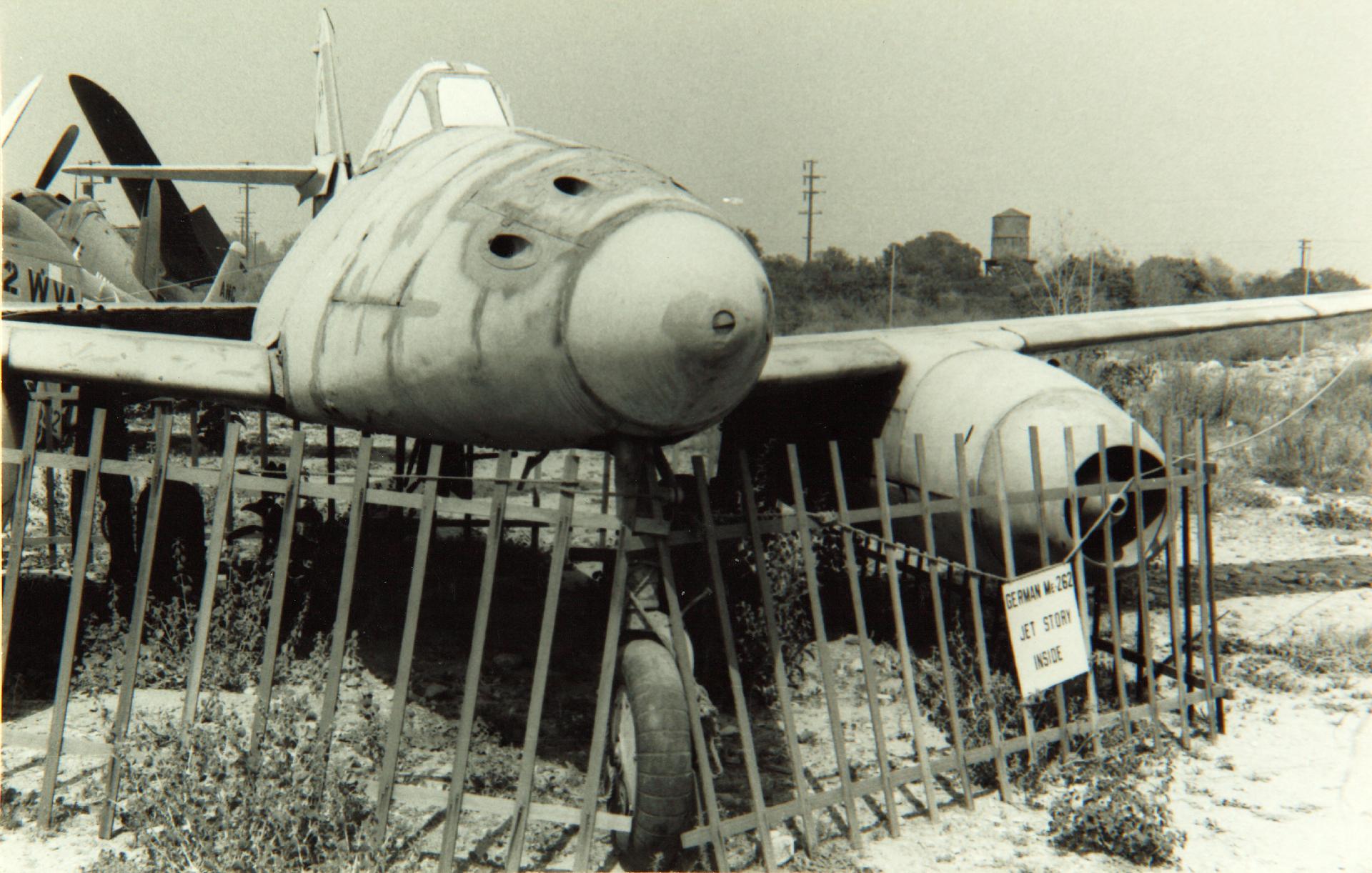
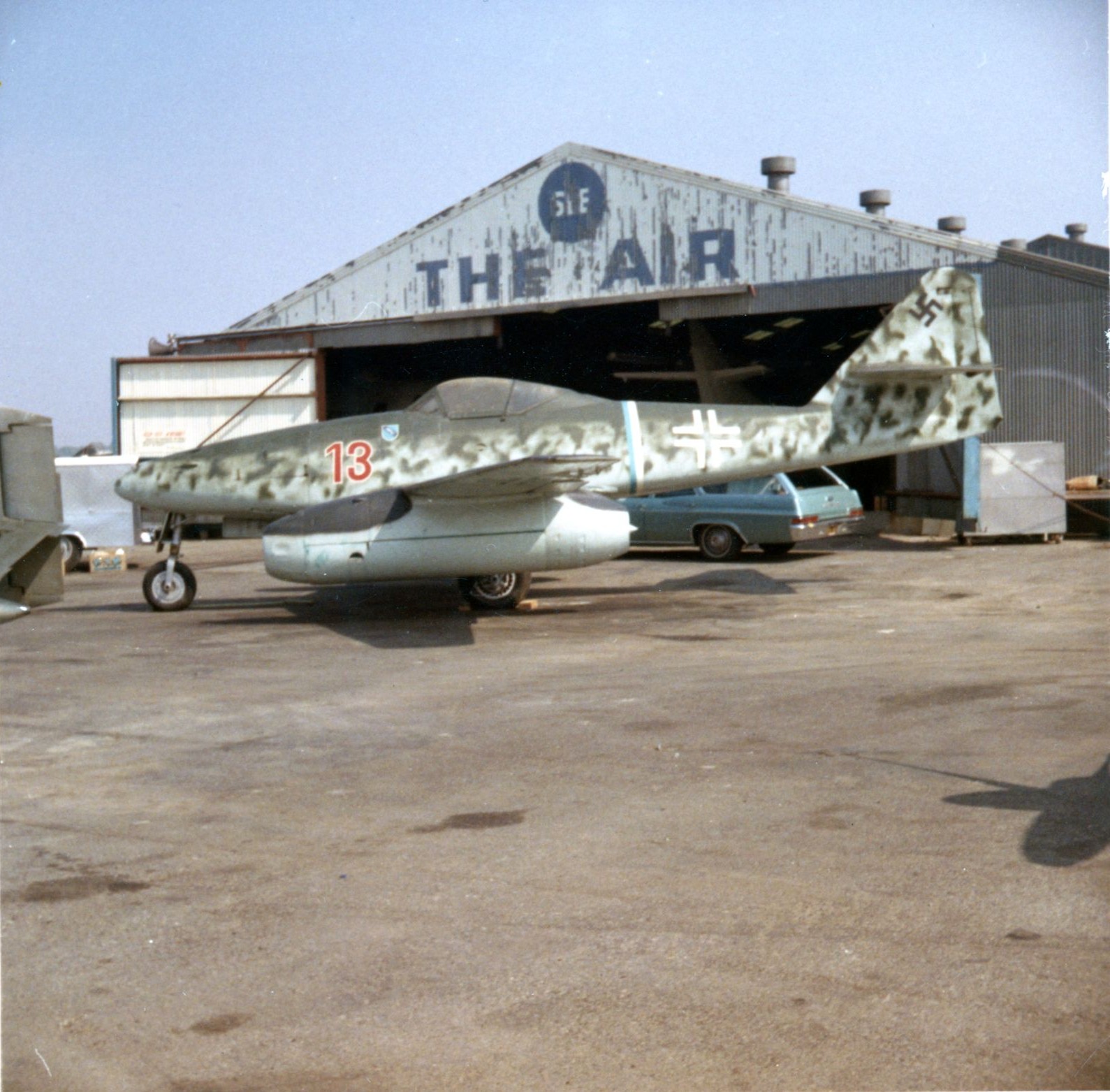
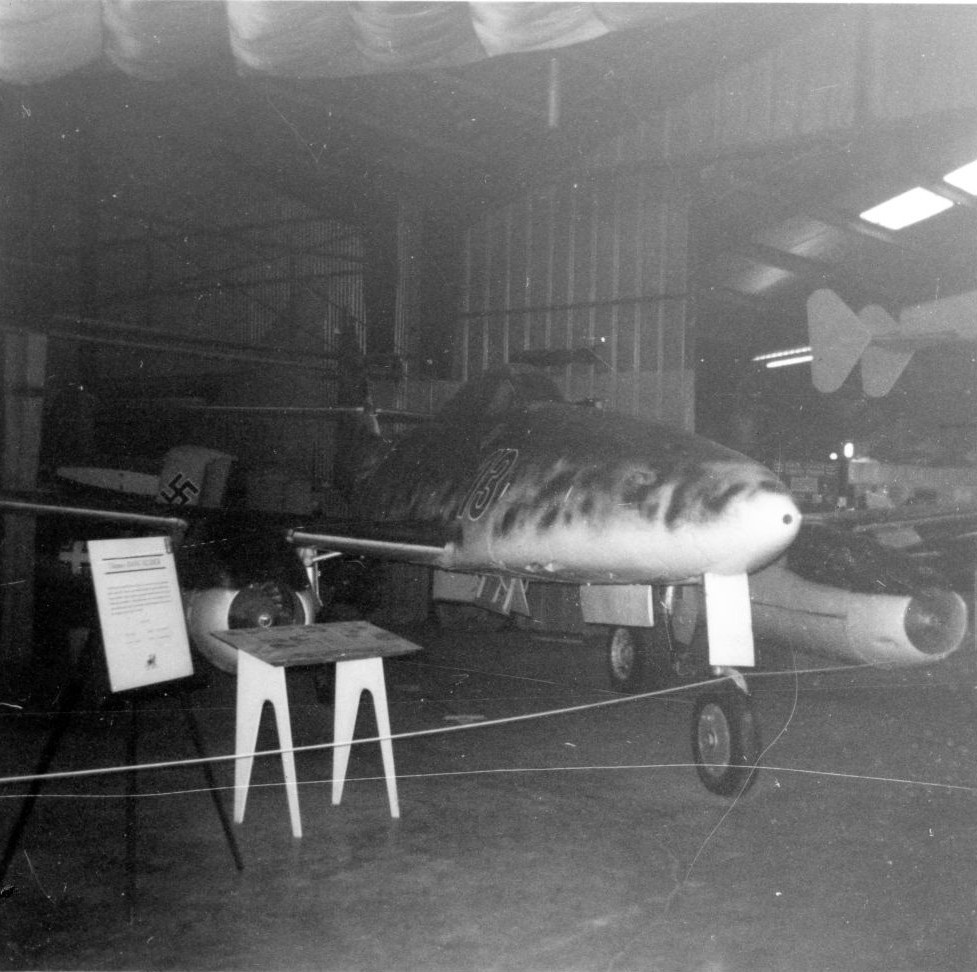
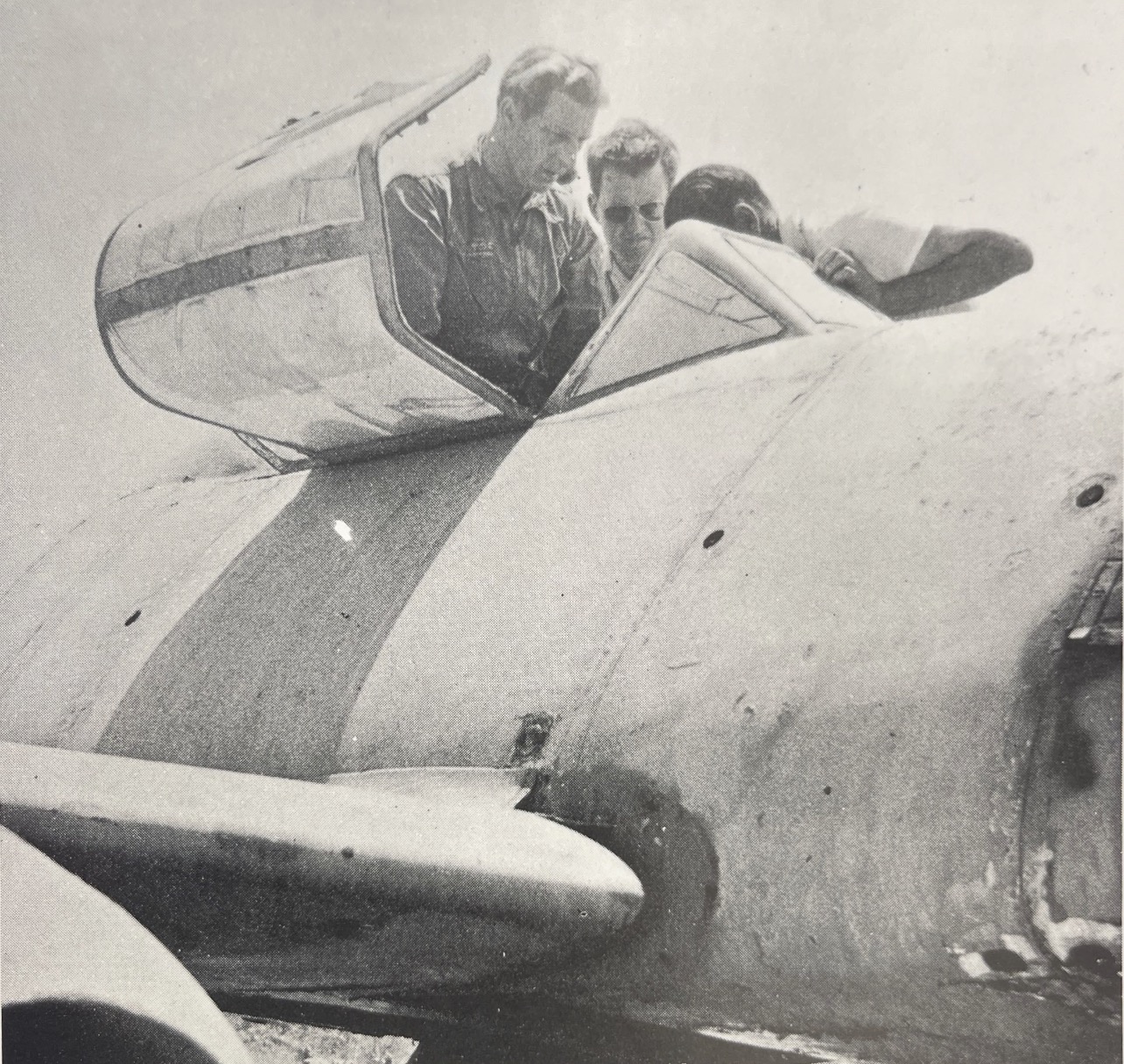
At Ontario, the Me 262 was repainted in Luftwaffe markings as ‘Red 13’ and was displayed alongside the museum’s growing collection of Allied and Axis aircraft of WWII, including a Bf 109 G-10/U4 (Werknummer 611943) and Heinkel He 162 A-2 Volksjager (Werknummer 120077) shipped by Watson’s Whizzers along with Me 262 A-1a/U3 500453 from Cherbourg to Newark in 1945. Additionally, Maloney acquired the Messerschmitt Bf 108B Taifun (Werknummer 8378) shipped aboard HMS Reaper along with the Me 262. But the addition of further aircraft required more storage space. From 1970 to 1973, the Me 262 would be displayed in Buena Park as part of the Cars of the Stars and Planes of Fame before being moved to the Planes of Fame Air Museum’s current location at Chino Airport, and by 1980, the Me 262 would be repainted yet again, this time in the colors of Me 262A-1a Werknummer 111617, “White 9” of Ergänzungs-Jagdgeschwader 2 (Replacement Fighter Wing 2), an aircraft that survived VE-Day but was later scrapped in Munich by American forces in 1945. Photos of Werknummer 111617 taken by American personnel appeared in several publications on the Messerschmitt Me 262 that served as reference material for the restoration of the aircraft. Additionally, Maloney himself would write a book about the Me 262, filled with detailed photographs of the museum’s very own Schwalbe. The aircraft remained on static display at the museum, sharing hangars with the various U.S., British, German and Japanese WWII aircraft in airworthy condition or on static display at Planes of Fame.
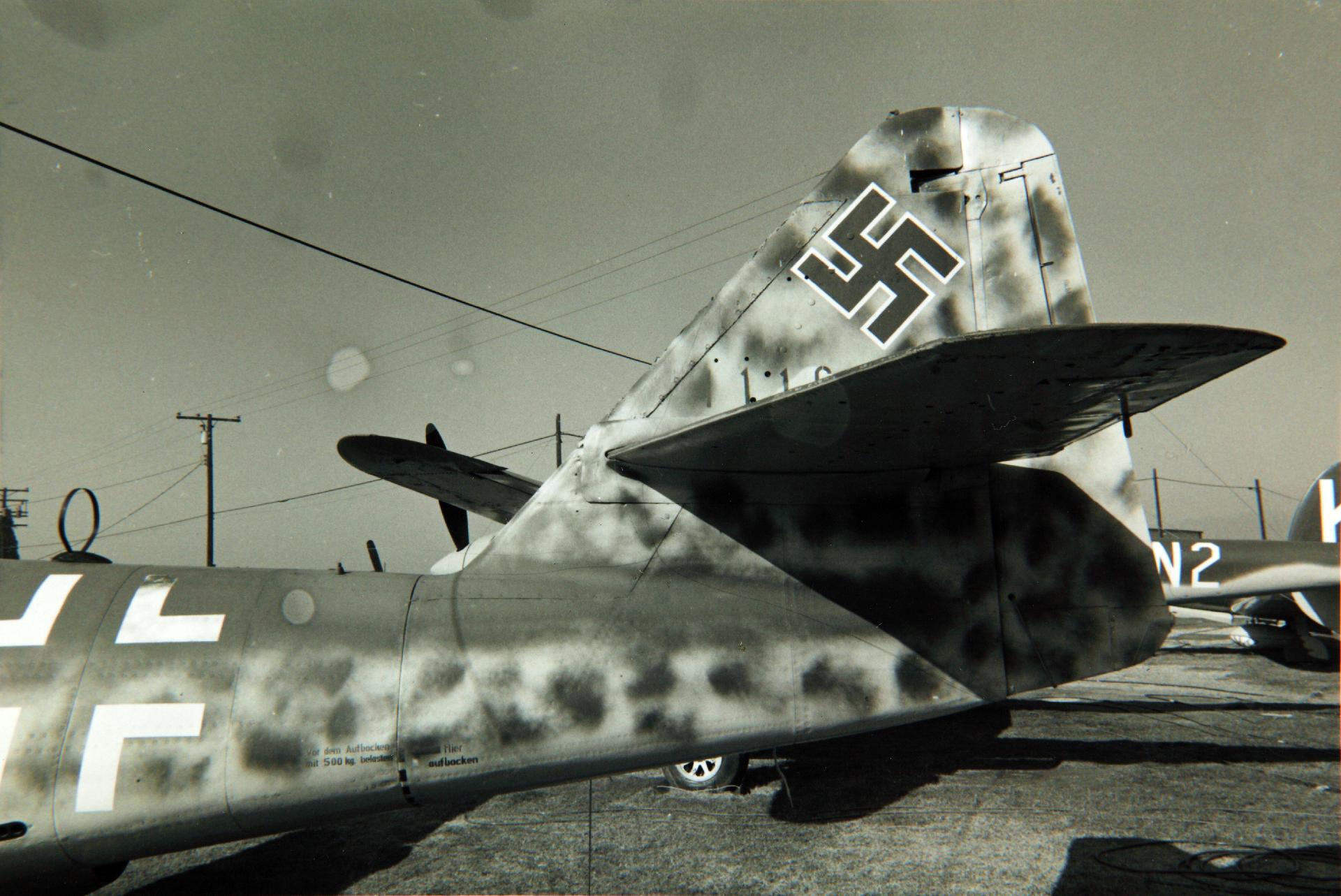
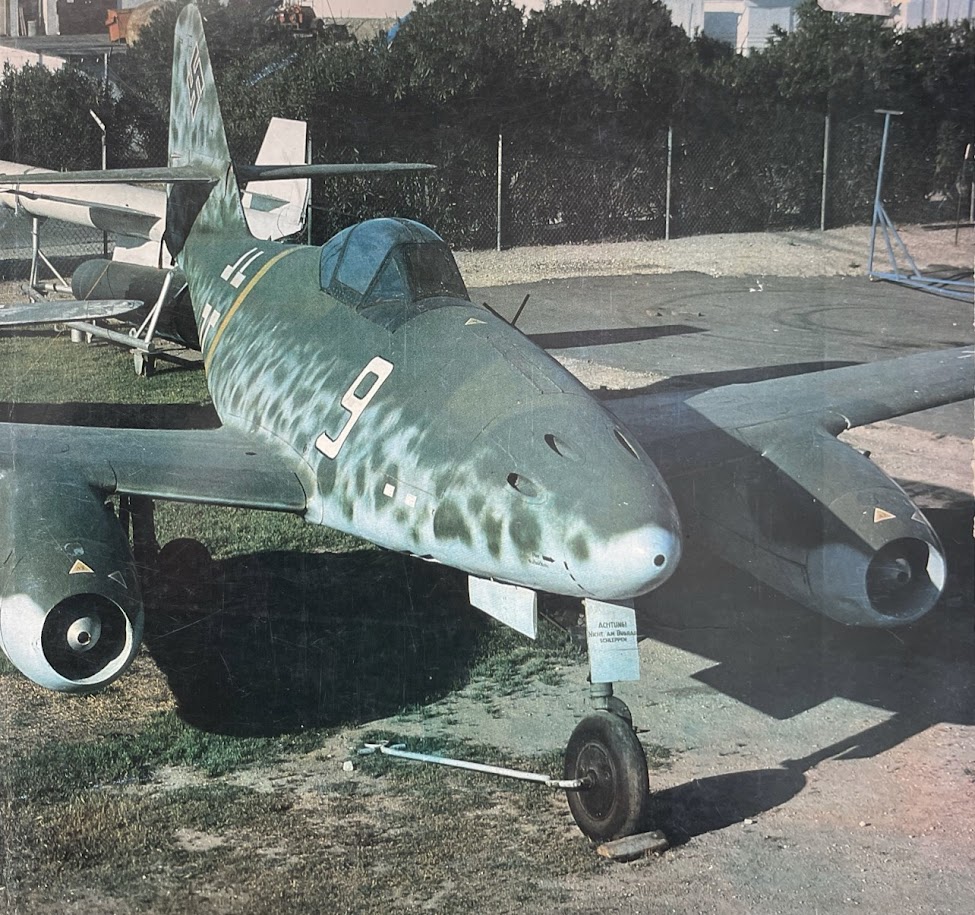
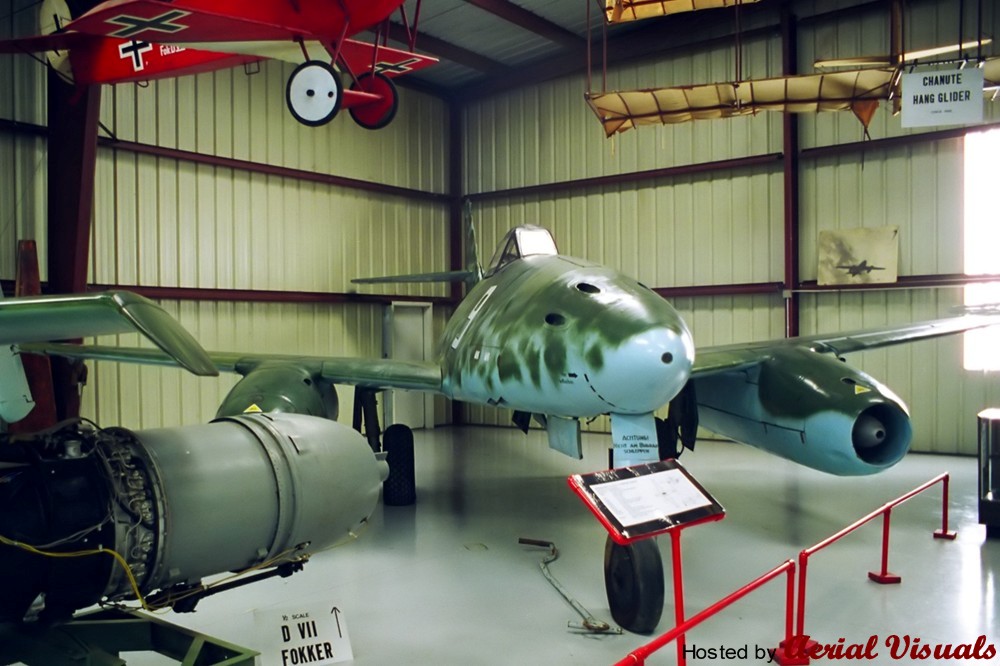
In December 2000, the Me 262 was sold to Vulcan Warbirds Inc. of Seattle, Washington, a holding company established by Microsoft co-founder Paul Allen, who also founded the Flying Heritage Collection (now the Flying Heritage and Combat Armor Museum) at Paine Field in Everett, Washington. This sale would help the Planes of Fame construct an entirely new hangar to house more of the collection at Chino. Much to the surprise of many, word got out that Allen intended to restore the aircraft to flying condition with its original Junkers Jumo 004 engines. Like many of Allen’s restoration projects, though, news of the restoration was tightly restricted, but in 2007, the aircraft was sent to the workshops of JME Aviation Ltd. in Norfolk, England, where the FHCAM’s equally-rare Focke Wulf Fw 190 A-5 had received much of the restoration work that brought it back to airworthy condition. JME would complete much of the work on restoring the structure of the wings and fuselage of the aircraft, but when JME Aircraft closed in 2010, the aircraft was shipped to Gosshawk Unlimited in Casa Grande, Arizona to continue the restoration.
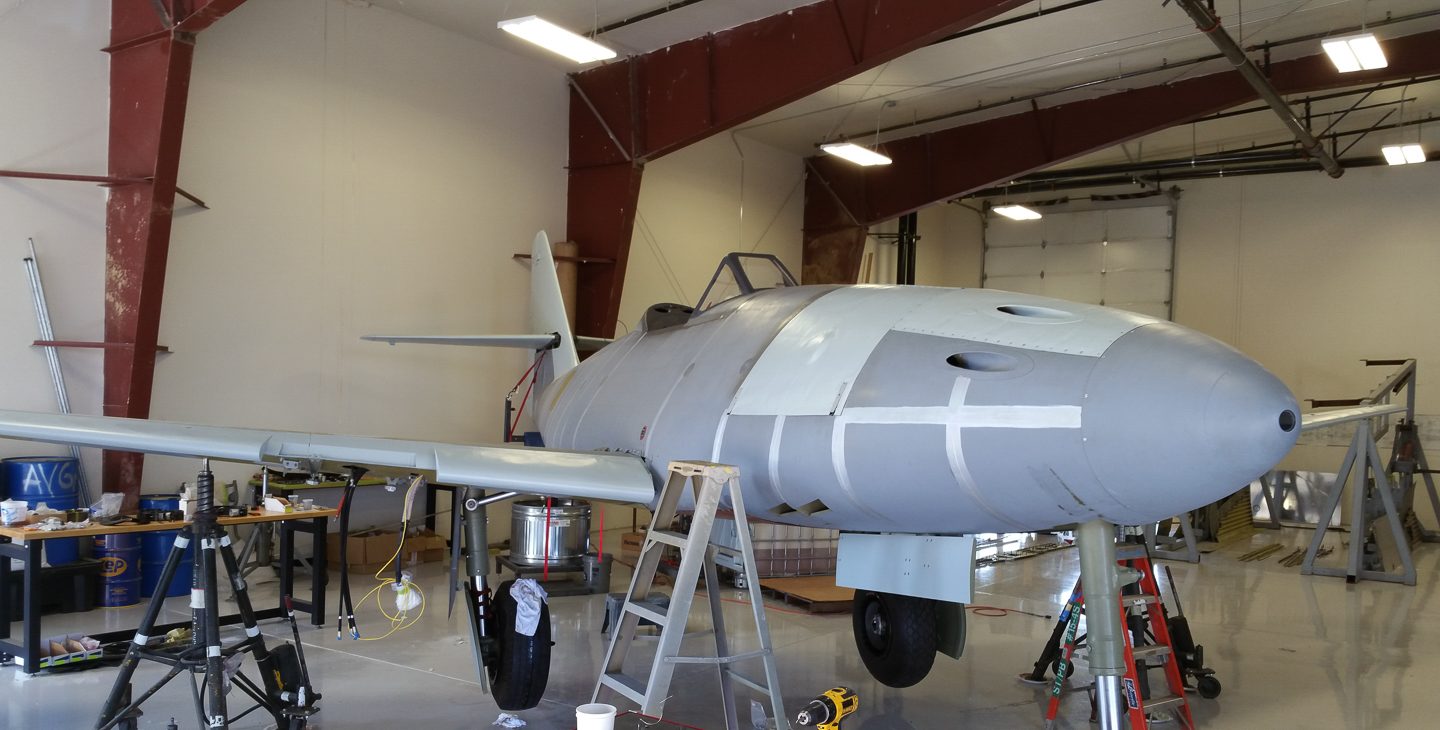
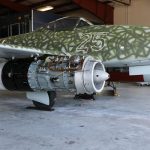
One of the biggest challenges in the restoration of the aircraft was in restoring the engines to be operational but yet safer than those built during the war. The original Junkers Jumo 004s were built in desperate conditions with fragmented supply chains producing often sub-standard materials. As a result, German WWII jet engines had an exceedingly low life expectancy, with some engines only being able to run for just 10 hours before requiring a complete overhaul. Many warbird enthusiasts doubted that the original engines could be restored to working order, but Paul Allen persisted. He hired Aero Turbine Inc. of Stockton, California, to overhaul the two Jumo 004B turbojet engines, and by 2015, the first test runs of the engines proved successful, marking the first time that any version of the Junkers Jumo 004 had run since 1951, when the Czechoslovakian Air Force retired the last of their locally-built Me 262s, the Avia S-92s, which were powered locally-built 004s designated as the Avia M-04.
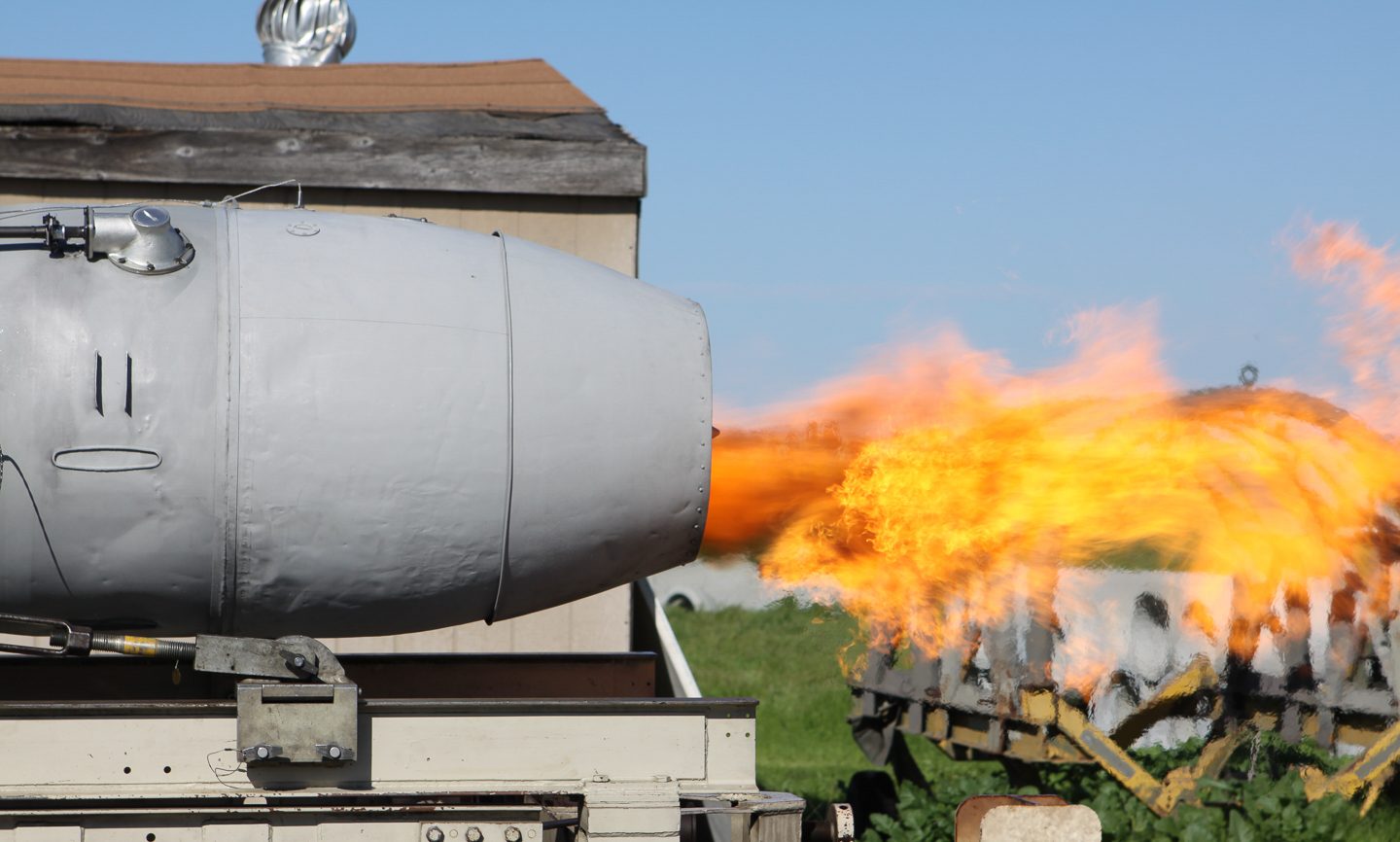
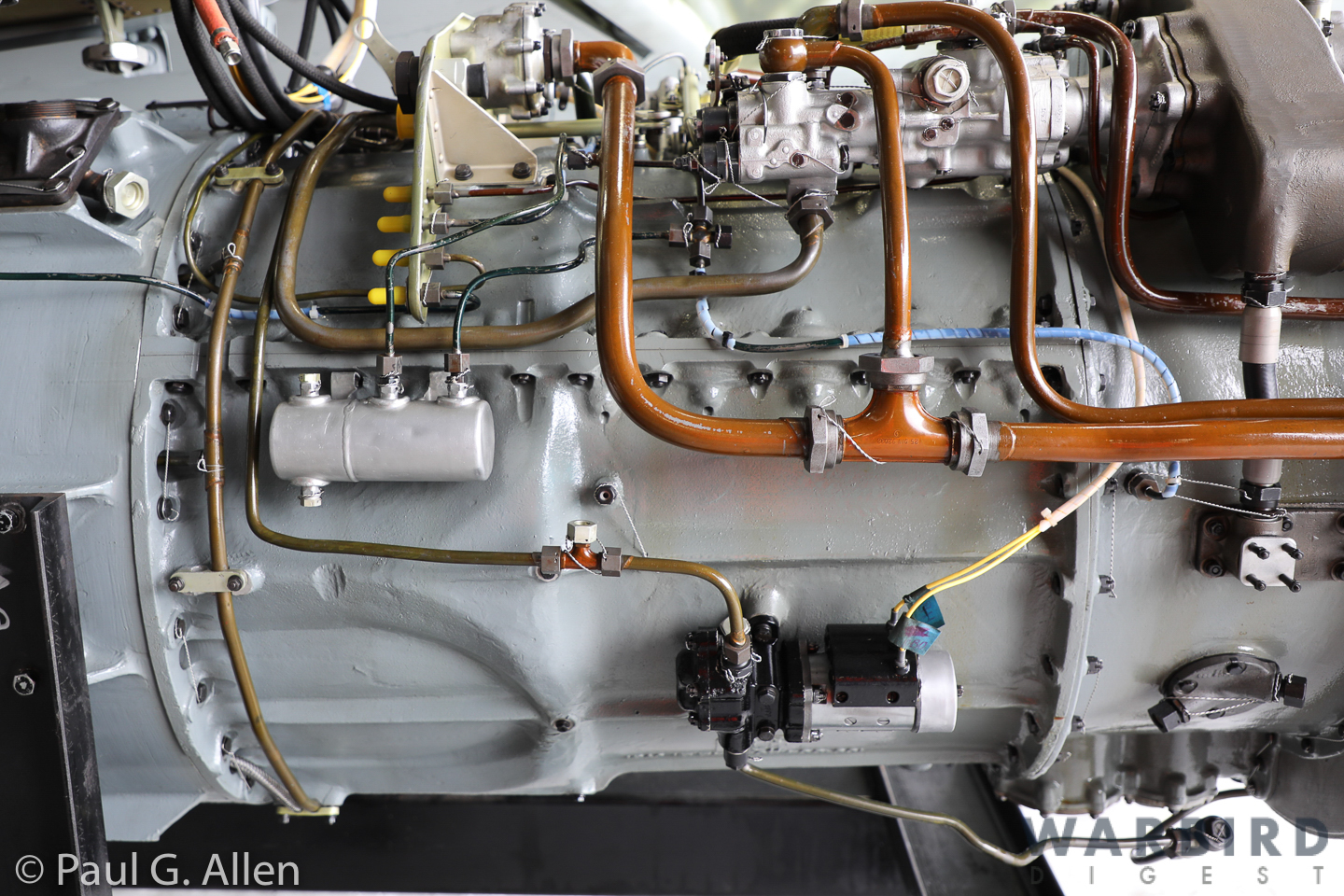
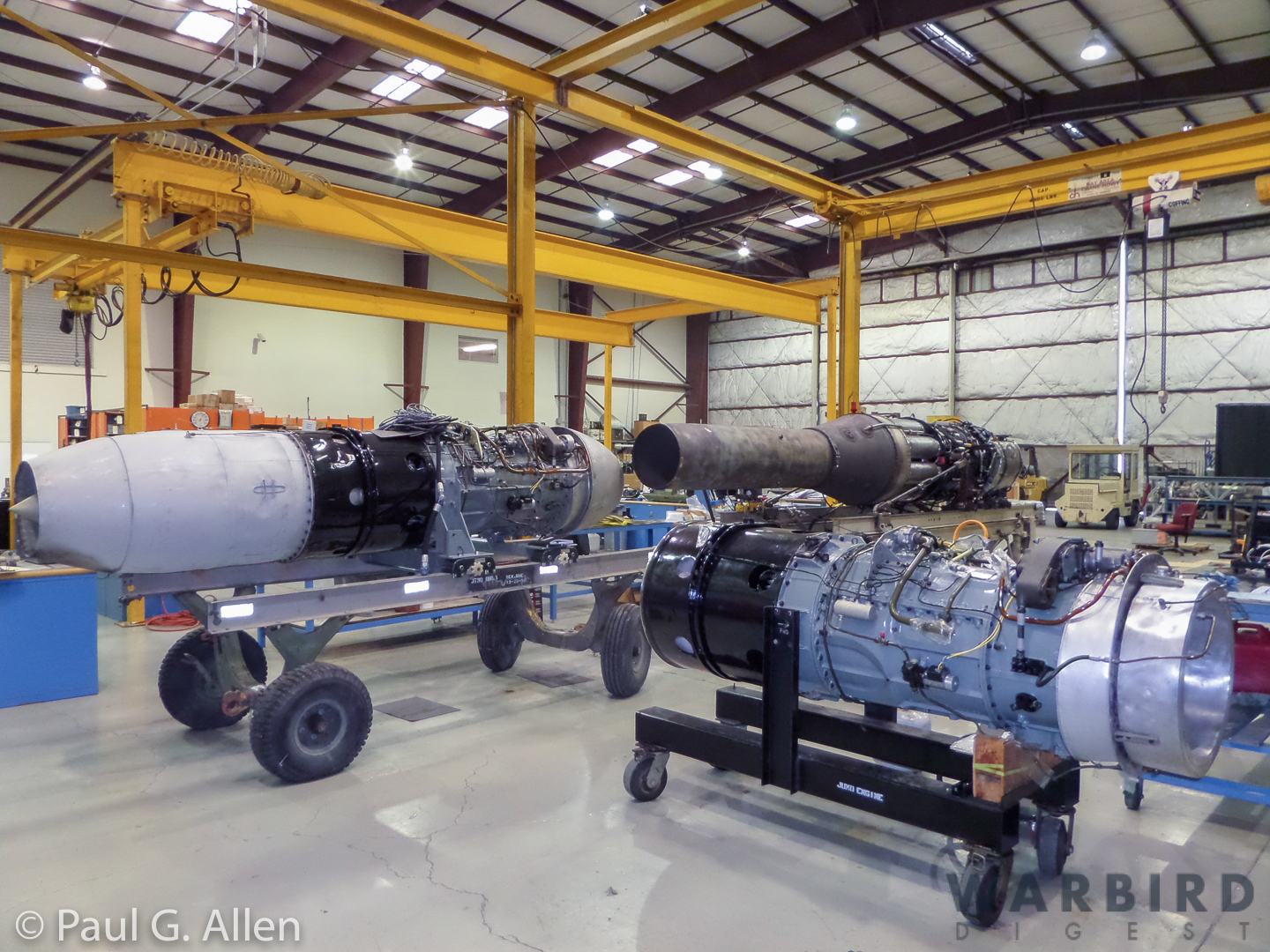
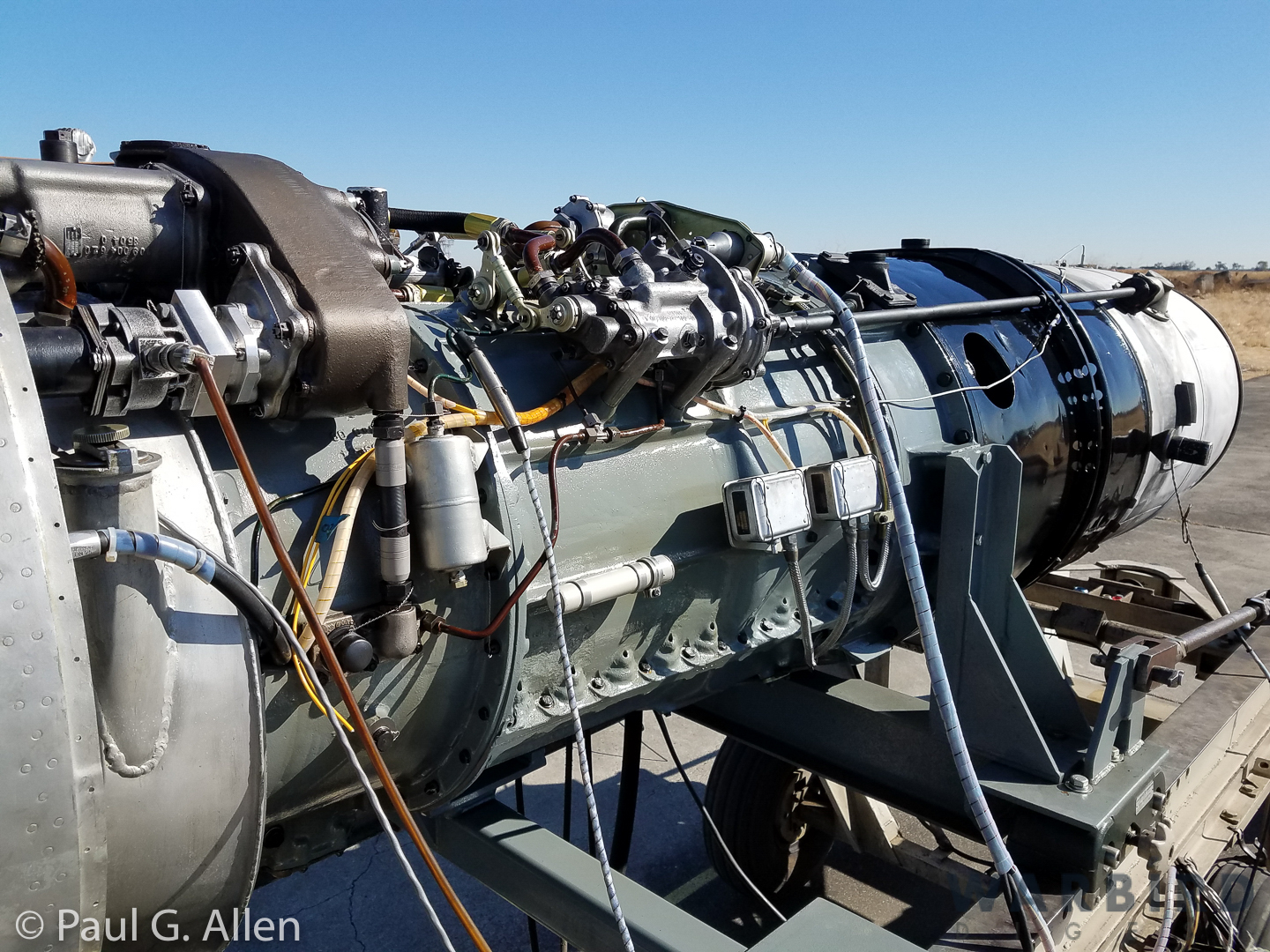
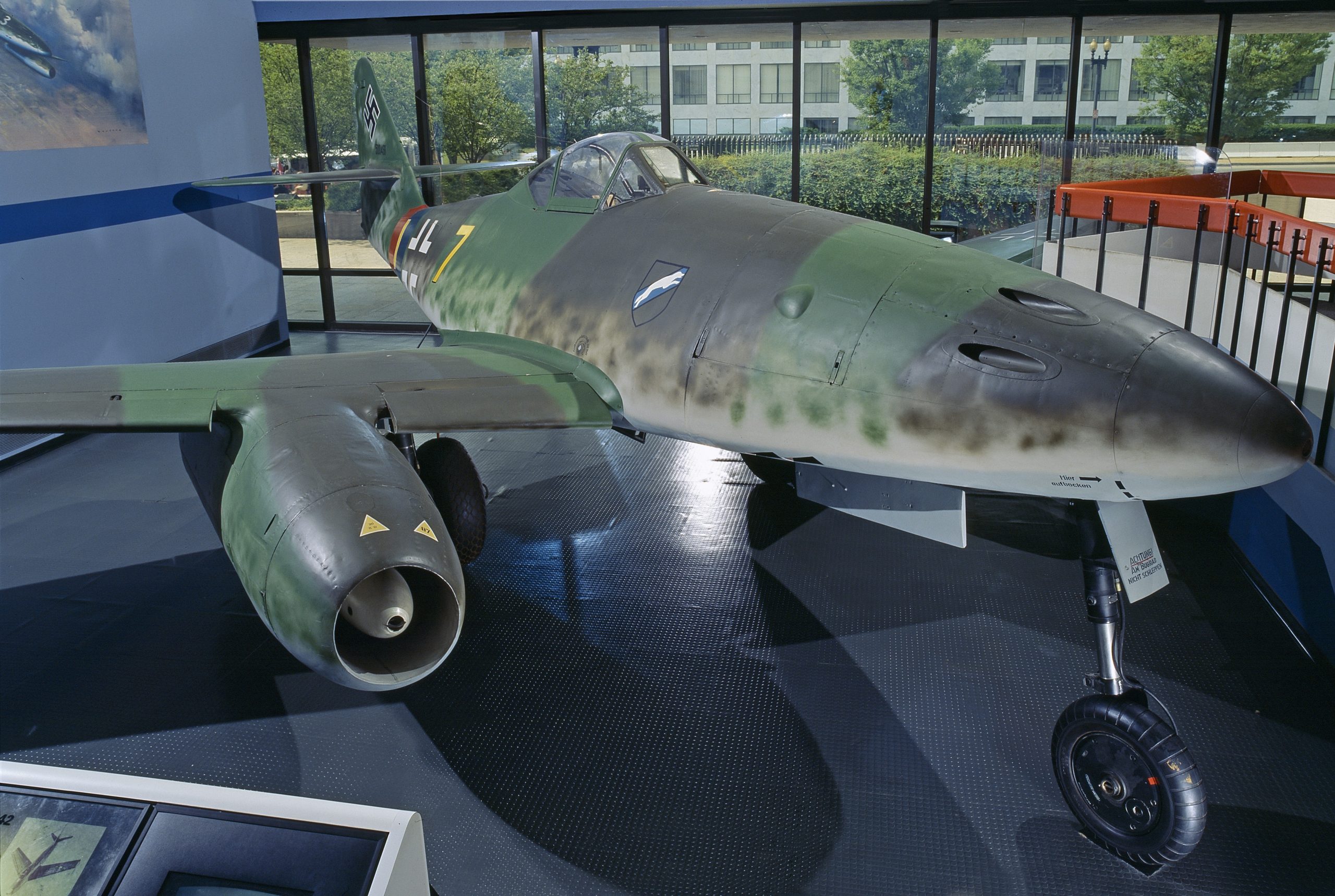
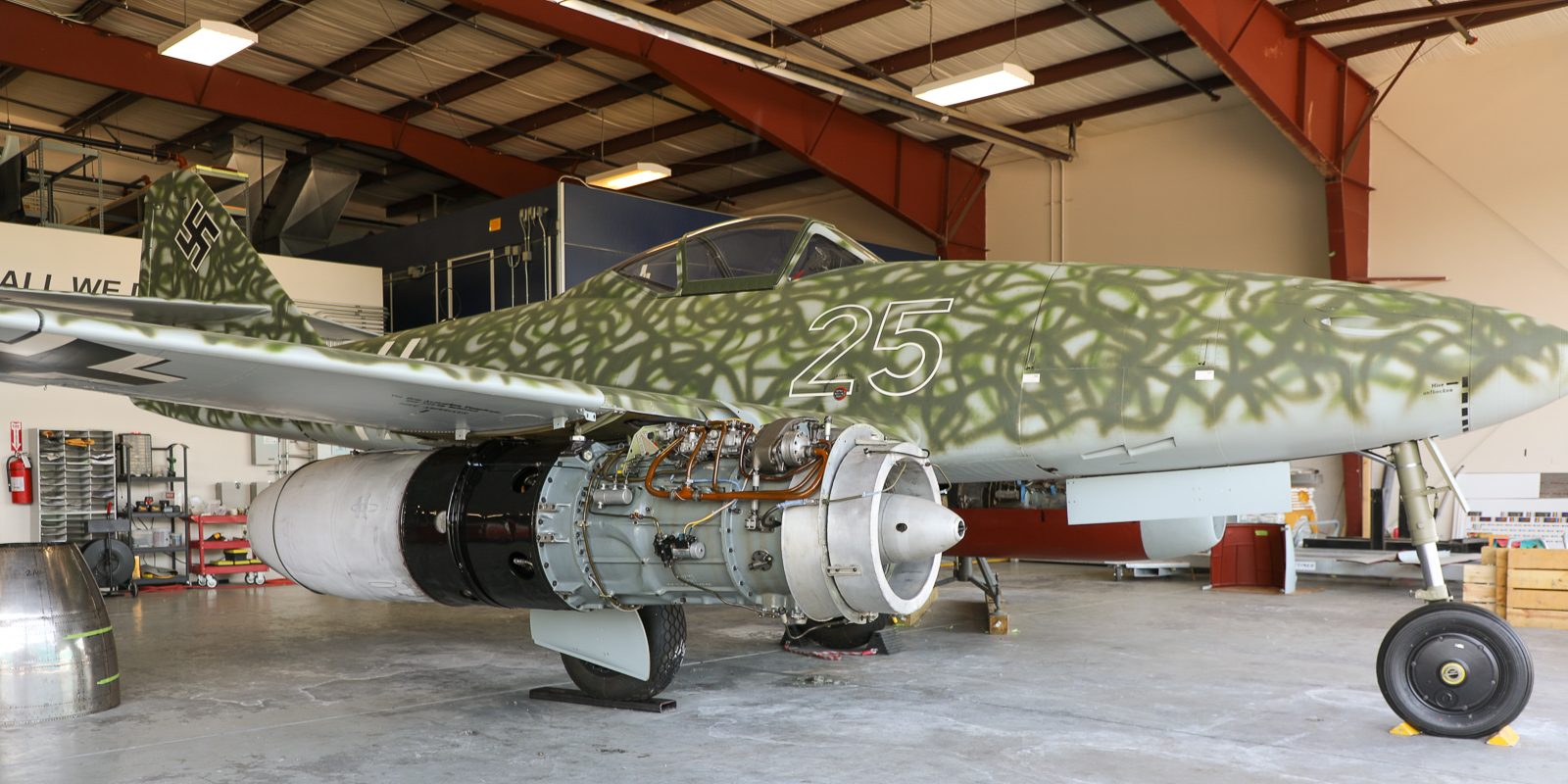
As Aero Turbine continued working on the two Jumo 004s, Me 262 500453 was transferred to Morgan Aircraft Limited at Arlington Municipal Airport in Arlington, Washington. The wings, tail, and fuselage were all reassembled here, and the technicians at Morgan Aircraft conducted gear swing tests and installed the hydraulic and electrical systems of the aircraft. When Aero Turbine completed the overhaul of the two Junkers Jumo 004 engines in 2018, they were shipped up to Arlington and installed on the Me 262, with the starboard engine being fitted first, followed by the portside engine. Meanwhile, the aircraft was repainted in the scheme it wore when it was captured by American forces in Lechfeld, Germany back in May 1945, as covered in this 2019 article HERE).
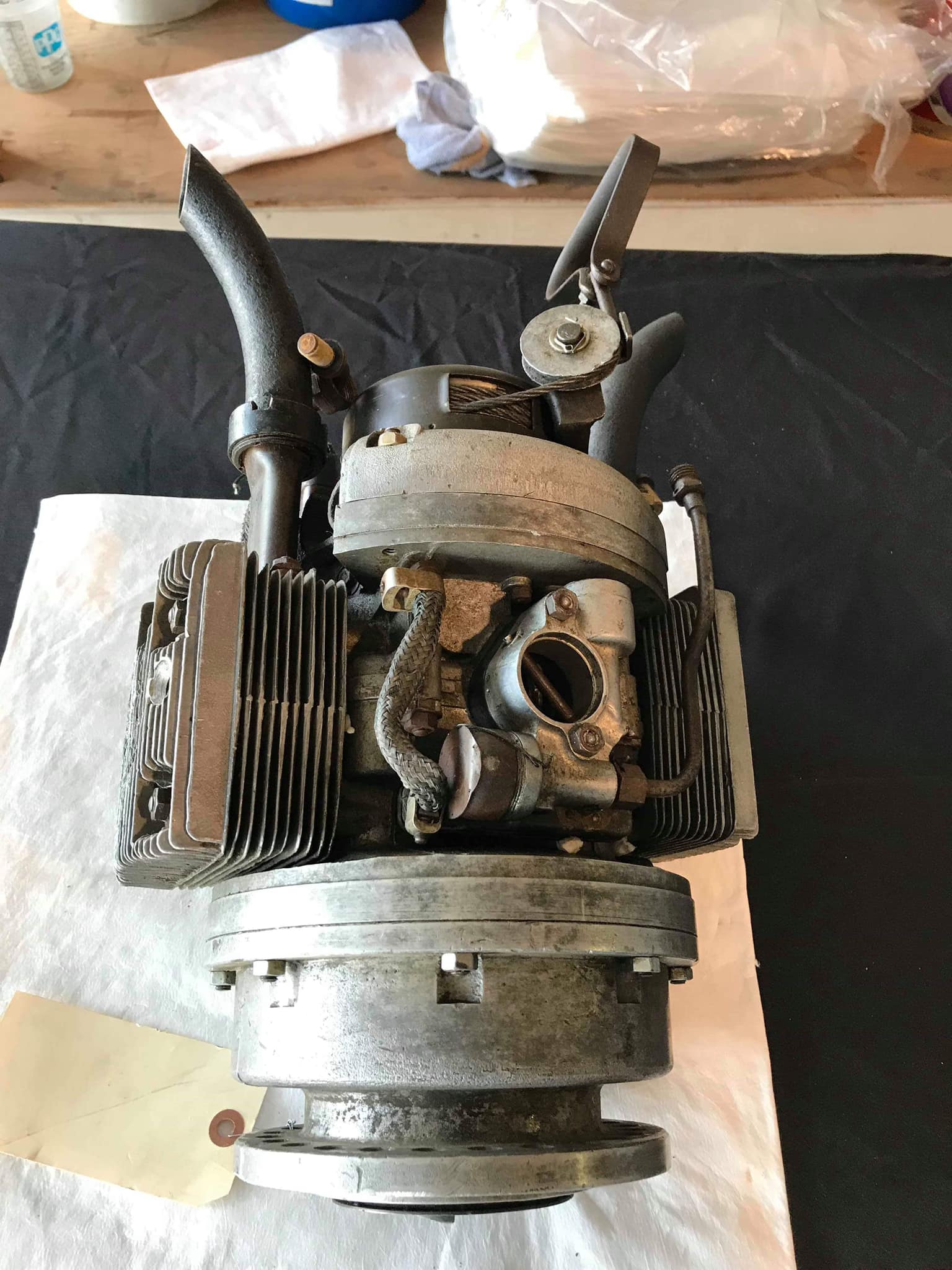
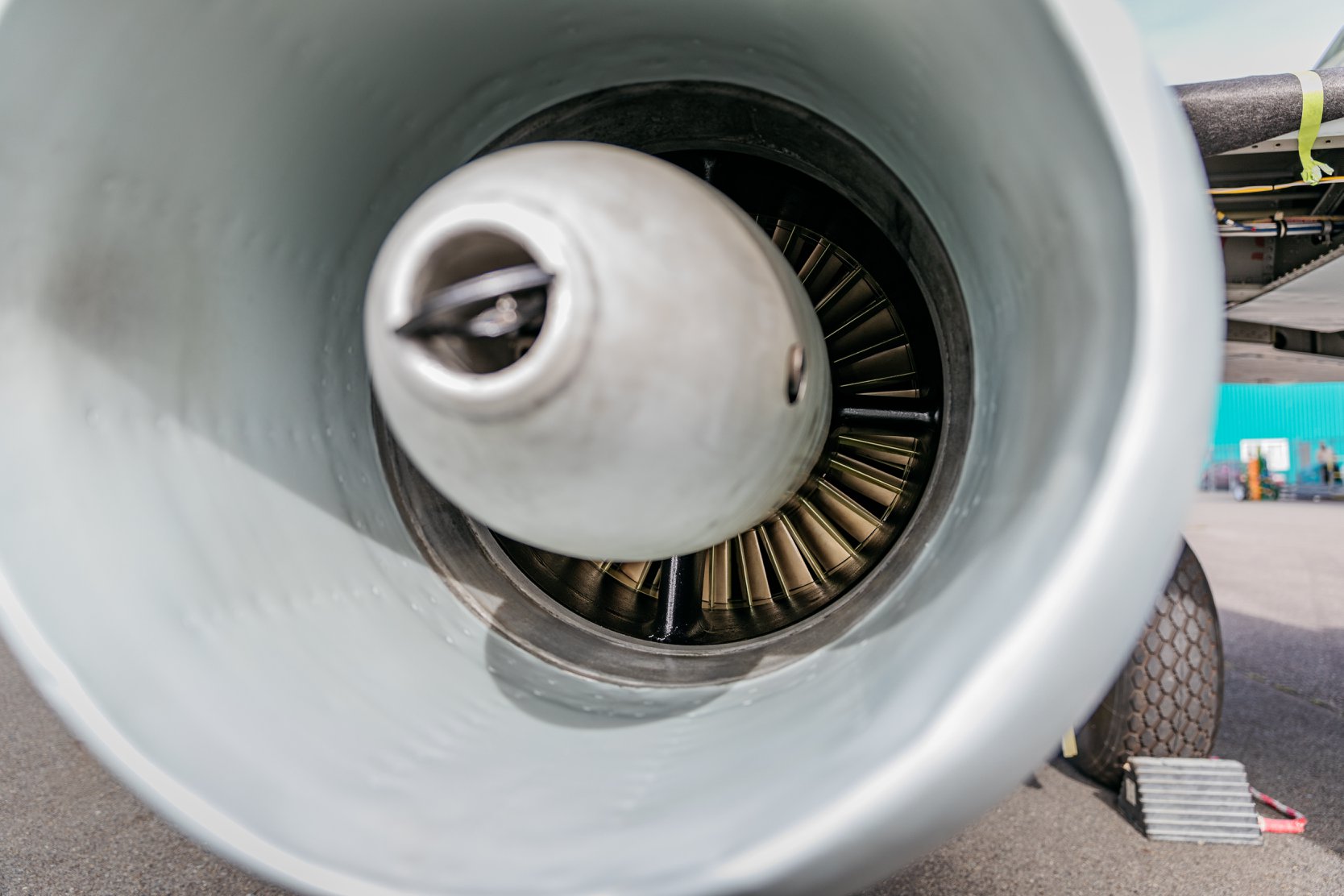
One unique feature of the Junkers Jumo 004 was the fact that inside the air intake is a nose cone that protects a 10 hp two-stroke engine developed by engineer Norbert Riedel used as a starter motor. In order to start the motor, the crew chief would pull a handle attached to a cable to manually start the Riedel motor. This motor would run for about 30 seconds before the turbines would take effect. The Riedel starter motor would also be used on other German jet engines, such as the BMW 003 and the Heinkel HeS 011.
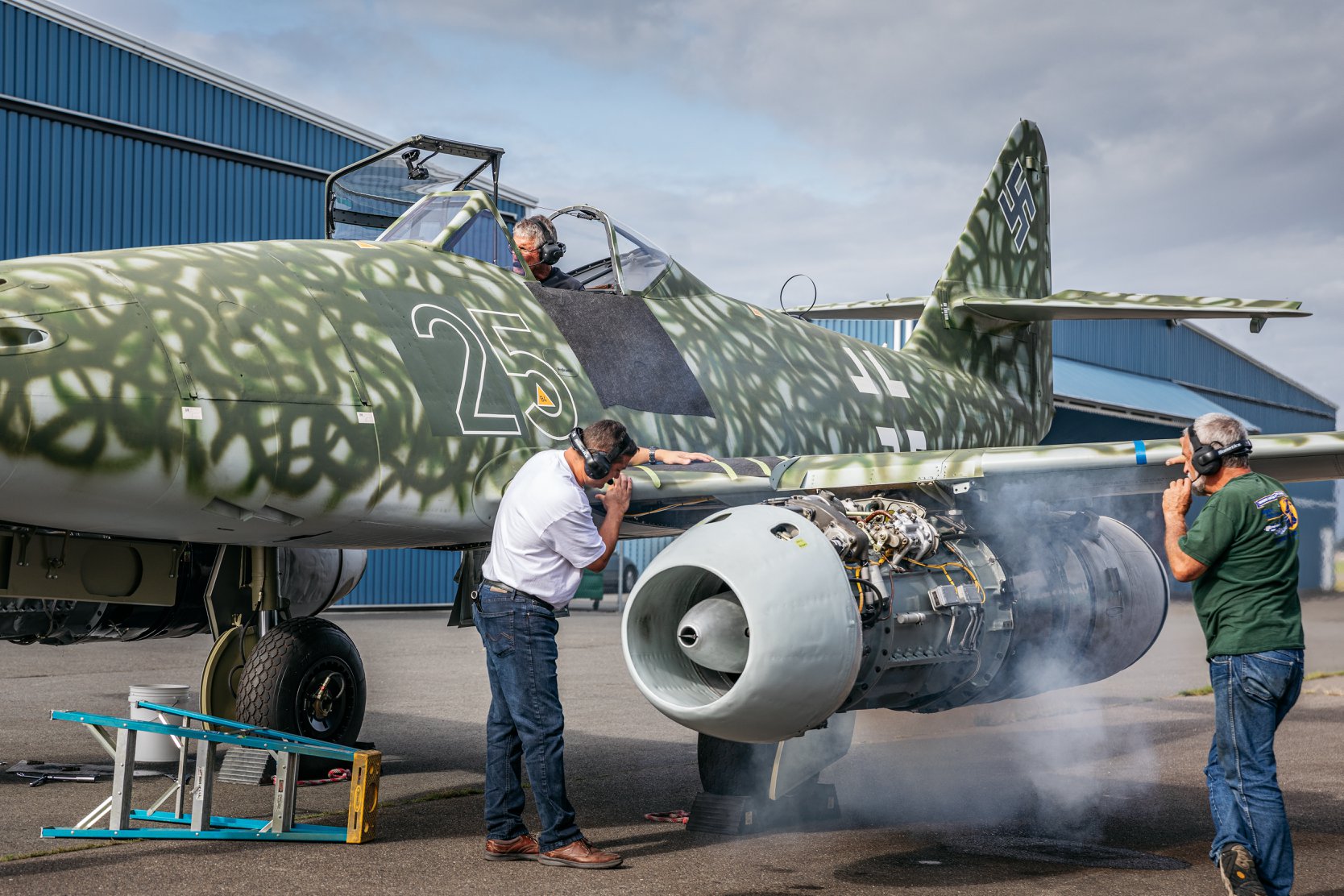
On September 25, 2019, Messerschmitt Me 262 A-1A/U3 Werknummer 500453 made history when the aircraft made its first engine run with the restored Junkers Jumo 004 engines, with pilot Steve Hinton in the cockpit, keeping a close eye on the engines and the instrument panel. (Video of that engine start-up HERE). Eight days after the first engine start-up, the Me 262, registered with the FAA as N94503, made its first taxi test, with Steve Hinton at the controls (Video of that taxi test HERE). Unfortunately, Paul Allen never lived to see this occasion, having passed away in October 2018. There was some concern over the future of the museum and the Me 262 in particular following the museum’s temporary closure in March 2020 in the midst of the COVID-19 pandemic, but following its purchase by Steuart Walton, grandson of Walmart founder Sam Walton, who is a pilot and aircraft collector in his own right, the future of the Flying Heritage and Combat Armor Museum was secured and in 2023, the FHCAM reopened to the public under the nonprofit organization, the Wartime History Museum Inc., and eventually, Me 262 A-1a/U3 Werknummer 500453 was brought to the FHCAM’s Hangar C, and reassembled for public display.
During the aircraft’s restoration, it was reported that it would make at least one flight before being kept on display, but as of writing, no such flight has been made. This can be attributed to several factors, from the costs of operating such an exotic aircraft, to Steve Hinton’s responsibilities as President of the Planes of Fame Air Museum and with managing the Fighter Rebuilders workshop in Chino, but yet another reason is that the museum’s restoration efforts are also focused on other projects, such as the FHCAM’s efforts to rebuild a Junkers Ju 87 Stuka, which was recently shipped to Bentonville, Arkansas to be restored at The Roost (as featured in a 2025 article HERE). It is unclear when or if the world’s last airworthy Messerschmitt Me 262 will ever return to the skies, but even if it is to remain on static display at the Flying Heritage and Combat Armor Museum, the work of everyone involved in the restoration of the aircraft over the span of nearly 20 years in both England and the United States is a true testament to the legacy of the men of Watson’s Whizzers who bought the aircraft out of Germany at the end of WWII. While Me 262 Werknummer 500453 is no longer at the Planes of Fame Air Museum, the aircraft still stands as yet another tangible link of the foresight of Ed Maloney in seeking to preserve historic aircraft at a time when scrapping such aircraft would have gone unmentioned. Be sure to see this historic aircraft on your visit to the Flying Heritage and Combat Armor Museum. For more information, visit the Flying Heritage and Combat Armor Museum’s website HERE.