

The RAF Coltishall Heritage Centre is bringing new life to aviation history at one of the Royal Air Force’s best-known former stations. Its expanding aircraft collection includes two restoration projects that reflect Coltishall’s role in the early jet age: a Gloster Meteor T.7 and a de Havilland Venom NF.3. Located near the village of Coltishall in Norfolk, England, the station became operational as a fighter base in June 1940. Its squadrons helped defend Britain during the Battle of Britain and continued operating through the end of WWII in Europe. After the war, Coltishall remained a fighter station, with upgrades and expansion allowing it to accommodate successive generations of jet aircraft. During the Cold War, Coltishall was home to interceptor squadrons tasked with defending British airspace. The arrival of the SEPECAT Jaguar in 1974 brought a new emphasis on ground attack and reconnaissance, and the station became known as the RAF’s “Home of the Jaguar.” Coltishall closed in November 2006 after 66 years of service, but former personnel and supporters continued working to preserve the stories of the people and aircraft associated with the station.

In January 2018, the RAF Station Coltishall Heritage Trust became a charitable incorporated organization, building on earlier preservation efforts. Its purpose includes educating the public about the station’s history and its role in the defense of the United Kingdom. The Heritage Centre opened in June 2021 in the former station guardroom, where volunteers use photographs, models, artifacts, and interactive exhibits to tell Coltishall’s story from WWII through the Cold War and later conflicts. The Centre is now extending that work through aircraft preservation. Alongside its existing exhibits, it is providing a home for restoration projects that help explain the types operated at Coltishall. Speaking to Vintage Aviation News, chairman Carl Lamb described the importance of these additions as “key to keep Coltishall’s story alive, honouring the people who served there and passing its history on to visitors and future generations”.

Lamb shared details of two of the Centre’s current projects, outlining the progress made so far and the challenges facing the volunteers restoring the aircraft.
Gloster Meteor T.7 WL332
The Gloster Meteor, Britain’s first operational jet fighter, was developed into several fighter, reconnaissance, and training variants. The two-seat T.7 helped pilots make the transition to jet aircraft. Built in 1952, WL332 served with the Royal Navy’s Fleet Air Arm and is now being restored at Coltishall. For Lamb, preserving a trainer is an important part of telling that story: “The T.7 may not have been a frontline combat aircraft, but it played a vital role in preparing pilots for the jet age. It helped a lot of cadets in bridging the gap between piston-engine and jet aircraft. That training aspect is an important part of RAF history, and it connects directly with Coltishall’s wider story as the RAF adapted to this post-war air defence scenario, based on jet-powered machines”.

According to Lamb, WL332 arrived at the Centre in March 2026 with its owner and lead restorer, Abigail Mills. The Heritage Centre provides a home for the project, while Mills—known to the volunteers as Abi—leads the work to prepare the Meteor for static display.

Lamb reported that substantial work had been completed on the fuselage and selected mechanical components during the eight months following the aircraft’s arrival. A recent development was the arrival of two Rolls-Royce Derwent Mk.8 engines, a type used in later Meteor variants. According to Lamb, they were part of a group of engines supplied by the RAF Museum Midlands at Cosford, which also included an Avon Mk.1 and an Avon Mk.202.

Although the project does not aim to return WL332 to flight, Lamb said the team hopes to restore it sufficiently to permit ground engine runs. The availability of original spare parts remains a challenge, as does finding volunteers with the specialist skills needed for particular components. Coordinating work around the availability of an entirely volunteer team also affects the pace of restoration. Lamb emphasized that the team is taking a careful approach to ensure the work “progresses safely, realistically and sustainably”. No completion date has been set.
de Havilland D.H.112 Venom NF.3 WX853
A second Cold War jet arrived at Coltishall in early September 2026, according to Lamb: de Havilland Venom NF.3 WX853. Delivered to the RAF in 1955, the aircraft served with No. 23 Squadron at Coltishall. That service connection makes it particularly relevant to the Centre’s interpretation of the station’s night-fighter operations.
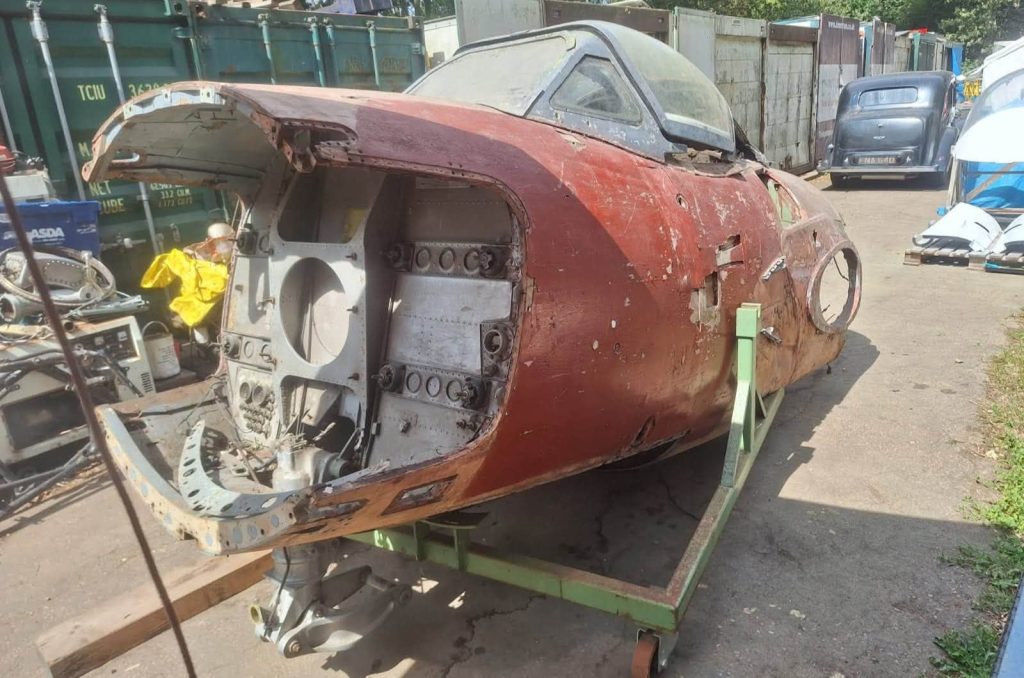
After its flying career, WX853 was allocated the maintenance serial 7443M in 1957 and became a gate guardian at RAF Debden. It moved to the museum at London Colney in January 1968, where it was displayed before eventually being dismantled and placed in storage. The new restoration project offers a route back to public display. The first stage will be a detailed assessment of the aircraft’s condition, identifying missing components and establishing which areas require the most work. Lamb said one of the main challenges is reuniting the fuselage with its wings, which remained at the de Havilland Aircraft Museum at the time of the interview. The team hopes they can be transferred to Coltishall in the coming months.

Lamb said the transfer agreement also included a de Havilland Ghost 104 engine to accompany the airframe. The Ghost 104 was used in the Venom family, and having an appropriate powerplant will help the team present the aircraft’s engineering as part of the restoration. As with other historic aircraft projects, access to specialist parts, skilled volunteers, funding, and suitable working space will determine how quickly the restoration advances. Once restored, WX853 will join the Centre’s growing collection of Cold War aircraft and artifacts, which also includes a complete SEPECAT Jaguar and cockpit sections from a Hawker Hunter T.7 and a Lightning T.5.

Together, the Meteor and Venom projects will help the Centre explain how Coltishall and the RAF adapted to the jet age. Restoring the aircraft at the former station also gives volunteers and visitors a direct connection to the machines and people whose service shaped its history. For restoration updates and further information, visit the RAF Coltishall Heritage Centre’s Facebook page.