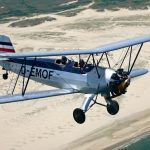

In January 1928, successful oilman William G. Skelly bought the struggling Mid-Continent Aircraft Manufacturing Company in Tulsa. He renamed it Spartan Aircraft Company and reorganized its finances. Skelly also started the Spartan School of Aeronautics. During the early years of the Great Depression, Skelly supported the company while it began making airplanes. However, the economic downturn affected his finances. In 1935, J. Paul Getty bought a controlling interest in the company from Skelly. At the start of WWII, Getty took direct control of the company. He expanded its production by making parts for warplanes and opened Spartan School branches in Miami, Muskogee, and Ponca City, Oklahoma. The Spartan Aircraft Company’s first aircraft was the Spartan C3 open-cockpit biplane. The C3-1 began a series of models designed for flight schools, sport pilots, and Fixed-Base Operators (FBOs). The Spartan C3-225 was the company’s last early biplane model. Spartan built at least 160 C-3 aircraft, using different types of engines. In 1930, Spartan introduced its first monoplane, the Spartan C2-60. This lightweight aircraft was made for sport pilots and had a small 60-horsepower engine. Building on the C2-60, Spartan created a heavier and more powerful model called the C2-165. The military did not prefer the C2-165 because its low-wing design obstructed views. It was mostly used for civilian flight training.

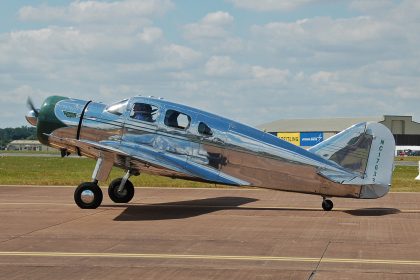
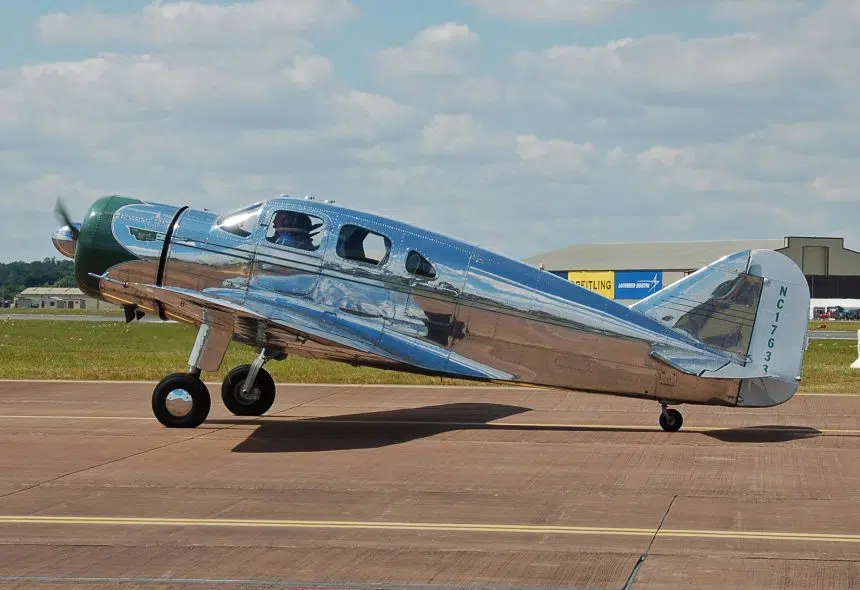
In 1930, the company developed the Spartan C4. The C4 was a high-wing monoplane designed for low maintenance and high comfort. It could accommodate larger engines of 230 horsepower or more. Later, founder William Skelly created the Spartan Executive Model 7W to meet wealthy customers’ luxury and performance needs. It was powered by a 450-horsepower Pratt & Whitney Wasp Jr. engine and was Spartan’s first all-metal aircraft, using a monocoque design. The design, along with the large engine and aerodynamic shape, allowed it to cruise at 200 miles per hour, reach a range of over 1,000 nautical miles, and reach an altitude of 25,000 feet. A total of thirty-four 7W aircraft were made. To meet military needs for high-performance reconnaissance and training, the military developed a version based on the Spartan 7W. The new model, the Spartan Zeus 8W, featured a more powerful 600-horsepower Pratt & Whitney Wasp engine. The last aircraft the Spartan Aircraft Company made was the Spartan NP-1 biplane. Although it looked like earlier planes, it used more modern technology than the wire-and-fabric construction of Spartan’s original biplanes. Designed as a trainer for the United States Navy, the Spartan NP-1 had a lightweight open-cockpit design and was powered by a Lycoming R-680-B4C engine with 225 horsepower.

After WWII, personal aviation slowed, and competition in the aircraft industry increased. J. Paul Getty and Spartan management shifted their focus to housing and leisure. They used the same strong and space-saving design from the Spartan Executive 7W to create their first all-metal travel trailer. Spartan followed earlier design trends and produced luxurious, fully-equipped trailers. In the 1940s and 1950s, people called Spartan trailers the “Cadillac” of trailers, and they sold for more than $4,000. Spartan made over 40,000 trailer homes before stopping production in 1961. At that time, the average home in the US cost around $8,000, which meant wealthy buyers mostly bought Spartan trailers. After 33 years of making aircraft and trailers, Spartan Aircraft Company closed its manufacturing facilities. It then moved into insurance and finance under the name Minnehoma Insurance Co. Spartan sold the name to Spartan School of Aeronautics, now called Spartan College of Aeronautics and Technology. However, Spartan Aircraft Company still overhauled Pratt and Whitney R2000 aircraft engines as late as 1970, according to Department of Defense records. The Spartan Aircraft Company produced several types of aircraft including Spartan C3, with around 122 built, Spartan C4, with seven units made, Spartan C5, which had four built, Spartan C2, with more than 56 built, Spartan 8W Zeus, with four or five made, Spartan NP, with 201 units built, and the Spartan 12W Executive had only one built as a single-engine cabin monoplane utility aircraft. Read more Forgotten Factories articles HERE.