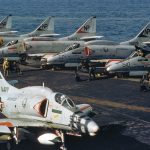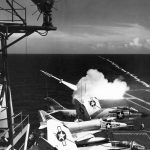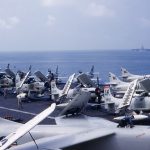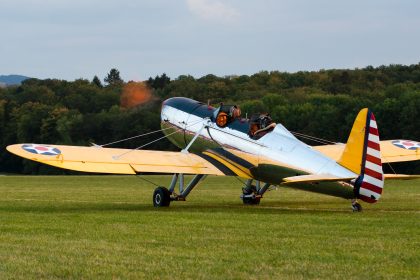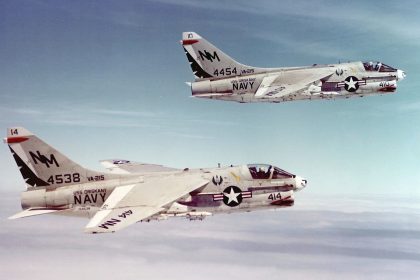

Attack Squadron 215 (VA-215), known as the “Barn Owls,” was formed twice in the US Navy. The first VA-215 was formed on June 22, 1955, and ended its service on August 31, 1967. During this time, it flew the A-1 Skyraider and participated in Cold War conflicts and the Vietnam War. The second VA-215, which started on March 1, 1968, took on the Barn Owls name and flew the A-7B Corsair II until it was disbanded in 1977. The first VA-215 squadron began at NAS Moffett Field and received the AD-6/A-1H Skyraider in August 1955. It later moved to NAS Alameda and then to NAS Lemoore, upgrading to the AD-7/A-1J Skyraider in 1961. One of the squadron’s earliest major missions happened during the Second Taiwan Strait Crisis in 1958. From the USS Lexington, Attack Squadron 215 operated flights in the Formosa Strait from August to November as tensions increased around the offshore islands. The following year, Commander P. Rippa, the squadron’s leader, died in a training flight in Yosemite Valley on March 24, 1959. In March 1961, the squadron was called back to action when the USS Lexington operated off the coast of Thailand. The Laotian government was struggling against the Pathet Lao. Aircraft from the carrier’s air group conducted reconnaissance missions over Laos.

In April 1962, Attack Squadron 215 was deployed on the USS Hancock and operated off the coast of South Vietnam. It was when the first US Marine Corps advisory unit arrived in the country. A month later, the squadron was ready to support Marines moving into Thailand at the request of the Thai government. There were growing concerns about the Pathet Lao advancing along the Thai-Laotian border. In September 1963, Attack Squadron 215 operated off Taiwan due to renewed tensions between Communist China and the Republic of China. Two months later, Hancock and its air group left South Vietnam following the coup that overthrew President Ngo Dinh Diem. By December 1964, the squadron was flying missions in Operation Barrel Roll, carrying out reconnaissance and strikes along infiltration routes in Laos. Their Skyraiders also supported Operation Flaming Dart against targets in North Vietnam and played a role in the early stages of Operation Rolling Thunder. On March 5, 1966, Commander R. C. Hessom, the squadron’s commanding officer, was killed during a mission over North Vietnam. In the same month, the Attack Squadron 215 Skyraiders helped with Operation Jackstay, providing close air support during amphibious operations in the Rung Sat Special Zone, southeast of Saigon.

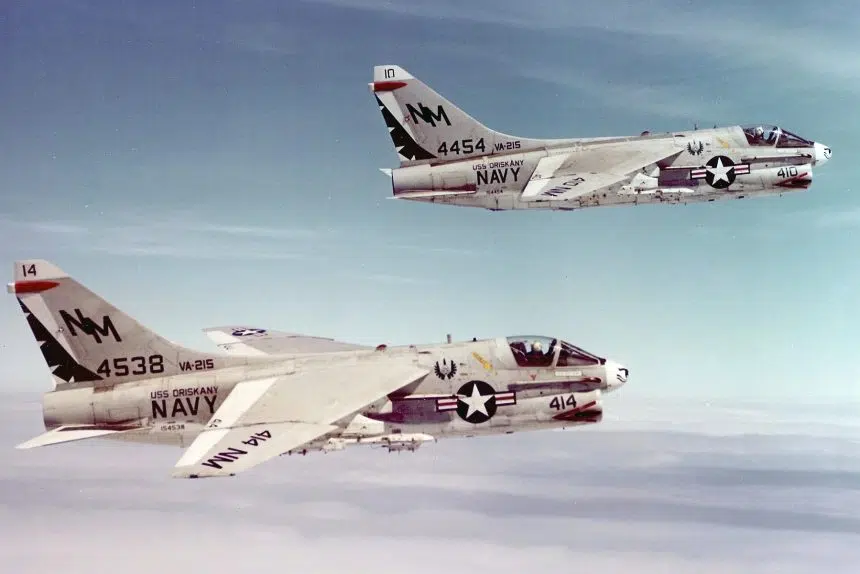
The first Attack Squadron 215 was disbanded on August 31, 1967, after 12 years of service. On March 1, 1968, the Attack Squadron 215 was again formed at NAS Lemoore and flew the LTV A-7B Corsair II. On January 14, 1969, while training aboard the USS Enterprise in Hawaiian waters, a fire broke out on the carrier’s flight deck. Several squadron members received recognition for their bravery during this emergency. Just three months later, the USS Enterprise was sent to Korea after North Korean forces shot down an EC-121 in April 1969. VA-215 operated in the Sea of Japan and Yellow Sea from April 16 to May 11. Later, the squadron deployed on the USS Franklin D. Roosevelt for the carrier’s 18th Mediterranean cruise in 1970. Its combat missions continued in Southeast Asia, including Operation Linebacker II in December 1972. After the ceasefire with North Vietnam, Attack Squadron 215 continued to fly combat missions in Laos until the Laotian ceasefire on February 22, 1973. The Barn Owls continued to serve in the Navy’s carrier force after the Vietnam War. In November 1973, the USS Oriskany, with the VA-215 squadron aboard, left its operations in the South China Sea to support the USS Hancock in the Arabian Sea amid unrest following the Yom Kippur War. The squadron’s last operational mission took place from October 1976 to April 1977 aboard the USS Franklin D. Roosevelt with Carrier Air Wing 19. The Attack Squadron 215 squadron was officially disbanded on September 30, 1977.