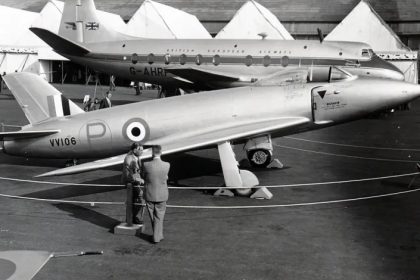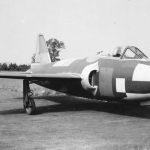
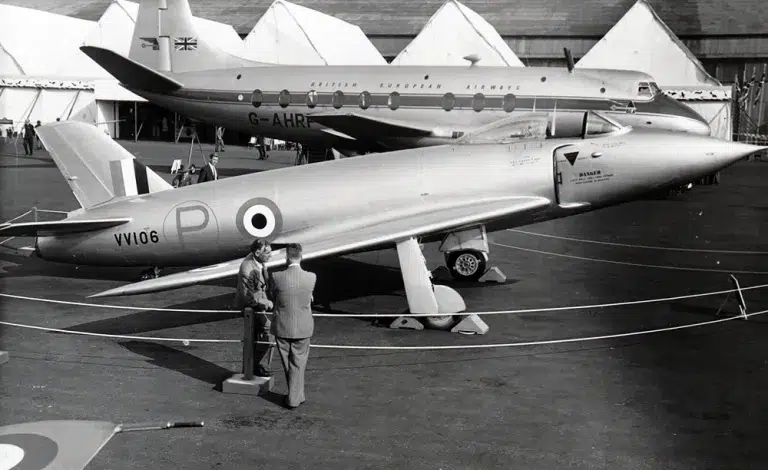


On this day in aviation history, 76 years ago (November 8, 1950), the Supermarine Type 510 became the first swept-wing jet aircraft to take off from and land aboard an aircraft carrier. Operating from the Royal Navy’s HMS Illustrious, the experimental British fighter demonstrated that swept-wing aircraft could be operated from carriers, helping pave the way for a new generation of high-performance naval fighters. The Type 510 was developed by Supermarine as an experimental swept-wing derivative of the company’s Attacker jet fighter. First flown in December 1948, the aircraft retained the Attacker’s fuselage, Rolls-Royce Nene turbojet, and tailwheel undercarriage, but incorporated new wings swept back 40 degrees. The design was intended to investigate the aerodynamic advantages of swept wings at high speeds, while also evaluating their handling characteristics at lower speeds.

In preparation for carrier trials, prototype VV106 was modified with strengthened landing gear, an arrestor hook, and provisions for rocket-assisted takeoff equipment. The trials aboard HMS Illustrious involved Supermarine test pilot Mike Lithgow and Royal Navy pilots Lieutenant Commander Doug Parker and Lieutenant Commander Jock Elliott. Twelve takeoffs and landings were reportedly completed during the November 8 trials. During one takeoff, Parker’s aircraft struck the top of a gun turret after a wing dropped unexpectedly, but he recovered and continued flying. The trials demonstrated the feasibility of operating swept-wing jets at sea and contributed to the development of later British naval fighters. The Supermarine Type 510 was powered by a single Rolls-Royce Nene turbojet producing approximately 5,000 pounds of thrust. Its wings featured 40 degrees of sweep, while the aircraft retained the conventional tailwheel landing gear arrangement of the Supermarine Attacker. During testing, the Type 510 reached approximately Mach 0.95 in a shallow dive, equivalent to speeds exceeding 670 mph under the test conditions. Although the aircraft never entered production, its development contributed to the later Supermarine Swift fighter. Prototype VV106 survives today at the Fleet Air Arm Museum in Yeovilton, England.