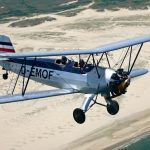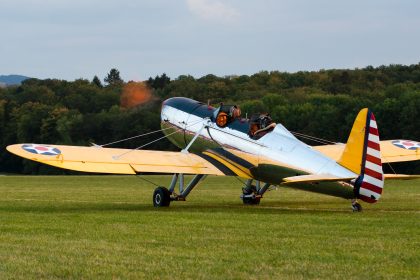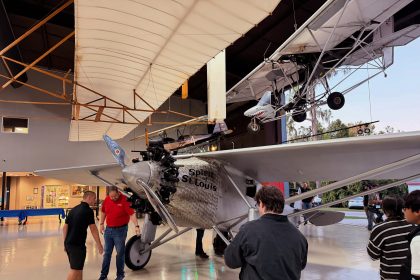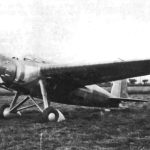
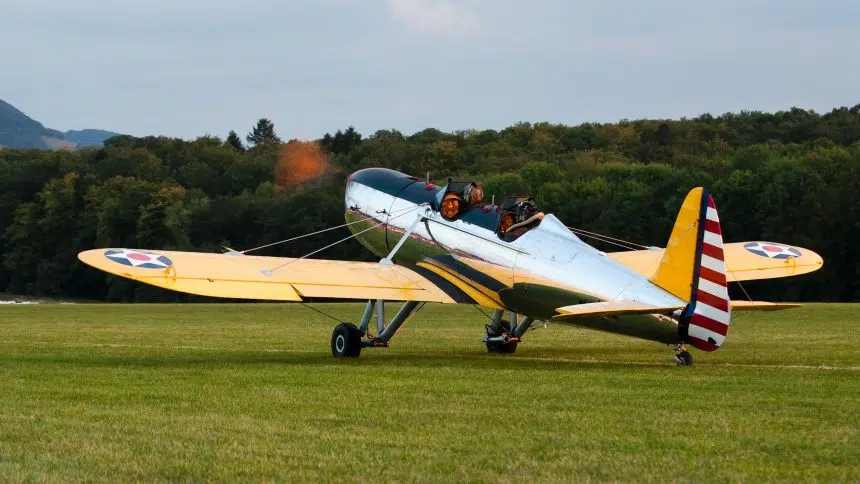

In 1922, T.C. Ryan started a flying service in San Diego, which led to several aviation businesses with the Ryan name, including the Ryan Airline Company in 1925. T.C. Ryan was involved in companies that helped build Charles Lindbergh’s famous transatlantic plane, the Spirit of St. Louis, but he did not actually build the aircraft himself. He had been an owner or partner in several businesses, including one called Ryan Aeronautical. The company’s first aircraft was the S-T Sport Trainer. This low-wing, tandem-seat monoplane featured a 95 hp Menasco B-4 Pirate engine. The company built five of these before moving to the Ryan ST-A Aerobatic model, which had a more powerful 125 hp Menasco C-4 engine in 1935. The ST-A had enough power for aerobatic performances and won the International Aerobatic Championships in 1937. An improved version, the ST-A Special, was built in 1936 with a 150 hp supercharged Menasco C-4S engine. In 1937 and 1938, the company introduced a second aircraft model, the S-C Sport Coupe, also known as SC-W. It was a larger three-seater with a 145-hp Warner Super Scarab radial engine, a sliding canopy, and side-by-side front seating.

The prototype SC-M initially used a Menasco C-4 inline engine, but testing showed it needed more power. Thirteen SC-W planes were built, although the last one was assembled from leftover parts decades after production ended. The United States Army Air Corps showed interest next. However, the Menasco engines were unreliable, so Kinner radial engines were used instead. The aircraft were made as the PT-16 (15 built), PT-20 (30 built), PT-21 (100 for the USAAF, 100 for the USN), and finally the PT-22 Recruit, which became the standard model (1,048 built). The order was placed in 1941 as pilot training expanded fast. Ryan also developed Short Takeoff and Landing (STOL) techniques in its YO-51 Dragonfly for liaison and observation, but only three of these aircraft were built. The Ryan FR Fireball was an American fighter aircraft designed for the United States Navy during WWII. It was the Navy’s first aircraft powered by both a jet engine and a piston engine. Only 66 of these planes were made before Japan surrendered in August 1945. The FR-1 Fireball was used by one squadron before the end of the war but did not see any combat.

After WWII, Ryan purchased the rights to the North American Aviation Navion light aircraft and sold it to both military and civilian customers. Ryan then entered the missile and unmanned aircraft industries. He developed the Ryan Firebee, an unmanned target drone, and the Ryan Firebird, which was the first American air-to-air missile. He also worked on several experimental and research aircraft. In 1965, Ryan bought a 50% share in Continental Motors Corporation, a builder of aircraft engines. In the 1950s, Ryan initiated jet vertical flight with the X-13 Vertijet. In the early 1960s, Ryan created the XV-5 Vertifan for the US Army. The aircraft used lift vanes on the wings and nose to achieve vertical flight. Other designs by Ryan for vertical takeoff and landing (V/STOL) included the VZ-3 Vertiplane. Ryan also developed the precise radar system used in the Apollo Lunar Module. In 1968, Teledyne purchased the company for $128 million. A year later, Ryan became a wholly owned part of Teledyne, called Teledyne Ryan Aeronautical Company. In 1999, Northrop Grumman acquired Teledyne Ryan, and Ryan’s products became important to its unmanned aerial vehicle programs. Read more Forgotten Factories articles HERE.