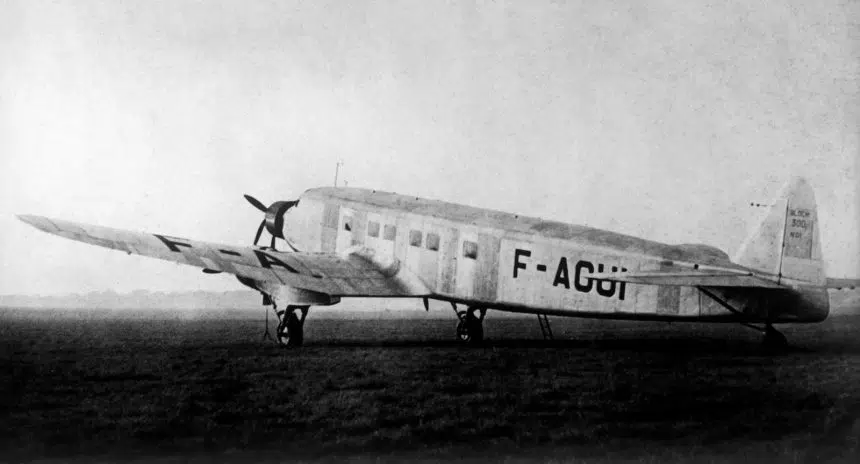

On this day in aviation history, 91 years ago (November 16, 1935), the Bloch MB.300 Pacifique made its first flight at Villacoublay, France. Flown by André Curvale and Jean Lapeyre, the large, three-engine airliner was developed by Société des Avions Marcel Bloch for Air France. Nicknamed La Grosse Julie, or “Big Julie,” the all-metal monoplane represented an ambitious attempt to modernize French commercial aviation during the 1930s. The MB.300 was developed in response to a French government requirement for a fast, 30-passenger airliner. Designed alongside the smaller Bloch MB.220, the aircraft incorporated a low-mounted wing derived from the MB.210 bomber, retractable landing gear, and a spacious passenger cabin. Its original interior featured separate first- and second-class seating areas, a small bar, and accommodations for 30 passengers, along with a four-person flight crew.

Following its maiden flight, the prototype underwent extensive modifications to improve performance and passenger comfort. Changes included a slightly longer fuselage, reduced wingspan, improved engine mounts, and enlarged tail surfaces. By 1937, the aircraft had received more powerful Gnome-Rhône engines and a revised 24-passenger interior. Although Air France conducted evaluation flights and eventually accepted ownership of the aircraft in January 1938, the MB.300 never entered regular airline service. Only one prototype was constructed, and its ultimate fate remains uncertain. In its later configuration, the MB.300 measured 81 feet 8 inches in length with a wingspan of 85 feet. It was powered by three Gnome-Rhône 14N radial engines producing approximately 915 horsepower each. The aircraft could reach a maximum speed of 220 mph, had a range of 620 miles, and a service ceiling of 26,000 feet. Its maximum gross weight was approximately 29,939 pounds, with accommodations for four crew members and a revised passenger cabin.