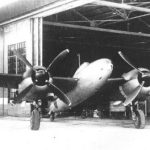
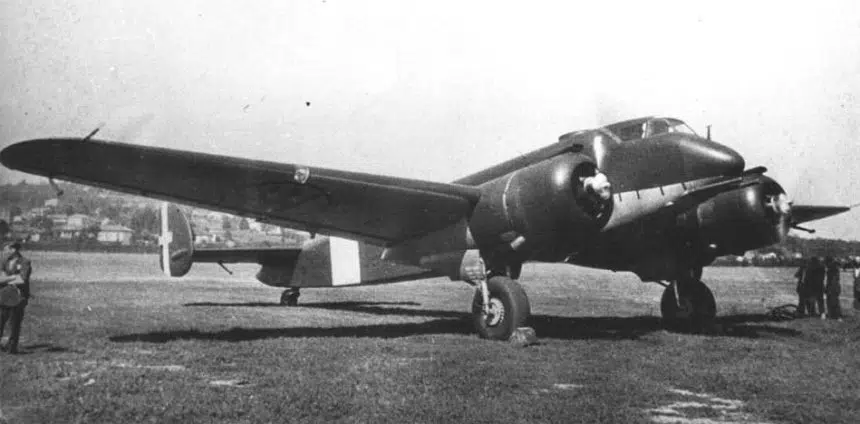

In the early 1940s, Italian aircraft manufacturer Savoia-Marchetti began developing a new aircraft intended as a bomber, similar to the German Junkers Ju 88. The aircraft, designated the Savoia-Marchetti SM.89, was based on the earlier SM.84 model. It kept the wings, the rear fuselage, and the mixed construction of the original design mostly unchanged, but completely redesigned the nose. The fuselage had a steel-tube frame and was covered with duralumin and wood up to the dorsal turret. The wings were made of wood and included three support beams, covered with special wood. The control surfaces had slats, flaps, and ailerons that worked together to increase lift. The main difference between the SM.84 and SM.89 aircraft was the forward fuselage. The Savoia-Marchetti SM.89 had space for a pilot, followed by a radio operator/gunner and a gunner, half the crew of the S.84.
Design of Savoia-Marchetti SM.89

Unlike many other Italian aircraft of its time, the Savoia-Marchetti SM.89 did not have a nose engine. It was powered by two Piaggio P.XII RC.35 18-cylinder, air-cooled, two-row radial piston engines, each producing 1,501 hp, allowing the nose to carry weapons. The main armament included 37 mm Breda anti-aircraft guns, which could be used against tanks and ships. The nose also contained three 12.7 mm Breda machine guns. Additionally, another Breda machine gun was mounted in a dorsal turret, and another in a new remote-controlled turret on the underside. The aircraft could carry 700 bomblets or 3,090 pounds of bombs or torpedoes underneath. It could be equipped with air brakes for dive bombing. Its speed allowed it to be used as a bomber interceptor, but it was never fitted with radar. The aircraft could carry 710 US gal of fuel in self-sealing tanks, giving it a 450-mile range. The Savoia-Marchetti SM.89 had heavy armor for protection. The front and windscreen had a combined armor weight of 660 lb, another 660 lb protected the engines, and an additional 180 pounds was used for rear armor.
The Cancellation

The aircraft flew for the first time in 1941. However, it was not sent to Guidonia for evaluation tests until September 1942. It officially entered service in March 1943 and was used in anti-tank and other roles. The results were good, with its firepower being second only to the P.108A. However, the Savoia-Marchetti SM.89 weighed 27,780 pounds, and its engines produced only 3,000 horsepower. It was not enough for an aircraft with heavy armor. Its heavy nose made it hard to fly and land. The company also planned to replace Piaggio P.XII engines with the more powerful Piaggio P.XV or Alfa Romeo 135 engines, but it never happened. Later, the aircraft went to Foligno in July 1943 and was captured by the Germans on September 8, 1943. The Savoia-Marchetti SM.89 was a good aircraft, but it did not reach its intended purpose. The SM.89 was intended as a bomber, but it mainly carried two 37 mm cannons, each 54 calibers long, which made it function more like modern ground-attack or maritime-strike aircraft, such as the Bristol Beaufighter or Douglas A-26 Invader. Read more Grounded Dreams articles HERE.