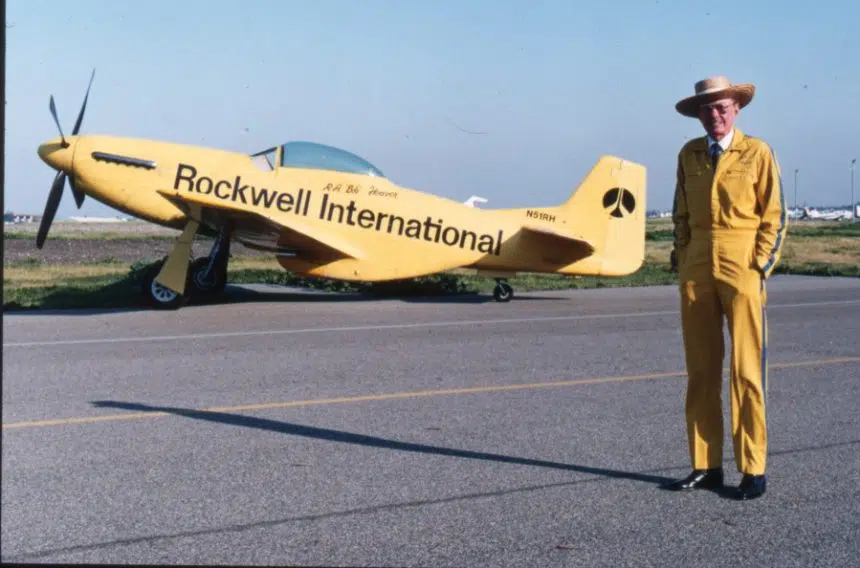

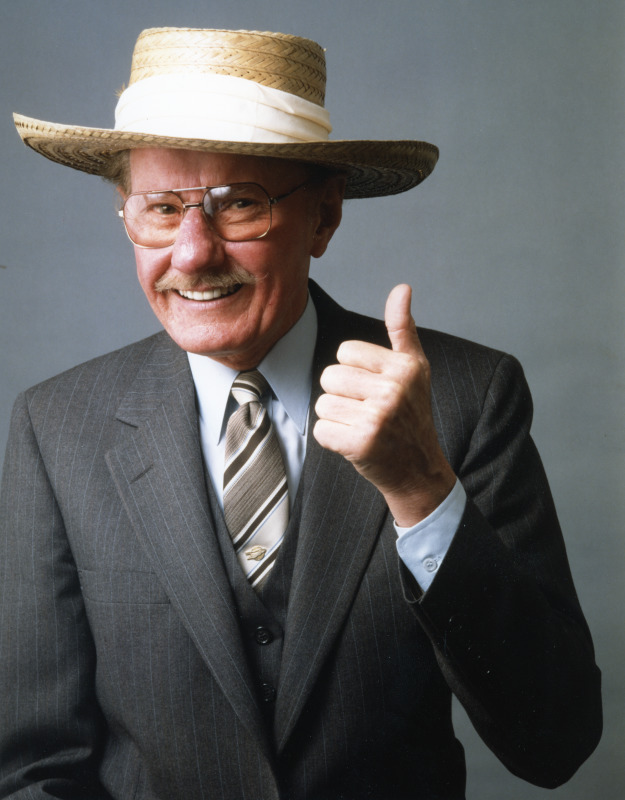
On May 18, 2010, legendary fighter, test, and aerobatic pilot Robert A. “Bob” Hoover delivered the annual Charles A. Lindbergh Memorial Lecture at the Smithsonian Institution’s National Air and Space Museum in Washington, D.C. General John R. “Jack” Dailey, who served as the director of the National Air and Space Museum, introduced Bob Hoover. As the longtime director of the museum, Gen. Dailey hosted the event and introduced the legendary pilot. Interestingly, Dailey and Hoover shared a close, historic friendship; Dailey famously allowed Hoover to accomplish an extraordinary museum first by taxiing his iconic green-and-white Shrike Commander airplane directly into the Boeing Aviation Hangar.
- A Career Marked by Close Calls
- An Unexpected Meeting with Charles Lindbergh
- Lindbergh Meets the Apollo 11 Crew
- Friendship with Jimmy Doolittle
- From Spitfires to Combat in North Africa
- Fighting for a Combat Assignment
- “One Hell of a Deflection Shot”
- Improving Fighter Operations in Korea
- The F-100 Fly-Off
- Surviving the F-100’s Failure
- Did the F-86 Beat the Bell X-1 Through Mach 1?
- Making the F-5 “Talk”
- Honoring an Aviation Legacy

Dailey opened the evening by recalling one of Hoover’s best-known pieces of advice: “When faced with a forced landing, fly the airplane as far through the crash as possible.” The words neatly summarized the combination of skill, composure, and determination that carried Hoover through some of aviation’s most dangerous moments. Dailey then borrowed the words of another aviation legend, Jimmy Doolittle, who described Hoover as “the greatest stick-and-rudder man who ever lived.” What followed was less a formal lecture than a journey through the history of 20th-century aviation, told by a man who had experienced much of it firsthand. Speaking with characteristic humor and humility, Hoover reflected on combat, test flying, friendships with aviation pioneers, and close calls that would have ended the careers—and lives—of less capable pilots.
A Career Marked by Close Calls
Hoover began by explaining that injuries sustained during his test-flying career were still affecting him. During one high-speed bailout, he struck the aircraft’s tail and later broke both legs upon landing. The airplane was traveling at approximately 500 mph when fire warning lights illuminated and the controls burned away. Hoover intended to use its experimental ejection seat, but the system failed. The seat had been based on a German design intended to prevent a pilot from being pulled into an engine intake mounted above and behind the cockpit. “We didn’t copy quite well enough,” Hoover joked. “And the seat didn’t work.” Instead, he was forced to leave the aircraft conventionally at extreme speed. It was one of several times Hoover survived circumstances that offered little margin for error. He also recognized Bob Morgenthaler, who flew alongside him in the Shrike Commander. Hoover had initially fought for approval to operate the aircraft as a single-pilot airplane, as it had been designed and tested. When regulations required a second pilot for commercial demonstrations, Morgenthaler volunteered to accompany him, beginning a partnership that lasted five years.

An Unexpected Meeting with Charles Lindbergh
Because the evening honored Charles Lindbergh, Hoover devoted much of his lecture to their friendship. Their first meeting occurred at an aviation event in Germany, where Hoover had been demonstrating a jet fighter. After Hoover landed, spectators gathered around the aircraft for autographs and photographs. An older man wearing an unfashionable suit quietly approached and asked to speak with him privately. Hoover apologized and asked him to wait until he had finished greeting the crowd. When they finally spoke, the man complimented Hoover’s flying and introduced himself. “I’m Charles Lindbergh,” he said. Hoover initially struggled to believe him. Lindbergh explained that he traveled under the name “Swartz” and had spent nearly three decades living largely outside public view. What he missed most, he told Hoover, was the opportunity to keep pace with advances in aircraft design and aerospace technology. North American Aviation was then at the leading edge of several major programs, including rocket engines and spaceflight hardware. Lindbergh, who served on Pan American World Airways’ board of directors, arranged to travel back to the United States with Hoover aboard a Boeing 377 Stratocruiser. During the nine-hour flight, the two became well acquainted. Hoover subsequently arranged for Lindbergh to receive private briefings from scientists and engineers at North American Aviation. Security officials first verified Lindbergh’s clearance, but his identity remained concealed from many of the specialists who briefed him. “The tragedy of this whole thing,” Hoover recalled, was that the scientists never realized they were speaking with Charles Lindbergh. Hoover often wondered how they would have reacted had they known. The meetings continued for years, and Lindbergh eventually visited Hoover’s home. Their friendship later placed Hoover in a unique position to bring together two generations representing defining moments in aviation and space exploration.
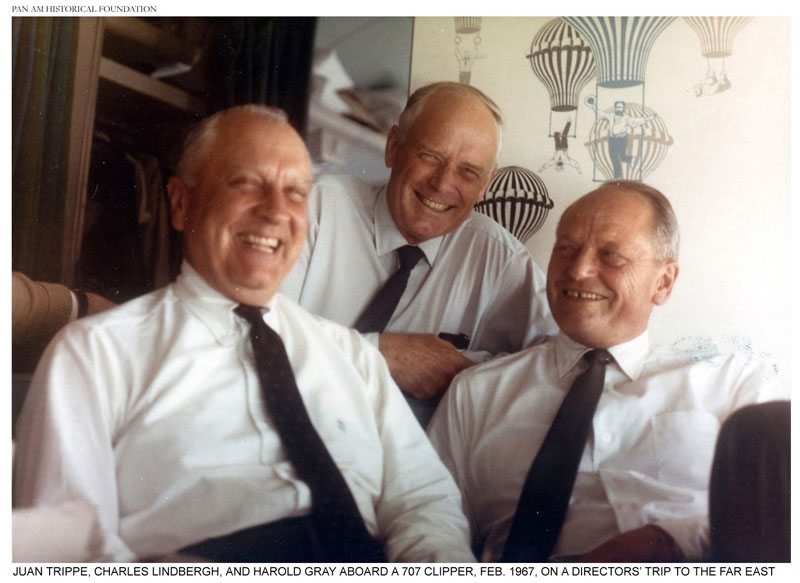
(Image credit: PAN AM HISTORICAL FOUNDATION)
Lindbergh Meets the Apollo 11 Crew
After becoming president of the Society of Experimental Test Pilots in 1969, Hoover envisioned an extraordinary gathering for the organization’s annual symposium: Charles Lindbergh appearing alongside the recently returned Apollo 11 crew. Hoover contacted Deke Slayton, then responsible for NASA’s astronaut corps, and proposed bringing Neil Armstrong, Buzz Aldrin, and Michael Collins to the event. The astronauts were scheduled to leave quarantine only one day before the symposium and had not yet reunited fully with their families. Slayton initially questioned the request, but Hoover emphasized the historical importance of placing the man who crossed the Atlantic alone in 1927 on the same stage as the men who had just returned from the Moon. Lindbergh presented another challenge. Although interested in becoming an honorary member of the Society of Experimental Test Pilots, he remained reluctant to return to public life. He asked Hoover whether he could enter through a rear door, avoid cameras, and leave under the protection of security personnel. Hoover assured him that the Apollo 11 astronauts would command everyone’s attention. “They won’t even know who you are,” he told Lindbergh. When Lindbergh arrived, no one recognized him. Hoover took him to his hotel suite, where Armstrong, Aldrin, Collins, Bob Hope, Barron Hilton, and other guests had gathered. Lindbergh initially resisted entering and instead asked Hoover to listen to the speech he had prepared. The address concerned environmental conservation, a subject that had become increasingly important to Lindbergh. Hoover admitted that he was preoccupied with the evening’s logistics and scarcely heard the speech. Lindbergh’s presence, he said, mattered more than the words themselves. When the two entered the suite, Bob Hope’s photographer immediately prepared to take a picture. Knowing Lindbergh’s aversion to publicity, Hoover blocked the camera and asked Hope to have the photographer leave. Lindbergh gradually relaxed and began speaking with the astronauts and Hoover’s other guests. At dinner, he was seated beside Hoover’s wife, while Neil Armstrong sat nearby. A photograph of the group was distributed by the Associated Press and appeared in newspapers around the world. “Well,” Hoover remarked, “he wasn’t obscure anymore.”

Friendship with Jimmy Doolittle
Hoover also reflected on his close friendship with Jimmy Doolittle, whom he had admired alongside Lindbergh, Roscoe Turner, and other leading aviators of the era. Their relationship began after Doolittle watched Hoover demonstrate a fighter. Doolittle, then a three-star general, told the young lieutenant that he had never witnessed flying like it. Hoover responded that Doolittle was the greatest aviator who had ever lived. Doolittle then told Hoover that protocol might prevent informality around other military personnel, but in private he wanted Hoover to call him Jimmy. Their friendship endured for the remainder of Doolittle’s life. The relationship grew closer during Hoover’s career with North American Aviation, the manufacturer of the B-25 Mitchell used during the April 1942 Doolittle Raid on Japan. After the war, company leaders James “Dutch” Kindelberger and Lee Atwood established an annual reunion for the surviving Doolittle Raiders, with North American covering the expenses. Hoover helped coordinate the gatherings, which continued following the company’s merger with Rockwell. As the number of surviving Raiders declined, the reunions became increasingly poignant. Hoover attended Doolittle’s birthdays and anniversaries, joking that Doolittle would sometimes telephone to remind him that a birthday was approaching. For Hoover, becoming a personal friend of someone he had once regarded as an almost unreachable hero was among the great privileges of his life.

From Spitfires to Combat in North Africa
Hoover entered military service at 18. By age 20, he was responsible for 67 fighter pilots overseas, despite the unit initially having no American aircraft available. He persuaded his commanding officer to attach the group to the Royal Air Force, allowing the American pilots to gain experience flying Supermarine Spitfires. It was Hoover’s first exposure to combat aviation. Following the Allied landings in North Africa, Hoover and his pilots separated from the British and moved into the theater. Eager to enter combat, he instead received an assignment flight-testing newly assembled aircraft. The airplanes arrived in crates and were assembled with locally recruited labor. Communication difficulties and the urgency of wartime production created numerous problems. Hoover remembered discovering reversed aileron connections and other serious defects during preflight inspections. He flew from dawn until dark, testing P-39 Airacobras, P-40 Warhawks, Spitfires, Hawker Hurricanes, P-38 Lightnings, and some of the first P-51 Mustangs sent overseas for American use. Some aircraft required as many as ten test flights before they corrected all their discrepancies. Hoover also tested bombers following battle-damage repairs. On two occasions, he ordered the crews to bail out but remained aboard and brought the damaged airplanes down himself. “At the time, I never realized what an enormous experience I was going through,” he said, “because I had just about everything go wrong that could go wrong in an airplane—and I survived it.”

Fighting for a Combat Assignment
Despite the value of his work, Hoover continued asking for a combat posting. Instead, he became operations officer for a newly established ferry command, checking pilots out in various fighters and delivering replacement aircraft to frontline units. During the invasion of Sicily, Hoover led a formation of P-40s to Palermo. There, he encountered Maj. Gen. Joseph Cannon and requested a private conversation. Hoover told the general about his flight-testing experience and insisted that he wanted to fight. Cannon promised that if Hoover’s claims were accurate, orders would follow within two weeks. The transfer orders eventually arrived but remained untouched on Hoover’s commanding officer’s desk for three weeks. A sympathetic sergeant secretly informed him of the situation. Hoover then telephoned his commander and claimed that headquarters had contacted him to ask why he had failed to report to the 52nd Fighter Group. The colonel admitted that he had withheld the orders because he did not want to lose his operations officer. Hoover nevertheless departed with his footlocker aboard a B-25 and joined the fighter group in Sicily. He ultimately flew 59 combat missions and was shot down twice—once by friendly fire and once by the Luftwaffe.

“One Hell of a Deflection Shot”
During the mission that ended with his capture by German forces, Hoover was flying a Spitfire Mk.V on an armed reconnaissance sortie over southern France and Italy. His four-aircraft formation was attacking ships used to supply German forces. Hoover recalled scoring an exceptionally fortunate hit with a 100-pound bomb, which entered a vessel’s smokestack and destroyed the ship. Soon afterward, several Focke-Wulf Fw 190s attacked. When Hoover attempted to jettison his external fuel tank, the mechanism released but the tank remained attached. Burdened by the additional drag and limited to approximately 1,100 horsepower, his Spitfire could not outrun the German fighters. Hoover repeatedly turned into each attacking airplane, causing it to overshoot before briefly reversing to fire. He noticed another Fw 190 farther away but initially dismissed it as too distant to pose an immediate threat. The German pilot fired from an extreme deflection angle and struck Hoover’s aircraft, destroying its engine. Years later, a German artist contacted Hoover after identifying the pilot who had shot him down. The Luftwaffe airman, a sergeant pilot credited with 70 victories, had reportedly removed two cannons and their ammunition from his fighter to reduce weight and improve maneuverability against Spitfires. A painting depicting the encounter was eventually produced under the title One Hell of a Deflection Shot. Both former adversaries signed several thousand prints, although the German pilot—by then a diabetic who had lost both legs—required several weeks to complete his signatures.

Improving Fighter Operations in Korea
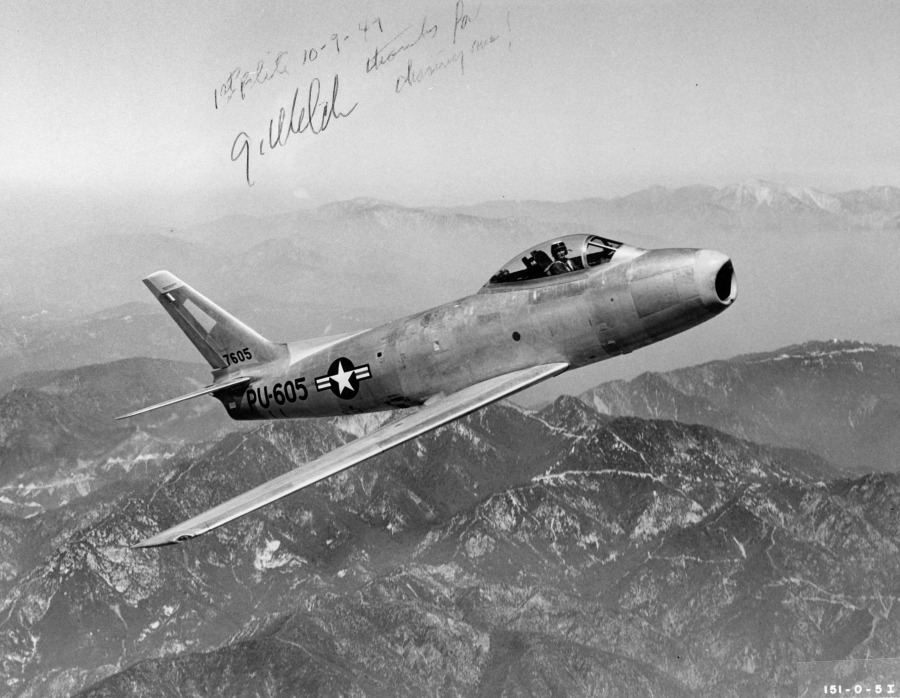
When the Korean War began, Hoover warned officials at the Pentagon that American pilots would once again need fighters capable of close-in aerial combat. He had heard similar predictions before World War II that dogfighting had become obsolete. “What are you going to do if you want to get on somebody’s rear end?” Hoover asked. “You’ve got to fight to get there.” By then, Hoover was a civilian test pilot for North American Aviation, manufacturer of the F-86 Sabre. Working with company engineers, he helped refine techniques intended to improve fighter-bomber accuracy against bridges, railroads, and other strategic targets. Hoover emphasized the importance of dive angle, release altitude, and airspeed. Templates helped pilots understand what a 20- or 30-degree dive actually looked like from the cockpit. Once the proper sight picture had been learned, bombing accuracy improved dramatically. Military officials reviewing Hoover’s results asked how quickly he could travel to Korea. When he asked when they wanted him, they replied, “How about tomorrow morning?”
(Image credit: SDASM Archives)
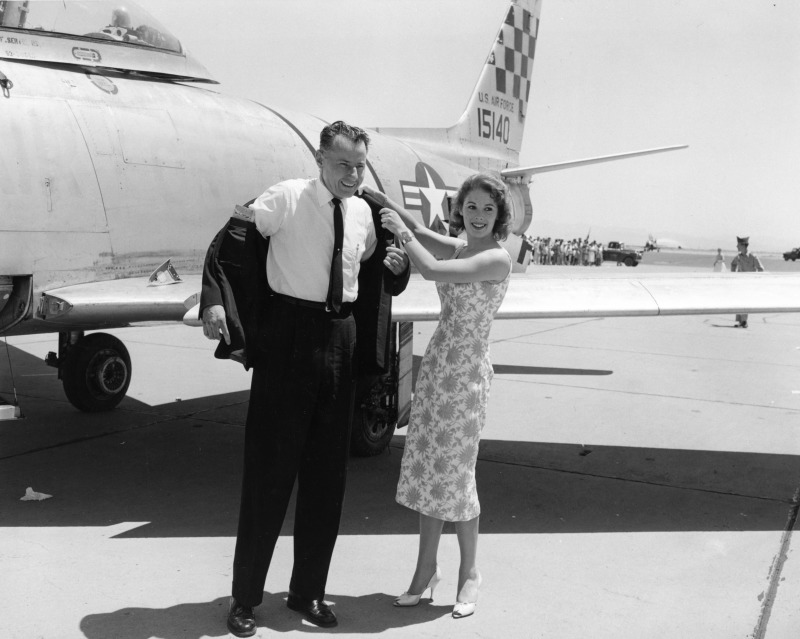
In Korea, Hoover helped explain the handling characteristics of an F-86 wing modification designed to provide additional internal fuel capacity. The change reduced dependence on bulky external tanks, but heavily loaded aircraft could settle back toward the runway if pilots attempted to lift off too early. Hoover also accompanied operational missions. Before one flight, the pilots were informed that because Hoover was a civilian with access to classified information, he could not be allowed to reach the ground alive if forced to bail out over enemy territory. “I was saying, ‘My gosh, I’ve used a parachute before,’” Hoover recalled. During the mission, the formation attacked a North Korean airfield before proceeding to a bridge that had resisted repeated bombing attempts. Hoover released his bombs and looked back to see that the bridge had disappeared. The formation leader received credit for the destruction until the aircraft rejoined and it became apparent that an electrical failure had prevented his bombs from releasing. Both weapons remained under his wings. After that mission, Hoover said, pilots at every base listened closely to what he had to teach.
(Image credit: SDASM Archives)
The F-100 Fly-Off
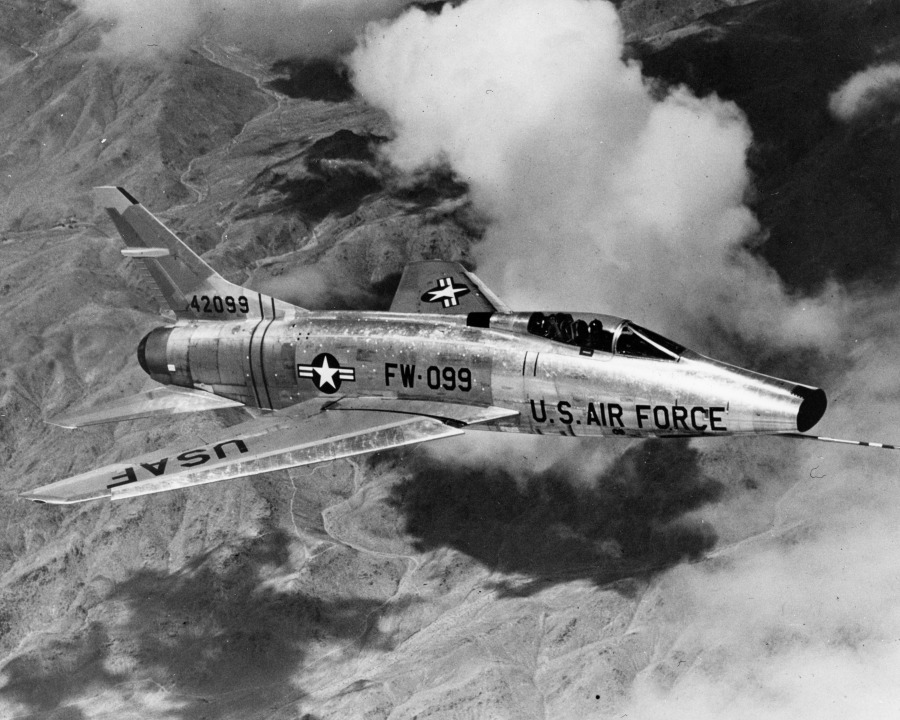
Following Korea, Hoover became involved in the development of North American Aviation’s F-100 Super Sabre. The company was preparing for a competitive evaluation against McDonnell’s F-101 Voodoo and had only two F-100 prototypes, one of which was not yet flying. Hoover had accumulated only about 30 minutes in the airplane when the assigned project pilot unexpectedly asked him to conduct the demonstration. Hoover attended the briefing wearing a business suit and learned that either aircraft would be disqualified if it exceeded Mach 1. During his demonstration, Hoover accelerated toward the transonic region, reduced power, and then selected afterburner to regain energy following a high-G pullout. The airplane suddenly pitched upward and entered a severe pilot-induced oscillation. Hoover recovered and continued vertically, rolling the aircraft until it disappeared from view. He returned for a low-speed demonstration before landing. A company executive later compared Hoover’s performance to a baby urinating on the lap of a wealthy uncle. “That’s just what you’ve done to our company,” he told Hoover. Fortunately, the Air Force ultimately purchased both aircraft types.

Surviving the F-100’s Failure
One of Hoover’s most serious accidents occurred while testing another F-100 prototype. He was flying above 40,000 feet when a tremendous explosion shook the aircraft. His feet came off the rudder pedals, debris rose from the cockpit floor, and a fireball repeatedly enveloped the airplane. Believing a fuel line had failed, Hoover shut down the engine and prepared to land on the dry lakebed at Edwards Air Force Base. Engineers warned him that the F-100’s high landing attitude made an engine-out touchdown exceptionally dangerous and advised him to eject. Hoover decided to remain with the aircraft. A small ram-air turbine initially supplied hydraulic power after the engine stopped, and he established the recommended approach speed of 285 knots—more than 300 mph. When he attempted to flare, however, the controls did not respond. Hydraulic pressure had fallen to zero. The F-100 struck the lakebed violently, rebounded approximately 200 feet into the air, and came down again with only limited rudder control available. One wing caught the surface, and the airplane cartwheeled across the lakebed. Hoover regained consciousness as rescuers opened the canopy. Recognizing a sensation in his back that an injured friend had once described to him, he concluded that his spine was fractured. He instructed the rescue team to deactivate the ejection seat, obtain a crane, and remove him from the wreckage while he remained secured in the seat. Initial X-rays suggested only a muscular injury, but Hoover refused to move. He contacted North American’s flight surgeon, who sent a DC-3 to transport him to Los Angeles. Additional X-rays revealed a diagonal spinal fracture that could have left him paralyzed had he attempted to walk. Hoover eventually recovered fully.
(Image credit: SDASM Archives)
Did the F-86 Beat the Bell X-1 Through Mach 1?
During the question-and-answer period, Dailey asked Hoover about claims that the North American F-86 might have exceeded the speed of sound before Chuck Yeager’s historic Bell X-1 flight on October 14, 1947. Hoover rejected the idea. He had flown chase for the first flight of the YF-86 on October 1, 1947, remaining within approximately 500 feet of the prototype throughout the 45-minute sortie. A landing-gear problem then kept the aircraft on jacks for nearly two weeks. The early YF-86 was also fitted with an Allison engine that lacked sufficient power for supersonic flight. Only after receiving a more powerful General Electric engine could the Sabre exceed Mach 1 in a dive. Hoover was also present when Yeager broke the sound barrier. Positioned at approximately 43,000 feet, he guided the rocket-powered X-1 back toward the lakebed after its release from the B-29 mothership. As Yeager accelerated past Hoover’s aircraft, Hoover photographed the X-1 and captured the shock-diamond pattern behind it. He recalled that a copy of the photograph reached President Harry S. Truman’s desk the following morning. “There’s no way that F-86 could have gone faster than sound,” Hoover said of the earlier claims. “It certainly didn’t happen before October the 14th.”

Making the F-5 “Talk”
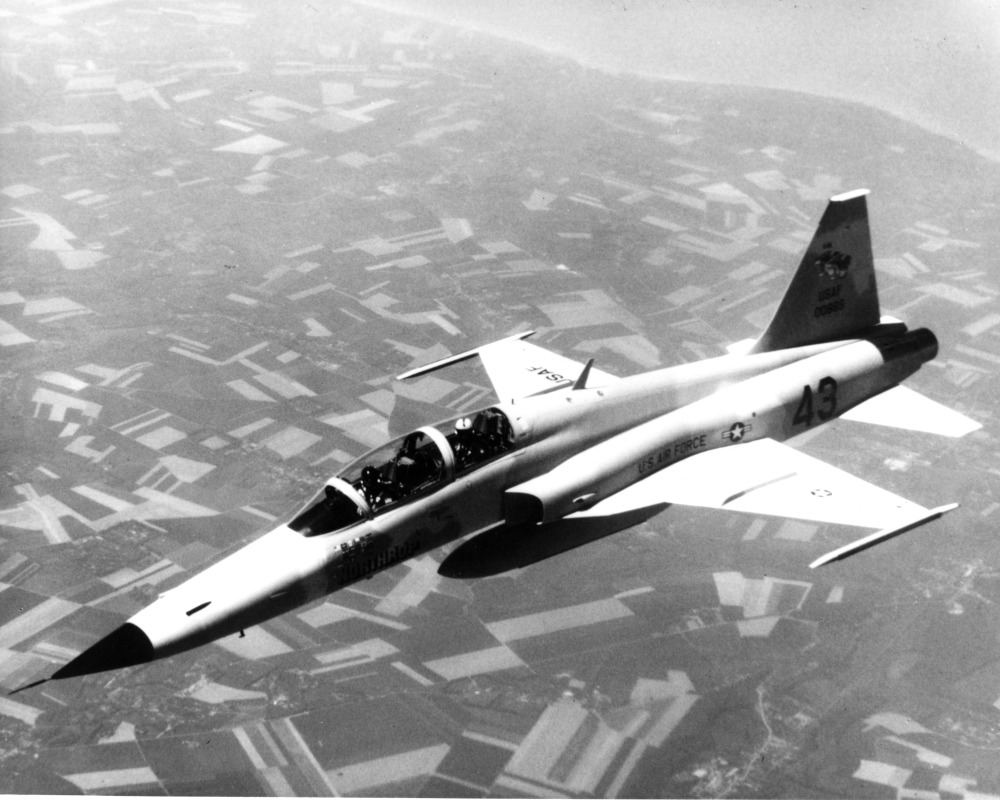
Asked whether he had a favorite aircraft, Hoover answered that he tended to fall in love with every new airplane he flew. He then shared one final story about demonstrating Northrop’s F-5 at the Paris Air Show. Northrop chief executive Thomas V. Jones believed Hoover’s international reputation could help sell the fighter. The company’s test pilots supported the idea, reasoning that spectators stopped what they were doing whenever Hoover was scheduled to fly. Hoover was initially reluctant, fearing that bringing in an outside pilot would insult Northrop’s own test team. He also lacked several qualifications demanded by the Air Force representative overseeing the aircraft. Hoover turned to Gen. George S. Brown, then Chief of Staff of the Air Force, who offered straightforward advice: “Just get in the damn airplane and fly its pants off.” Before departing for Paris, Hoover completed a T-38 checkout, underwent altitude-chamber training, and logged two hours in the F-5 to develop his routine. Northrop’s engineers then approved him to fly the lightweight aircraft at 8.5 g, above its normal 7.33-g limit. At the show, Hoover used the fighter’s performance to its fullest while carefully monitoring his physiological limits. He later recalled that the F-5 went on to achieve approximately 3,000 sales. When Jones asked what payment Hoover wanted, Hoover declined. He considered the F-5 an American product competing against foreign aircraft and wanted the sale to benefit the United States. A letter later arrived from Jones with Northrop stock certificates. “For 11 days at the Paris Air Show, you worked for me,” Jones wrote. “But with these stock certificates, I’m now working for you.”
(Image credit: SDASM Archives)
Honoring an Aviation Legacy
At the conclusion of the evening, the Lindbergh Foundation presented Hoover with a commemorative medal connected to two bas-relief sculptures created by artist Don Wiegand for the 80th anniversary of Lindbergh’s transatlantic flight. The sculptures, depicting Lindbergh and the Spirit of St. Louis, had been donated to the National Air and Space Museum. Hoover’s lecture offered far more than a collection of colorful flying stories. It provided a direct connection to an extraordinary period spanning World War II, the dawn of the jet age, the breaking of the sound barrier, the Korean War, and the maturation of American aerospace technology. Yet throughout the evening, Hoover placed as much emphasis on people as he did on airplanes. He spoke with admiration for engineers, mechanics, fellow pilots, commanders, and the aviation pioneers who became his friends. Looking back on his relationships with figures such as Charles Lindbergh and Jimmy Doolittle, Hoover described his career as almost unbelievable. Few people had flown such a wide variety of aircraft, survived so many emergencies, or participated so directly in so many pivotal chapters of aviation history. Even fewer could tell those stories with Bob Hoover’s warmth, humor, and unmistakable humility.
(Image credit: SDASM Archives)