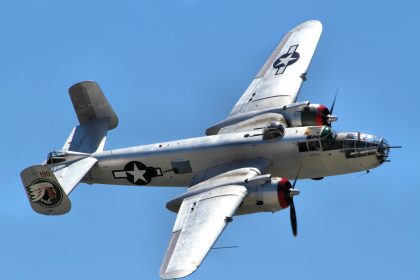
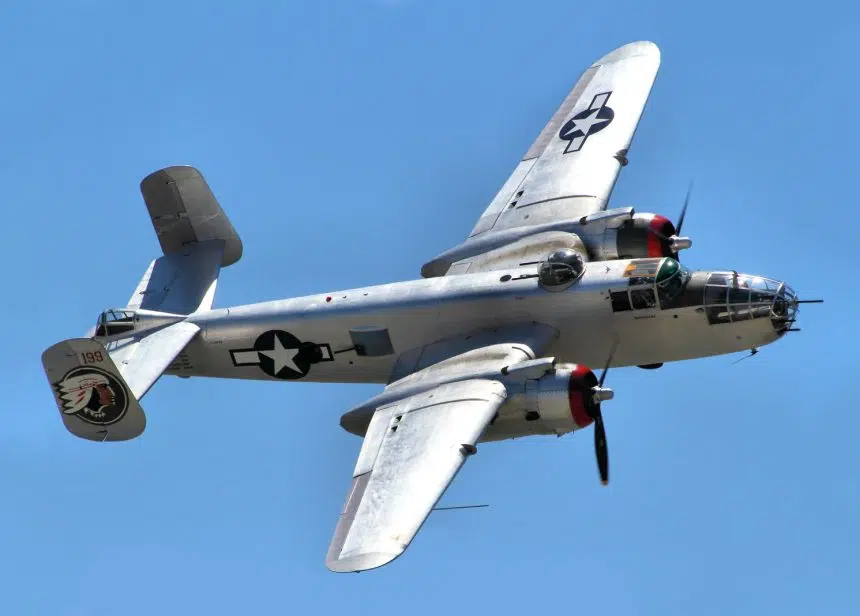

In December 1940, the president of North American Aviation inspected an aircraft production facility adjacent to Fairfax Field near Kansas City. The US government approved the construction of this plant in Kansas City to build B-25 Mitchell bombers for the US Army Air Forces and PBJ-1D bombers for the US Navy. Survey work started in December. In February, Kansas City bought the airport. The groundbreaking for the plant took place on March 8, 1941. On June 28, 1941, the government approved a contract to produce the first 1,200 B-25D bombers, and production began in December 1941. Fairfax delivered its first B-25D aircraft to the US Army Air Forces (USAAF) in February 1942. North American supplied parts for the initial 100 B-25Ds at the Inglewood, California plant, and it also operated a test flight office at Fairfax. From May to October 1942, a USAAF Modification Center was built at Fairfax Field to modify the B-25s produced there. The plant expanded in 1942 to prepare for a contract to build Boeing B-29 Superfortress bombers alongside the B-25s, although that contract was never implemented. The expansion added 350 feet by 1,060 feet of space, with a height twice that of the original assembly area, and was completed in March 1943.

After adding several outbuildings to the modification center, it became part of the final assembly line in October 1944. Employment peaked at 24,329 in October 1943. The first Fairfax B-25J was accepted in December 1943, and 555 B-25Js were produced in the first block, called B-25J-1-NC. Production of the B-25D model ended in March 1944, with the last unit being block 35 (B-25D-35-NA). After North American’s California plant stopped making B-25s on July 7, 1944, Fairfax became the only producer of B-25 Mitchells. In January 1945, Fairfax set a record by having the Army Air Forces accept 315 aircraft. Lockheed planned to produce the P-80 Shooting Star jet fighter. In February 1945, two Lockheed representatives visited Fairfax. In April, Lockheed sent a P-80 to the bomber plant for analysis. Fairfax began preparing to produce the P-80 by building jigs, clearing space in the high bay, and shortening the B-25 assembly line. B-25J production was supposed to last until December 1945, but it ended early on August 15, after V-J Day. Fairfax built 2,290 B-25Ds, including 152 Navy PBJ-1D versions, and 4,318 B-25Js out of about 11,000 produced.

The federal Reconstruction Finance Corporation set up a depot in the Fairfax area to manage surplus war materials that were not sent to government depots. They reclaimed reusable materials like aluminum and steel. The government sold 72 incomplete but flyable B-25Js to the public. The Buick-Oldsmobile-Pontiac Assembly Plant was established next to Fairfax Field. On November 7, 1945, General Motors announced it had signed a five-year lease for the old bomber plant, which had several railroad spurs. The factory made its first car in June 1946. In 1953, when the Republic F-84F Thunderstreak fighter was unveiled, its assembly line was part of the same 53-acre building as the car production line. General Motors produced 599 F-84Fs at the Fairfax plant, with both the aircraft and vehicle lines working side by side. GM bought the plant in 1960. In 1985, production began at the new General Motors Fairfax Assembly Plant, built on the runways of the closed municipal airport. Production at the former Air Force Plant ended in May 1987, and the building was demolished in 1989. Read more Forgotten Factories articles HERE.