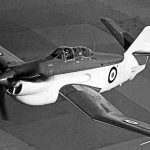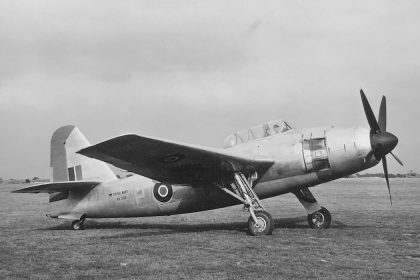



In the 1940s, Fairey Aviation began developing the Spearfish to meet Admiralty Specification O.5/43. It was designed to replace the Fairey Barracuda as a torpedo and dive bomber. Compared with the Barracuda, the Fairey Spearfish had a more powerful engine, an internal weapons bay, and a retractable ASV Mk.XV radar for surface searching, located behind the bomb bay. The Spearfish was also larger; it was designed for use on the Malta-class aircraft carriers, which weighed 46,000 tons and were in development at that time. In August 1943, the company received an order to build three prototypes based on Specification O.5/43. The first prototype, serial number RA356, was made at Fairey’s Hayes factory and had its first flight on July 5, 1945, from Heston Aerodrome. The other two prototypes did not fly until 1947. The Fairey Spearfish was a mid-wing monoplane with a cantilever design and an all-metal body. Its center wing section was part of the fuselage, and the outer wing panels could fold hydraulically for carrier use. A key feature of the wings was the large Fairey-Youngman flaps, which covered 73.5% of the trailing edge. The Fairey Spearfish had traditional landing gear that retracted outward and included a tailwheel. The wings contained two fuel tanks, each holding 220 US gallons, plus a 52 US gallon tank in the leading edge of the right wing.
Design of Fairey Spearfish
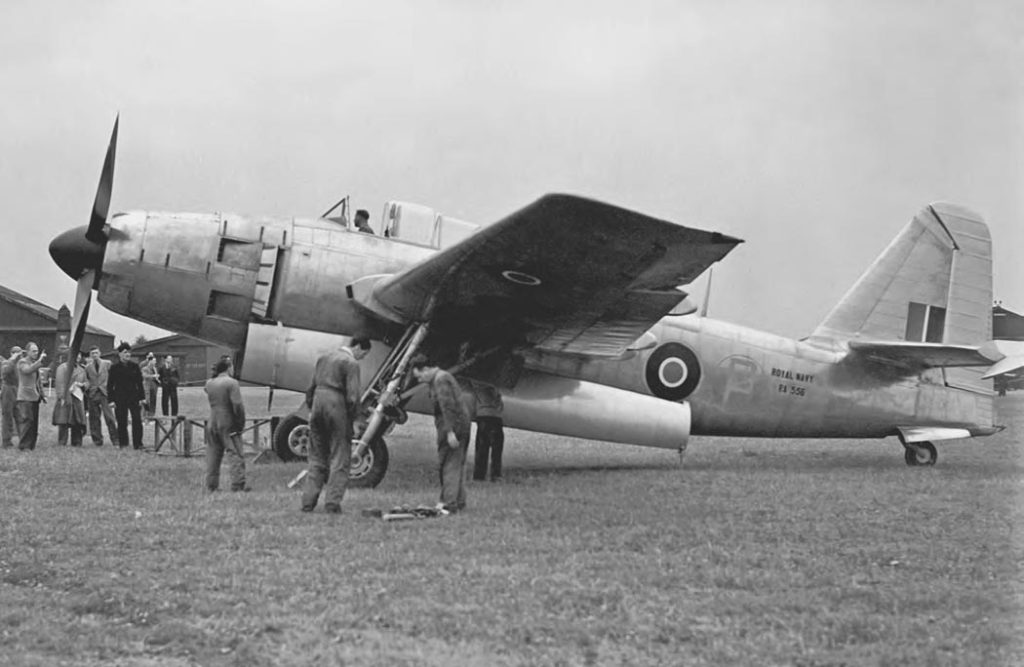
The cockpit seated two people in a tandem layout and had a hydraulically operated canopy. The large internal weapons bay could hold different types of weapons. It could carry up to four 500-pound bombs, four depth charges, one torpedo, or one 180-imperial-gallon auxiliary fuel tank. The Fairey Spearfish was designed to carry four 0.5-inch M2 Browning machine guns. Two of these guns were in a remote-controlled turret behind the cockpit, and two were located in the wings. The only external weapons were 16 RP-3 rockets that could be attached under the outer wing panels. It was powered by a Bristol Centaurus 57 18-cylinder radial engine, producing 2,825 hp. Captain Eric Brown, a test pilot and naval aviator, evaluated the first prototype of the aircraft. He found the controls felt very heavy in cruise. In fact, he could barely move the ailerons with one hand at 150 mph. In bad weather, a pilot circling a carrier while waiting to land would have to fly a wide circuit, making it hard to keep the carrier in sight. Later prototypes had hydraulically assisted ailerons and an artificial spring feel.
The Cancellation

However, Brown noted that the second prototype was less enjoyable to fly because the stick constantly moved around and didn’t provide more resistance as speed increased. The Fairey Spearfish lacked a stall warning system, which could be a problem in actual use since stall and approach speeds were fairly close. For landing, the aircraft was quite easy to control. The first prototype was later used by Napier & Son in Luton to test their in-flight de-icing systems. After that, it was briefly used for ground training starting on April 30, 1952, until it was scrapped soon after. The second prototype was used by the Royal Navy Carrier Trials Unit at RNAS Ford in Sussex before it was sold for scrap on September 15. The third prototype conducted ASV Mk.XV radar tests but was damaged in a heavy landing on September 1, 1949. It was sold for scrap on August 22, 1950, because it was too costly to repair. The fourth prototype never flew and was used for spare parts. In the Grounded Dreams series, the Fairey Spearfish was canceled for several reasons, including the end of WWII, the cancellation of Malta-class aircraft carriers, and its own poor performance. Read more Grounded Dreams articles HERE.