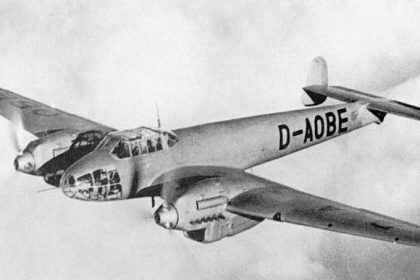
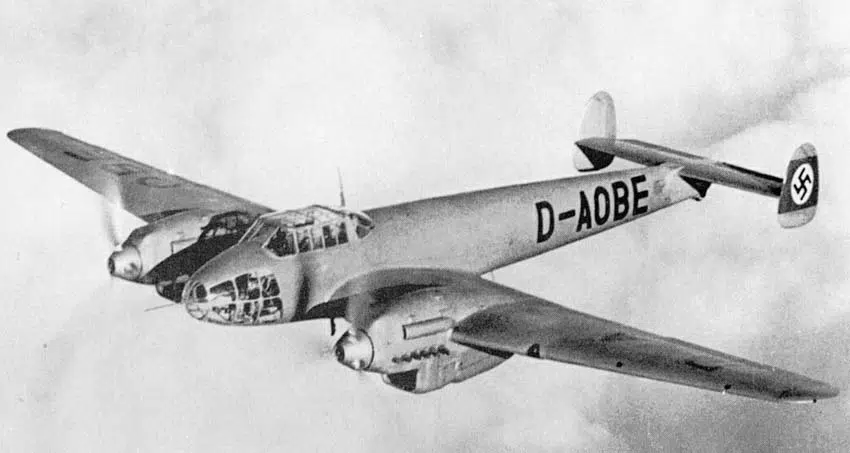

In January 1933, the Nazis came to power in Germany and began to develop a powerful air force of modern fighters. Therefore, the Bf 110 was produced in the early 1930s. Hermann Göring supported the aircraft, believing its heavy armament, speed, and long range would make it the Luftwaffe’s top offensive fighter. Then the Luftwaffe decided it needed a specialized high-speed tactical bomber that could also serve as a reconnaissance aircraft. It issued a specification in 1935 for a three-seat plane capable of carrying a standard bomb load of 1,100 lbs and a maximum of 1,650 lbs. The plane should have a single 7.92 mm machine gun for defense and reach a maximum speed of 310 mph. In response to the request from the Reich Aviation Ministry for a “fast bomber” for tactical use, Messerschmitt developed the Messerschmitt Bf 162. Messerschmitt designed it based on a modified Bf 110, adding a glass nose for a bombardier. The pilot sat behind the bombardier, and a rear gunner with a machine gun was positioned at the back of the cockpit.
Design of Messerschmitt Bf 162

The Messerschmitt Bf 162 was 41.10 feet long, 11.9 feet high, with a wingspan of 56.4 feet. It was powered by two Daimler-Benz DB 600Aa V-12 inverted liquid-cooled piston engines, each producing 987 hp. It was designed to fly at a top speed of 300 mph at 11,200 feet, and a cruising speed of 264 mph. In addition to a 7.92 mm MG 15 machine gun, the bomber could carry 110 pounds of bombs internally and two 550-pound bombs externally. The plan was to develop five pre-production aircraft, with plans to add 65 more in the 1937/38 production plan. By the time the second aircraft flew, both the Bf 109 and Bf 110 were already in full production. With this success, Messerschmitt likely thought it had a winning project. However, flight testing for the Messerschmitt Bf 162 was disappointing. It reached a maximum speed of 300 mph, which was much slower than its competitors, the Henschel Hs 127 and the Junkers Ju 88.
The Cancellation

The Junkers, being a larger aircraft, could carry more bombs and had better defensive features. Messerschmitt finished the third prototype of the Messerschmitt Bf 162, but its weaknesses were clear. The Luftwaffe chose the Ju 88 as its new tactical bomber. To mislead the public, the German press shared images of the Messerschmitt Bf 162, calling it the “Messerschmitt Jaguar,” a name never used outside this situation. The last two ordered prototypes were never built and were repurposed to help produce the Bf 110. The second completed aircraft was later used for towing trials with the Me 163 rocket interceptor. In the Grounded Dreams series, the Messerschmitt Bf 162 proved capable of achieving what it was intended for, but lost to a better aircraft. Read more Grounded Dreams articles HERE.