

Patrol Squadron 28 (VP-28) was a US Navy squadron that operated from WWII through the Cold War. It was created on July 1, 1943, as Bombing Squadron 108 (VB-108) and flew PB4Y-1 Liberators and PB4Y-2 Privateers against Japanese forces in the Pacific. After the war, the squadron used the P4Y-2 Privateer, P2V Neptune, and P-3A Orion for surveillance, antisubmarine warfare, and reconnaissance missions. After its establishment, VB-108 moved to NAAS Camp Kearney. The squadron grew to 15 aircraft, 57 officers, and 148 enlisted personnel. After finishing training, the squadron deployed to NAS Kaneohe Bay, Hawaii, arriving on October 3, 1943, under Fleet Air Wing Two. On October 23, nine aircraft went to Kanton Island to escort VD-3 reconnaissance planes. VB-108 was one of the first Navy Liberator squadrons to receive aircraft with powered ERCO nose turrets and twin .50-caliber machine guns. On November 11, the squadron moved to Nukufetau in the Ellice Islands. They began reconnaissance and attack missions against Japanese-held areas. The crews developed a low-level attack technique, flying just 25 feet above the sea before climbing to drop bombs and strafe enemy positions. On December 3, Lieutenant Ackerman, flying Pistol Packing Mama, attacked Mili Atoll. He strafed the runway and aircraft revetments and sank a transport in the harbor.

During its retreat, six Japanese fighters intercepted the Liberator, but the crew fought them off and possibly destroyed two. Further attacks took place at Jaluit Atoll. On December 6, Lieutenant Daley’s crew sank a landing barge and attacked a Kawanishi H8K flying boat. On December 12, Lieutenant John H. Stickell led another raid despite heavy antiaircraft fire. He was wounded during the attack but continued flying toward an airfield with a long enough runway to protect his crew. He died from blood loss before reaching it and was posthumously awarded the Navy Cross. In January 1944, VB-108 moved to Apanama in the Gilbert Islands. The squadron attacked Japanese positions and ships around Kwajalein, Rongelap, Eniwetok, Wake, and other islands. On February 28, two aircraft from the squadron, led by Lieutenant Commander John E. Muldrow and Lieutenant Max A. Piper, conducted the first daylight bombing raid on Wake Island. The mission covered about 2,500 miles and lasted more than 19 hours. On April 11, the squadron moved to Stickell Field in Eniwetok. Its aircraft continued to attack Japanese installations in the area. One Liberator also targeted a submarine, claiming to have sunk I-174. After returning to Kaneohe Bay in July 1944, the squadron reformed at NAS Alameda, California, in September. It received the newer PB4Y-2 Privateer, replacing its Liberators.

On October 1, the squadron was renamed VPB-108 and deployed to Peleliu on March 13, 1945, for nighttime patrols against enemy ships. On April 4, the squadron moved to Tinian and set up detachments at Iwo Jima. During this time, Lieutenant Commander Robert C. Lefever tested adding twin 20-mm cannons to the Privateer’s nose. On May 9, Lieutenant Commander Muldrow led an attack on Japanese-controlled Marcus Island, working with VPB-102. His aircraft was shot down, resulting in Muldrow’s death and that of seven crew members. Five survivors were rescued by USS Jallao. Muldrow and Lieutenant (jg) Richard D. Panther received Navy Crosses posthumously for their bravery during the attacks. By July, the squadron had grouped its aircraft at Iwo Jima. It conducted maritime searches, patrols against enemy ships, and completed 31 air-sea rescue missions during the month. On September 2, 1945, its aircraft joined VPB-117 and VPB-124 in a flyover above Truk Island, marking Japan’s formal surrender aboard USS Missouri. The squadron became VP-108 on May 15, 1946, and changed its name to VP-HL-8 on November 15 of that same year. It received its final name, Patrol Squadron 28, on September 1, 1948. In 1949, VP-28 was based at NAF Naha in Okinawa, where it carried out search-and-rescue missions and helped with emergency airlifts during the Chinese Civil War.
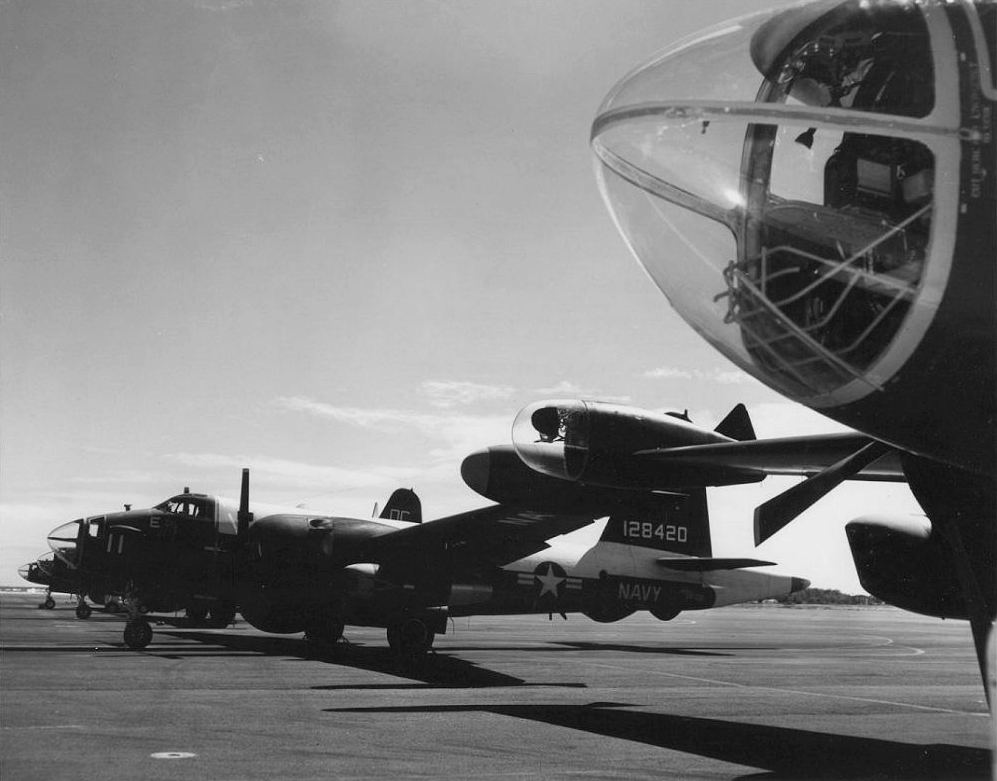
When the Korean War began in June 1950, Patrol Squadron 28 was based at NAS Agana in Guam. In July, it moved to Naha and patrolled the Formosa Strait and nearby areas like Shanghai and Foochow. Later, the squadron’s aircraft performed shipping surveillance, antisubmarine patrols, and nighttime weather checks. On June 28, 1951, the squadron took part in Operation Firefly. They dropped flares to light up North Korean supply routes for US Marine Corps night fighters. A four-aircraft detachment continued this work after the main squadron returned to Hawaii, totaling 1,103 flight hours before coming back in December. Patrol Squadron 28 returned to Naha in May 1952 to monitor the Chinese coast. On September 20, two MiG-15 fighters intercepted a P4Y-2S Privateer flown by Lieutenant Harvey R. Britt near Shanghai. The MiGs made five passes and fired at the aircraft, but it escaped without damage. Other squadron patrols also encountered MiGs during this deployment. In January 1955, Patrol Squadron 28 deployed to Japan to watch over the Sea of Japan and Yellow Sea. The next year, it operated from NAS Kodiak, Alaska, monitoring the northern defense area and assisting with scientific studies of Bering Sea ice conditions and volcanic activity in the Aleutians. On July 23, 1957, a P2V-5F Neptune plane from the squadron crashed beyond the runway at NAS Barbers Point, resulting in the deaths of all 11 crew members.

Patrol Squadron 28 later supported US nuclear tests, deploying to Christmas and Johnston Islands in April 1962. During this three-month operation, its aircraft flew enough miles to go around the world 18 times. In May 1964, the squadron was deployed to Japan and the Philippines. During this time, it flew 1,148 hours to support the Seventh Fleet after the Gulf of Tonkin incident. In December, the squadron got P-3A Orion aircraft and finished transitioning from the SP-2H Neptune by April 1965. In November 1965, during a deployment to the western Pacific, VP-28 supported Operation Market Time and Yankee Team patrols. Despite facing maintenance issues, the squadron set a new monthly flight-hour record. In May 1967, the squadron moved to NAS Adak, Alaska, where it worked on destroying the submerged wreck of the former USS Robert Louis Stevenson, which still had old explosives on board. After the initial underwater detonation failed, Patrol Squadron 28 aircraft dropped 24 2,000-pound bombs on the wreck to disperse the explosives and eliminate the navigation hazard. The squadron’s final deployment started in January 1969 at NAF Naha, with detachments at Cam Ranh Bay, South Vietnam, and NAS Atsugi, Japan. After North Korea shot down a U.S. Navy EC-121 reconnaissance aircraft on April 15, VP-28 was put on alert but returned to normal operations on May 26. Patrol Squadron 28 was disbanded at NAS Barbers Point on October 1, 1969, ending nearly 26 years of service that included the Pacific War, the Korean War, and the Cold War. Read more Squadron Histories articles HERE.