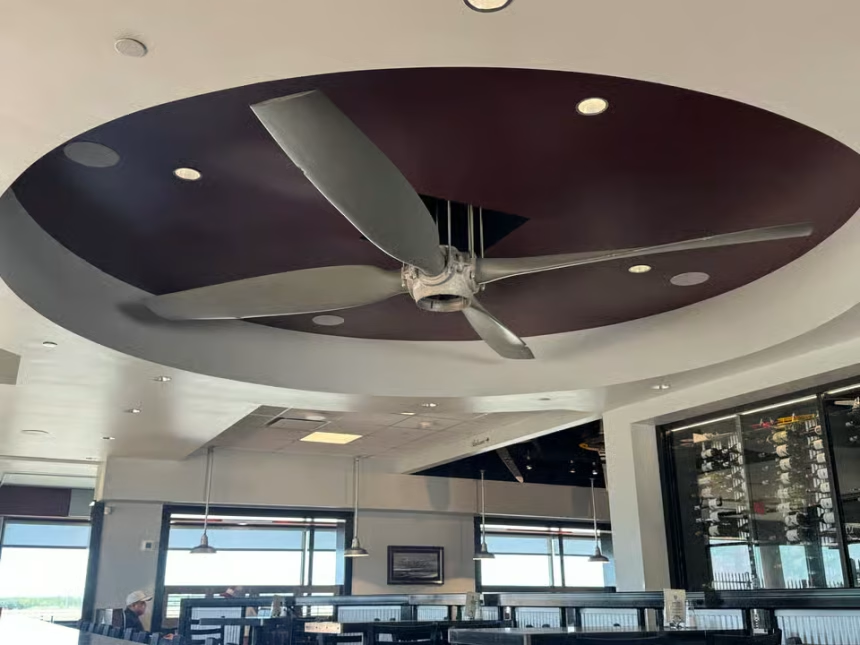

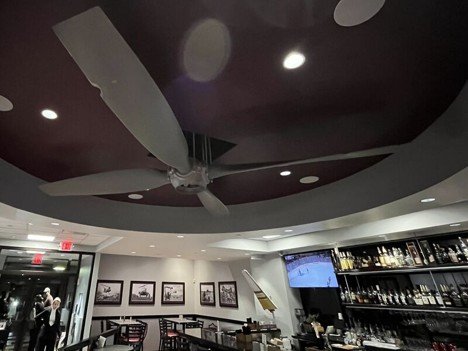
At Gate 12 Bar & Grill in College Station, Texas, the aviation history extends well beyond the aircraft visible outside the windows. Suspended above the bar is a four-bladed B-29 propeller with a reported connection to Enola Gay, the Boeing Superfortress that dropped the atomic bomb on Hiroshima, Japan, on August 6, 1945. The propeller is the subject of Kent Vincent’s article, “Last Known Enola Gay Propeller Is in a Texas Bar & Grill,” published by the 6th Bomb Group Association. Vincent identifies it as the only known surviving original propeller from the aircraft. Gate 12’s own account is more cautious, describing the Enola Gay connection as a belief that has yet to be conclusively established. That distinction matters, but the artifact’s subsequent career offers an unusual aviation story in its own right: a bomber propeller repurposed for university research before becoming a public display.
(Image credit: Gate 12 Bar & Grill)
From Bomber Hardware to Research Equipment
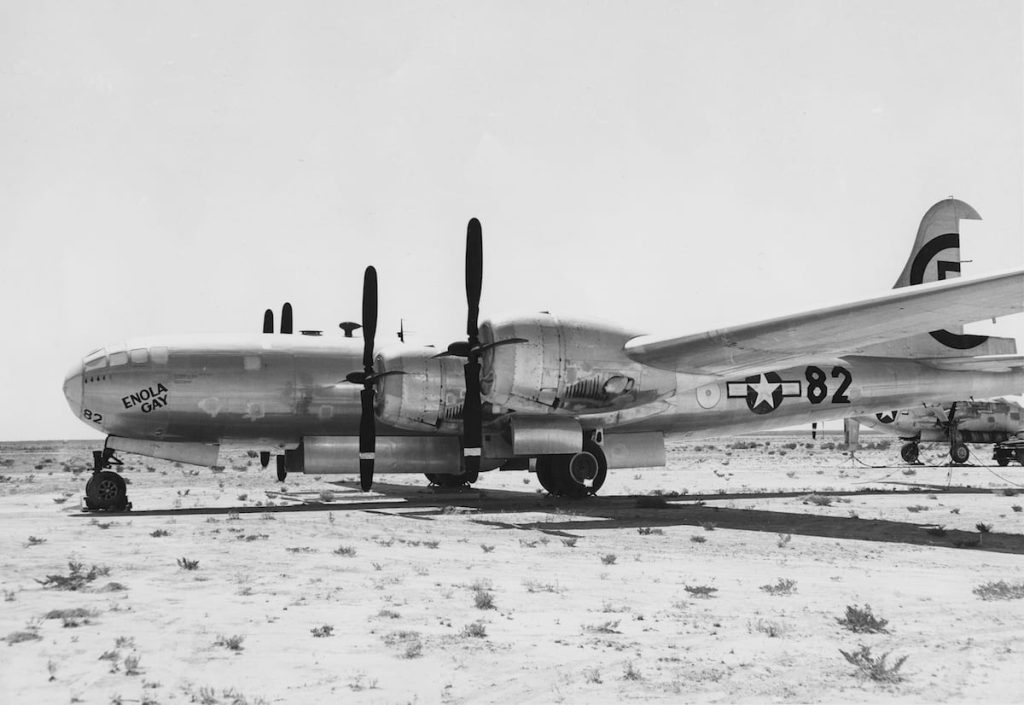
According to Vincent, Enola Gay’s original propellers were removed after WWII and sent to Wright-Patterson Air Force Base, Ohio. He reports that the aircraft received replacement propellers before its later transfer to the Smithsonian. Texas A&M’s wind-tunnel website reproduces a historical account identifying its research propeller as one of Enola Gay’s four and stating that the Air Force supplied it from the Wright-Patterson museum. That account supports the longstanding association, although Gate 12 stops short of presenting the aircraft-specific provenance as proven. The university needed a propeller to generate airflow for aerodynamic testing. Gate 12 explains that each blade was shortened by 18 inches to suit the wind tunnel. The modified assembly then served a very different purpose from the one for which it had been manufactured, moving air over test models rather than pulling a bomber through the sky. Its research career eventually ended after a model broke apart and passed through the rotating blades. The restaurant’s account says the resulting damage remains visible. Concern over the blades’ continued integrity prompted the propeller’s retirement and replacement with another B-29 propeller.
A Pilot’s Restaurant at Easterwood
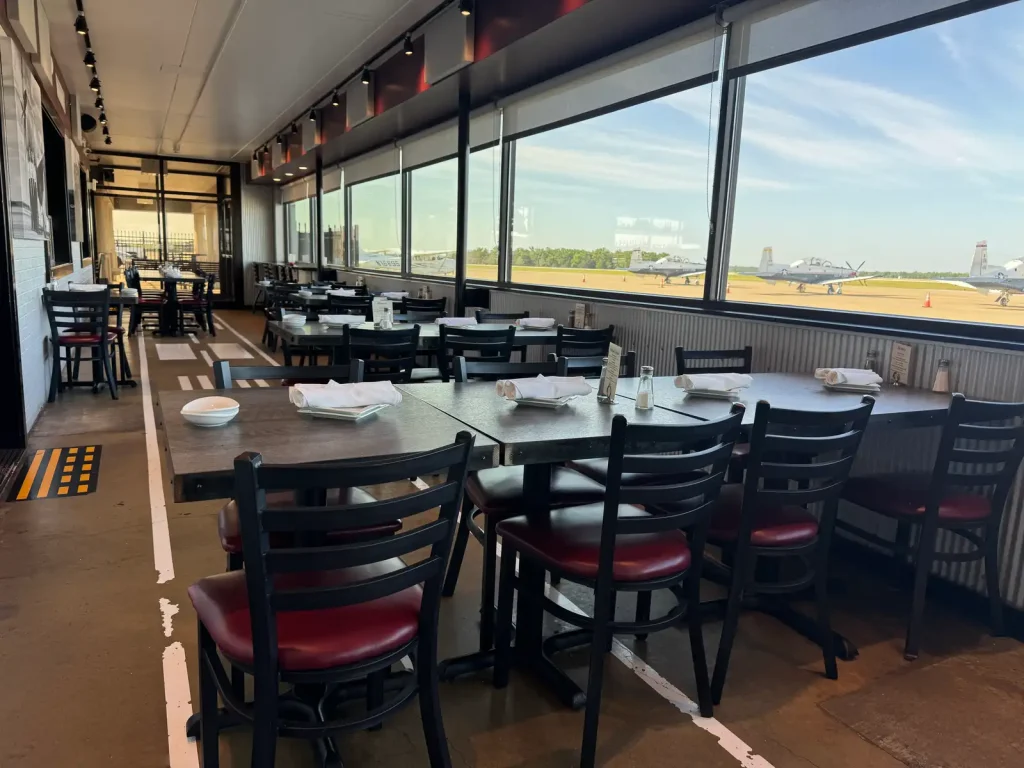
The setting for the retired propeller reflects the interests of Gate 12 owner Cody Whitten. In “A Legacy of Flight and Flavor,” Authentic Texas writer Pamela Anderson describes an aviation family whose father operated an agricultural flying business. Cody and his brothers, Brett and Beau, all became pilots. Whitten opened J. Cody’s Steaks & BBQ in 2001 before bringing his interests in food and aviation together at Gate 12. Located in Easterwood Airport’s former general aviation terminal, the restaurant offers views of aircraft movements alongside aviation memorabilia. Anderson reports that Whitten restored the propeller in Brett’s hangar in Snook, Texas, where his brother operates a crop-dusting business. Other features include a floor painted as a runway, an original telephone booth, and photographs recalling WWII and the Vietnam War. When the restaurant was being planned, Texas A&M wind-tunnel management offered the retired assembly for display. University approval allowed the propeller to move from storage to its prominent position above the bar.
(Image credit: Gate 12 Bar & Grill)
An Unusual Place to Encounter Aviation History
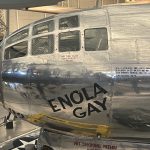
Enola Gay itself is preserved at the Smithsonian’s Steven F. Udvar-Hazy Center in Chantilly, Virginia. Its restoration began in 1984, required approximately 300,000 work-hours, and culminated in the fully assembled bomber’s permanent display in 2003. At Gate 12, visitors encounter a smaller artifact whose story combines a reported connection to that aircraft with a documented place in Texas A&M’s wind-tunnel history. Its survival also shows how military equipment could acquire a second career in research—and eventually find an audience far beyond a conventional museum.

Sources
Kent Vincent, 6th Bomb Group Association
Pamela Anderson, Authentic Texas, A Legacy of Flight and Flavor
Texas A&M Oran W. Nicks Low Speed Wind Tunnel
Smithsonian Institution, Boeing B-29 Superfortress Enola Gay