

(Image credit: VAN)
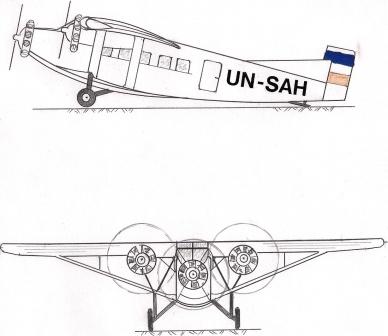
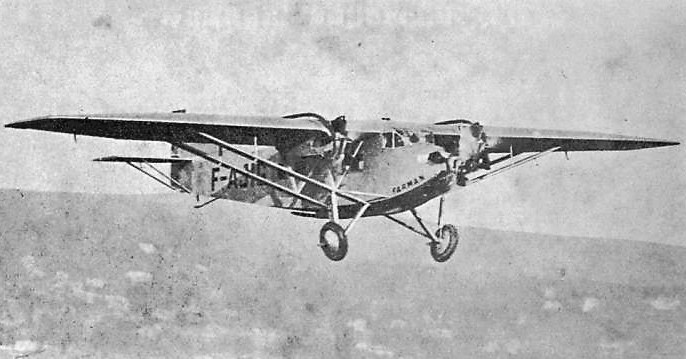
On this day in aviation history, 96 years ago (January 13, 1930), the Farman F.300 took its first flight. The F.300 was a prototype of the production F.301 through F.310 series of aircraft, designed and built by French aircraft manufacturer Farman Aviation Works. Farman’s “F-series” prototype was a trimotor monoplane design, focused on serving the airline industry. The F.100 was a high-wing monoplane design that utilized strut braces and featured fixed landing gear with a tail-skid. Tri-motor designs were popular at the time of the F.300’s development, as evidenced by the Ford Tri-Motor and Junkers Ju 52. The F.300 featured a fully enclosed cockpit and passenger compartment. The aircraft was built with night-flying capability with regulatory position lights and optional searchlights, signal lamps, flares, and rockets. Radio equipment was also onboard the aircraft, powered by either a battery or a windmill generator. The F.300’s construction consisted of wood, duralumin, and fabric. Farman’s own airline, Farman Line, operated the production F.300 series aircraft commercially. French airliner Air Orient, and Yugoslavian air-carrier Aeroput both flew the Farman tri-motor as well.
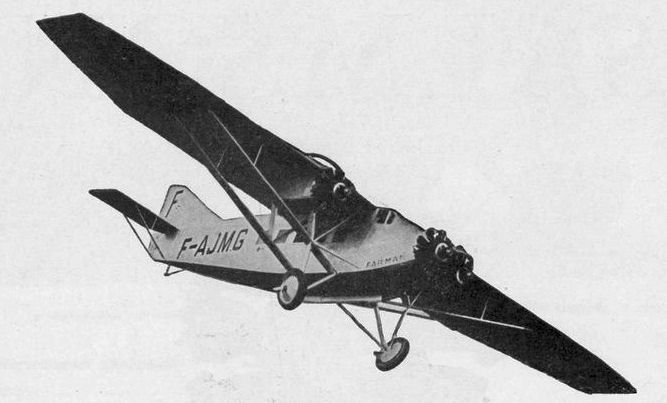
Two Farman tri-motors were built specifically for record-breaking flights. On March 9, 1931, the F.302 set a new distance and duration record (over a closed circuit) while carrying a 2,000 kg payload while flying 1,664 miles in 17 hours. That same month, the F.304 would complete a long-distance flight from Paris to Tananarive and back, at the hands of pilot Marcel Goulette. A floatplane prototype named the F.310 was built, but this aircraft was destroyed during landing trials. Farman’s F.301 was flown by a single pilot and had a capacity for eight passengers. The aircraft was powered by three Salmson 9Ab nine-cylinder radial engines, each with 230 horsepower. The F.301 had an empty weight of 5,754 pounds and a gross weight of 9,987 pounds. A maximum airspeed of 140 mph was attainable for the F.301, though it would typically cruise closer to 120 mph. Farnam built a total of 22 F.300s of differing variants during the aircraft’s production run.