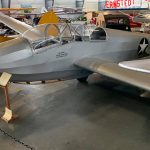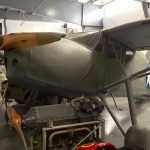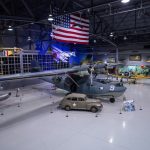


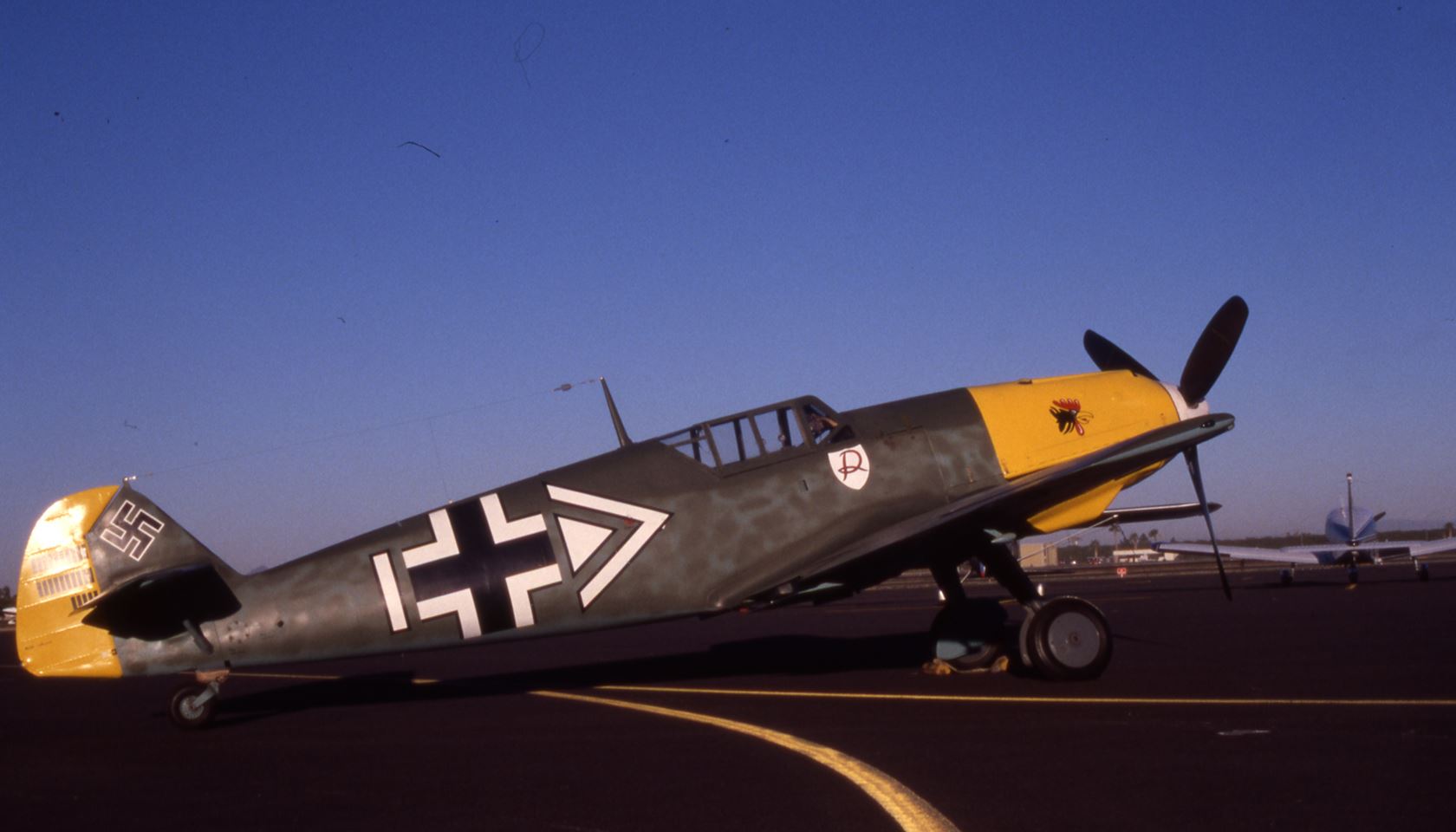
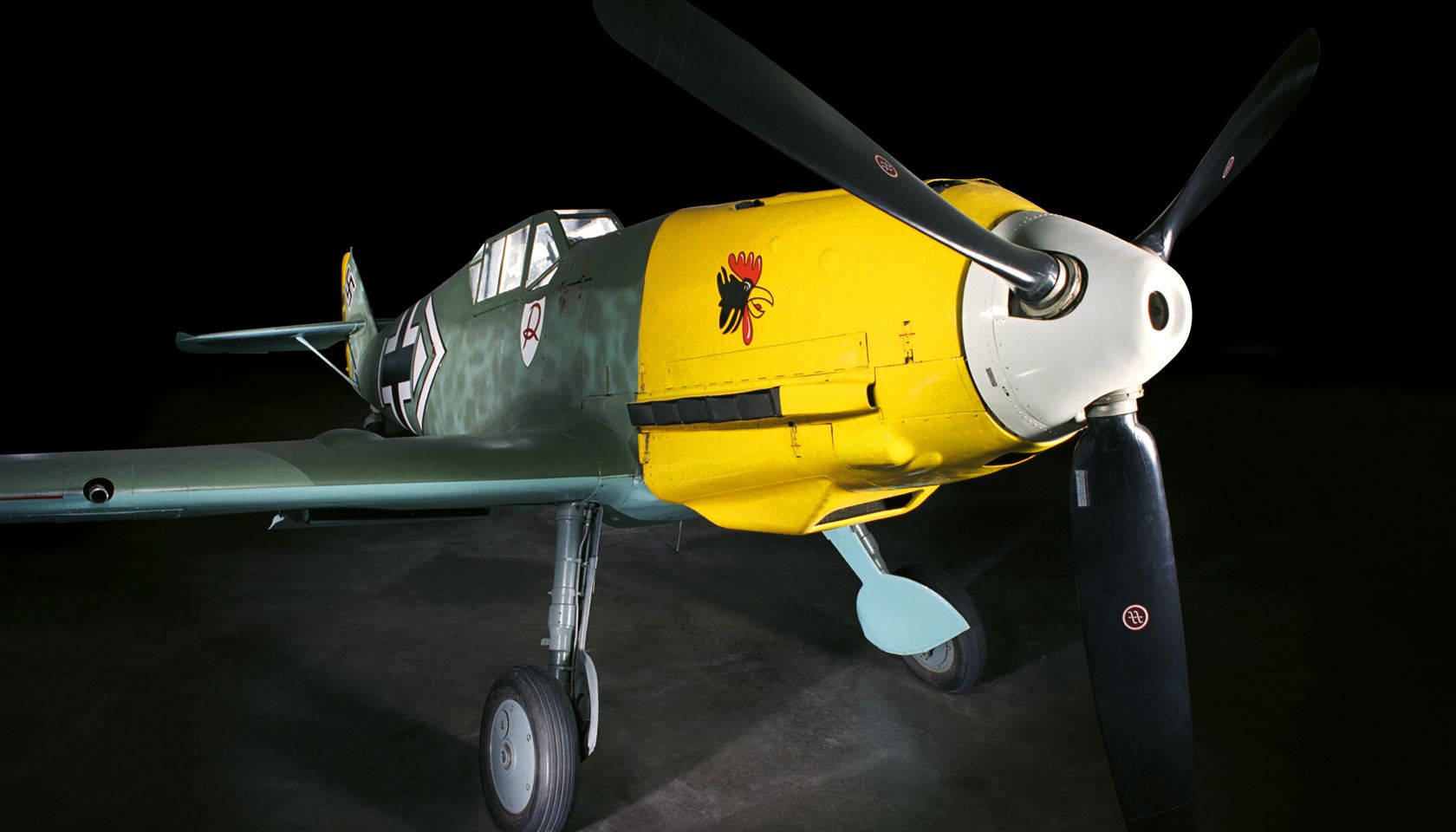
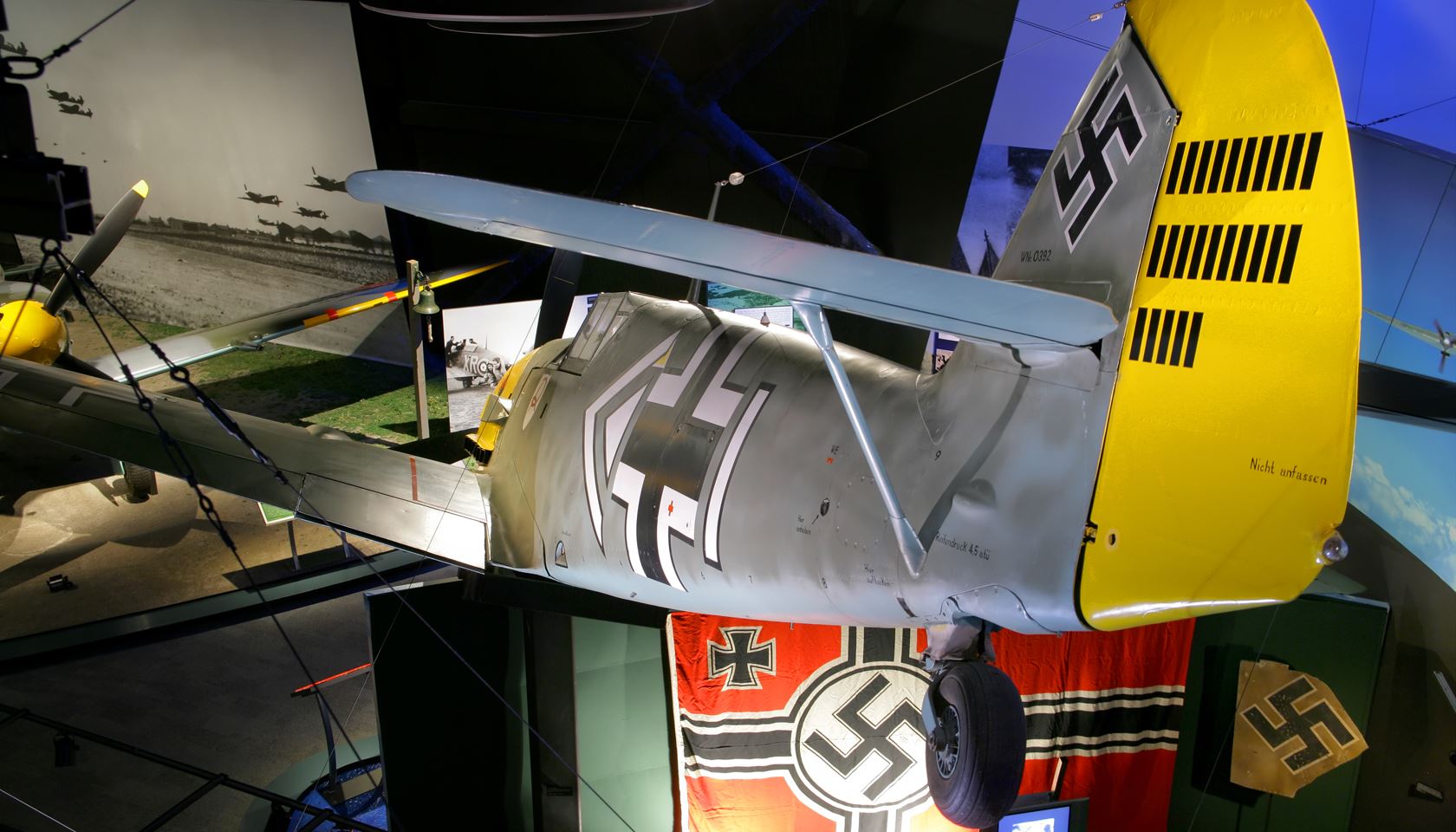
Messerschmitt Bf 109 E-3. This particular aircraft at the Museum of Flight is made up of the cowling of a Swiss-made aircraft, a Spanish HA-1112 airframe, and a Daimler-Benz DB-601 engine. Markings of Hans “Assi” Hahn of JG/2. My photos.


In 1954, the Spanish introduced the HA-1112-M1L, which was powered by surplus Rolls-Royce Merlin engines imported from the United Kingdom. This version became known as the Buchón (Pouter), as the new cowling made to accommodate the Merlin engine resembled the inflatable crop of a pouter dove. Equipped with a Rotol four-bladed propeller, two wing-mounted Hispano HS-404 20mm cannons, and mounts for 80mm rockets. The Buchón would be the last variation of the Bf 109 and was retired from service with the Spanish Air Force on December 27, 1965.

The aircraft was one of 28 Buchóns offered for sale by the Spanish Air Force at Tablada Air Base near Seville, of which 18 were flyable. In July 1966, they were purchased by retired RAF Group Captain Thomas Gilbert “Hamish” Mahaddie for use in the production of the film Battle of Britain. Hamish also secured the purchase of several CASA 2.111 bombers (license-built Heinkel He 111s powered by Rolls-Royce Merlin engines) and CASA 352 transports (license-built Junkers Ju 52s). HA-1112 Buchón s/n C.4K-122 was registered as G-AWHL to “Hamish” Mahaddie through the company Spitfire Productions Ltd at Duxford, England, and was flown in the filming of Battle of Britain, painted to represent a Messerschmitt Bf 109E of the type used in the Battle of Britain of 1940. After filming concluded, it was one of the 21 Buchóns offered to American pilot Wilson C. “Connie” Edwards of Big Springs, Texas, in October 1968, but while he famously took many of the Buchóns back with him to Texas, Edwards resold G-AWHL to Mahaddie.


In 1969, the aircraft was painted in the colors of a U.S. Army Air Force P-51B Mustang with the fake serial “714112“, fitted with a dummy belly scoop, and sent back to Spain to partake in the production of the movie Patton. After being stricken from the British civil aircraft registry on February 17, 1969, it was used for film production work in West Germany. From 1970 to 1973, it was displayed at the Luftsportverein Hellertal (Hellertal Air Sports Club), Siegerland, in the colors of Jagdgeschwader 54 (JG 54).
In 1973, the aircraft was purchased by American aircraft collector Doug Champlin, who had the aircraft converted to truly resemble a Bf 109E in Augsburg, West Germany, the home of Messerschmitt. While the Champlin Fighter Museum reported that the aircraft was fitted with an original Daimler-Benz DB-601 engine, the Museum of Flight states that the aircraft was fitted with a DB-605 when a DB-601 could not be found. Regardless, genuine Bf 109E parts were acquired from Switzerland (likely from Bf 109E, Swiss Air Force s/n J-392), such as the engine cowling, wingtips, and other miscellaneous parts. The aircraft was registered with the FAA as N109J and would later be displayed at the Champlin Fighter Museum at Falcon Field, Mesa, Arizona.

About the author:  Randy Malmstrom grew up in a family steeped in aviation culture. His father, Bob, was still a cadet in training with the USAAF at the end of WWII, but did serve in Germany during the U.S. occupation in the immediate post-war period, where he had the opportunity to fly in a wide variety of types that flew in WWII. After returning to the States, Bob became a multi-engine aircraft sales manager and, as such, flew a wide variety of aircraft; Randy frequently accompanied him on these flights. Furthermore, Randy’s cousin, Einar Axel Malmstrom, flew P-47 Thunderbolts with the 356th FG from RAF Martlesham Heath. He was commanding this unit at the time he was shot down over France on April 24th, 1944, and spent the rest of the war as a prisoner of war. Following his repatriation at war’s end, Einar continued his military service, attaining the rank of Colonel. He was serving as Deputy Wing Commander of the 407th Strategic Fighter Wing at Great Falls AFB, MT, at the time of his death in a T-33 training accident on August 21, 1954. The base was renamed in his honor in October 1955 and continues to serve in the present USAF as home to the 341st Missile Wing. Randy’s innate interest in history in general, and aviation history in particular, plus his educational background and passion for WWII warbirds, led him down his current path of capturing detailed aircraft walk-around photos and in-depth airframe histories, recording a precise description of a particular aircraft in all aspects.