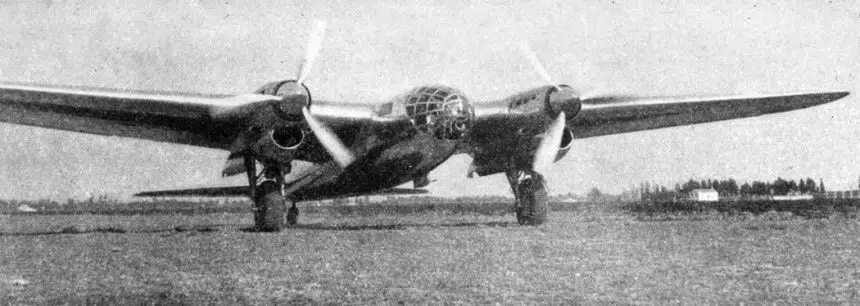


In August 1933, the French Air Force wanted a reconnaissance bomber, which they called Bombardement Combat Renseignement (BCR). French aircraft manufacturer Amiot initially planned to submit the Amiot 144, a modified version of its Amiot 143 bomber with retractable landing gear. However, the company soon realized it needed a completely new design to meet the performance requirements. It led to the development of the Amiot 340 BR3, a twin-engined aircraft designed for a crew of three. The aircraft promised a speed of 290 mph using either Hispano-Suiza 12Y or Gnome-Rhône 14N engines. The French inspected a mock-up of the Amiot 340 in March 1936. The inspection led to an order for a prototype. At the same time, the company planned a four-seat version, the Amiot 341 B4, to meet the Air Force’s needs better. Additionally, Amiot was asked to create a civil version for a trans-Atlantic air race to celebrate the 10th anniversary of Charles Lindbergh’s solo trans-Atlantic flight. The company modified the Amiot 340 mock-up to represent this civil version, which was displayed as a long-range postal aircraft at the 1936 Paris Air Show and was designated Amiot 341. The civil version was later completed as the Amiot 370.
Flight Tests of Amiot 370

The Amiot 370 first flew at Istres on July 25, 1937. It had two liquid-cooled 860 hp Hispano-Suiza 12Yjrs/Ykrs engines, allowing it to reach a maximum speed of 295 mph. It also had an estimated range of 4,300 miles at a cruising speed of 250 mph. The Amiot 370 design was based on the Amiot 354 single-fin modification. Unlike older models, this mail plane had a shared cockpit for the pilot and navigator in a large, well-windowed front section. The design eliminated the need for a separate pilot’s cabin, making it more aerodynamic. Instead of a bomb bay, it had a spacious cargo area. The old radial engines, which took up a lot of space, were replaced with smaller inline Hispano-Suiza 12 engines. There was also no weaponry included. Starting on February 6, 1938, the Amiot 370, flown by Commander Maurice Rossy, set four world speed records for flights over 2,000 kilometers (1240 miles). The final flight reached an average speed of 437 kilometers per hour (272 mph). The team also set records for carrying loads of 1,100, 2,200, and 4,400 pounds. On June 8, 1938, they broke the world record for a 5,000-kilometer (3,100-mile) flight, averaging 401 km/h (250 mph).
The Cancellation

In August of the following year, Rossy set his last record in the Amiot 370, flying 10,000 kilometers (6,200 miles) in 33 hours at an average speed of 311 km/h (193 mph). The Amiot 370 prototype was built in 1937, but only one was ever made. Production did not start before the war, and the project was completely abandoned during the German occupation. In the spring of 1941, the Amiot 370 was restored to flying condition under the supervision of German and Italian observation missions. The aircraft officially belonged to France. On the night of July 22–23, Air France pilot Gaston Durmont flew it from Marseille to Athens and then to Djibouti, covering 5,500 km (3,400 miles) in 16 hours. Despite this, the Vichy Air Force used the Amiot 370 for its intended purpose in France. In November 1942, French workers damaged the aircraft heavily to stop it from being captured by the Germans. It stayed damaged until 1947. Plans to fix the Amiot 370 were canceled, and the aircraft was scrapped that year. The Amiot 370 was a capable aircraft that met a grim fate because of WWII. Read more Grounded Dreams articles HERE.